a person holding a political poster

EPISODE 99 – KAREN BASS, COMMUNITY COALITION, SOUTH LOS ANGELES AND THE FUTURE

For our 99th episode, L.A. Times reporter Benjamin Oreskes (@boreskes) sits down to chat with us about Karen Bass’ upbringing through South Los Angeles as described by his profile of the congresswoman recently. We touch on Bass’ early years in Los Angeles, including when as a teenager she wrote letters in support of Robert F. Kennedy’s presidential campaign, her various trips to Cuba to learn about healthcare and education systems there, her fight against the crack epidemic in South L.A. during the 1990s, and what else we can expect to learn from the L.A. Times about her and Rick Caruso four months before November 2022. Find Bass’ letter to the Times following their coverage of the crack cocaine epidemic’s impact on the Black community HERE.

J.T.

close up shot of scrabble tiles on a white surface

Eight Days Out, L.A.’s Missing Voters in the Millions for the 2022 Primary

With just eight days left before the June 7th primary, as of Friday, May 27th, less than 139,000 ballots of 2.1 million mailed out to voters in the city of Los Angeles have been returned to the Registrar’s office, making for a gap of 2,010,187 ballots to find quickly over the next week. 66% of these returned ballots have come from voters aged 50 and upwards. Since these groups hold only 44% of all ballots, their early returns mark an increase of 22% over their registration rate. Voters aged 18 – 49 currently hold 55% of L.A. city’s ballots, but can only claim credit for 36% of ballots returned to the Registrar so far, marking a 19% gap with respect to their registration rate.

Additionally, white voters have returned 59% of L.A. City’s 2.1 million ballots so far, or approximately 82,000 ballots, a 10 point increase from their share of ballots overall (49%). Latinx voters have accounted for only 20% of returns so far, or roughly 28,000 ballots, despite their hold on 33% of ballots overall, making for a 13 point decrease or gap with respect to their registration. Ballots returned from Asian-American voters currently make for 12%, or 17,000 ballots, a 3 point increase from their hold on ballots overall. And ballots from African-American voters returned so far make for 9% of all returns, or about 12,500 ballots, consistent with their hold on ballots overall (9%).

It’s accurate to say, then, that the 13 point gap for ballots returned from younger, Latinx voters in particular relative to their hold on all ballots have so far opened a path for more returns from white and Asian-American voters, particularly those over the age of 50.

The trajectory so far is reminiscent of L.A.’s last major primary in 2017, when Eric Garcetti and Mitch O’Farrell were re-elected to their offices by only 17% of L.A.’s voters; ballots from white voters also surged then as those from Latinxs fell by nearly half. The 2017 primary also saw saw an uptick in ballots returned from Asian-Americans compared to their registration rates, while ballots from African-American decreased, albeit slightly, compared to their registration rates.

Data from Tableu Public by paulmitche11, 2017

Let’s now take a look at the numbers more locally. In Council District 13 (CD-13), at least 11,000 of approximately 148,000 ballots have been returned so far. 57% of these ballots are from voters aged 50 and upwards, compared to their share of 48% of the electorate in the district overall, an increase of 9 points. 43% of returned ballots in CD-13 so far hail from voters aged 18 – 49, compared to their share of 51% of the electorate overall, a decrease of 8 points compared to their registration. In terms of ethnic categories, white voters have accounted for 59% of these same returns so far, or 4 points up from their overall share (55%). Latinx voters, who account for 30% of the ballots in CD-13, have accounted for 22% of returned ballots so far, or a decrease of 8 points compared to their registration.

Asian-American voters, the third largest bloc in CD-13, have accounted for 17% of ballots returned in the area so far, an increase of 4 percentage points, while African-American voters, the fourth largest bloc in the area, have accounted for 2% of returns, consistent with their share of ballots in CD-13 overall.

In Council District 1, at least 7,300 of roughly 106,500 ballots have been returned so far. 62% of these ballots are from voters over the age of 50, compared to their 47% share of the electorate in the area overall, an increase of 15 points. Along ethnic categories, ballots returned from Latinx voters have made for 36% of returns so far, making for a gap of 12% with respect to their share of the electorate in CD-1 overall (48%), which is also the largest voting bloc in the area. White voters, who make up for the second largest voting bloc in the area (34%), have returned 35% of CD-1’s ballots, an increase of 1 point with respect to their share of the area’s eligible voters. Asian-American voters, who represent the third largest bloc of voters in CD-1, have returned 27% of the area’s ballots, an increase of 11 points from their registration rates in CD-1 (16%). African-American voters, the fourth largest bloc in the area (3%), have returned about 2% of ballots there, a slight decrease of 1% with respect to their registration in CD-1.

While so far L.A. City’s numbers aren’t exactly reassuring, they’re also not far removed from trends for the Golden State as a whole at the moment. Consider that across California, there are roughly more than 22 million voters on the rolls; of this number, those over the age of 50 represent up to 10.8 million voters (slightly more than the size of all of L.A. County before 2020, or 49%). However, as of May 27th, these voters accounted for more than 75% of ballots returned so far, an increase of 26 points with respect to their overall share. Inversely, voters aged 18 – 49 represent 51% of California’s electorate, but only made for 25% of votes back to the state registrar as of May 27th.

Ballots returned by Age and Ethnicity in California overall as of May 27th, 2022; Political Data, Inc.

Additionally, white voters maintain the largest bloc in California, representing 57% of the electorate, but have returned at least 69% of the state’s ballots so far, or an increase of 8 points. Latinx voters, who make for the second largest bloc at 27%, have returned 15% of the state’s ballots, or a decrease of 12 points with respect to their rate of registration. Asian-American voters, who are the third largest group of voters at 12% of the state’s electorate, have returned 12% of ballots, consistent with their registration rate; and African-American voters, the fourth largest voting bloc at 4%, have returned 3% of the state’s ballots, a slight decrease of one point compared to their registration rates.

The numbers are obviously poised to change over the next week, but it’s clear that it will take more from the state and voting proponents across our cities to dislodge the historic trends. As the California Public Policy Institute noted as early as 2000: “At present, California’s electorate does not accurately reflect the state’s diversity. Despite being only about half of the state’s population, whites make up 68 percent of the voters. Latinos are well behind with only 19 percent of the electorate, and blacks and Asian Americans follow with 6 and 7 percent, respectively.”

According to the U.S. Census in 2000, Latinxs made for 32% of the state’s population then, while Asian-Americans accounted for 11% and 7%, respectively. As recently as 2020, white residents made for roughly 41% of the state’s population, while Latinxs, Asian-Americans, and African-Americans accounted for about 39%, 15%, and 6%, respectively.

Statistics cited for the June 2022 primary are from Political Data, Inc.’s Tracker, a well-crafted data engine. Keep up with more updates over the next week via this page and wherever else you follow JIMBO TIMES. And if you’re still doing research for your ballot, the L.A. Times can lead you to a useful guide HERE.

J.T.

EPISODE 97 – GUSTAVO ARELLANO ON LATINOS AND JOE ROGAN, SHERIFF VILLANUEVA, THE REPUBLICAN PARTY AND MORE

For our 97th episode, Gustavo Arellano (@GustavoArellano), author of the “¡Ask a Mexican!” column from The OC Weekly from 2004 – 2017, and now a columnist for the L.A. Times, as well as host of The Times: Daily News from the L.A. Times podcast, joins us for a dynamic conversation on the state of the world, particularly for Latinx communities in the U.S. Among other things, Arellano chats with us about “rancho libertarianism,” or what for a growing bloc of Latinx voters is belief in “rugged individualism, distrust of government and elites, conservative moral beliefs, a love of community and a hatred of political correctness — that are like catnip for Republicans,” in his words. We analyze just how such a political philosophy may play out in local elections and across the nation, especially given recent history in Orange County, and more; a can’t-miss convo on the culture at this time, for sure!

J.T.

EPISODE 67 – HUGO SOTO-MARTINEZ FOR CD-13

In our 67th episode, we chat with Hugo Soto-Martinez. Hugo recently announced his candidacy for the office of the 13th Council District at L.A. City Hall. In this interview, he describes his background as the son of two immigrants who worked as street vendors through South Central Los Angeles, his experience organizing with domestic and service workers as a part of Unite Here Local 11, policy goals he’s interested in for CD-13, and how folks can get involved with his campaign. Learn more about Hugo at his new campaign website.

J.T.

Use these Maps To Show Your Neighbors the Rate of Homelessness in Your District Since 2011

In 2011, the Los Angeles Homeless Services Authority (LAHSA) published a map and sheet showing homelessness rates per district in Los Angeles.

On LAHSA’s 2011 map, districts with the highest numbers of unhoused people were shaded dark-blue and included:

I. CD-9, where the historic Skid Row area was based before a change to the district map, or redistricting, in 2012. The district was overseen by Jan Perry when an estimated 5,800 people in the community were reported without shelter.

II. CD-14, where Boyle Heights was based. The district was overseen by Jose Huizar–who vacated his seat recently after being arrested on charges of bribery–when an estimated 2,200 people in the community were reported without shelter.

III. CD-13, where East Hollywood was based. The district was overseen by Eric Garcetti when an estimated 1,900 people in the community were reported without shelter.

IV. CD-8, where Leimert Park was based. The district was overseen by Bernard C. Parks when an estimated 1,600 people in the community were reported without shelter.

A list of homelessness rates in Los Angeles per district as of LAHSA’s count in 2011.

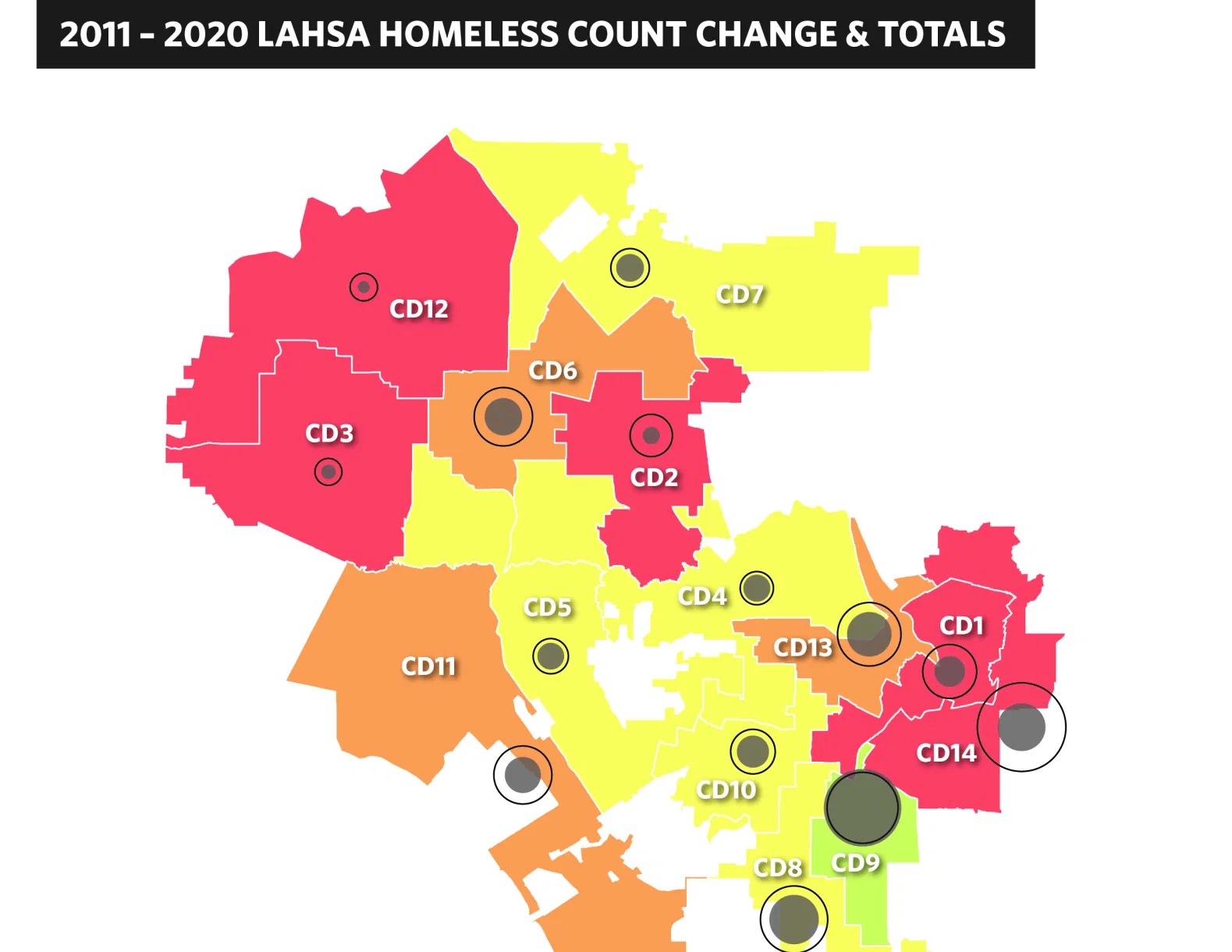
Nine years later, for the 2020 count, LAHSA did not publish a map showing district per homelessness, but that didn’t stop a band of looky-loos from publishing another one for Los Angeles on their behalf. The choropleth map below notes percent changes for homelessness rates per district in a bivariate color scheme from green to red. Listed further below is a sheet ranking homelessness rates in order of highest to lowest per district based on LAHSA’s most recent count.

By 2020, a year after L.A. County reported $727 billion dollars in gross domestic product, fourteen of L.A.’s fifteen council districts, or 93% of the city, saw an increase of homelessness since 2011. As well, the districts with the highest numbers of unhoused residents actually included the same four districts from ten years earlier, though in a slightly rearranged order. These districts were:

I. CD-14, where Skid Row, along with much of downtown, was moved to after city redistricting in 2012. The district is now overseen by Kevin De Leon, and an estimated 7,600 people were reported without shelter as of last year, an increase of more than 245% since 2011.

II. CD-9, where historic South Central is still based. The district is now overseen by Curren D. Price, in which an estimated 4,900 people were reported without shelter as of last year, a decrease of 15.5% since 2011.

III. CD-8, where Leimert Park is still based along with the Crenshaw Corridor. The district is now overseen by Marqueece Harris-Dawson, in which an estimated 4,400 people were reported without shelter as of last year, an increase of 175% since 2011.

IV. CD-13, where East Hollywood is still based. The district is now overseen by Mitch O’Farrell, in which an estimated 3,900 people were reported without shelter as of last year, an increase of 105% since 2011.

A list of homelessness rates in Los Angeles per district as of LAHSA’s count in 2020.

Also note that while our choropleth map shows that District 9 was the only district that didn’t see an increase of homelessness since 2011, the lack of an increase did not change the district’s status as the second of the four areas with the most pronounced homelessness in Los Angeles over the last ten years.

While the growth of this issue may not be promising, a new day may be on the horizon. As of today, voters in Los Angeles have less than 397 days to pick eight new City Council Members, a new Mayor, City Attorney, and City Controller. But with over thirteen months to go, these races have already seen up to $2.5 million in campaign donations, more than a few of which ring peculiar.

Special thanks to Mehmet Berker, L.A.’s local cartographer, for this report’s map.

J.T