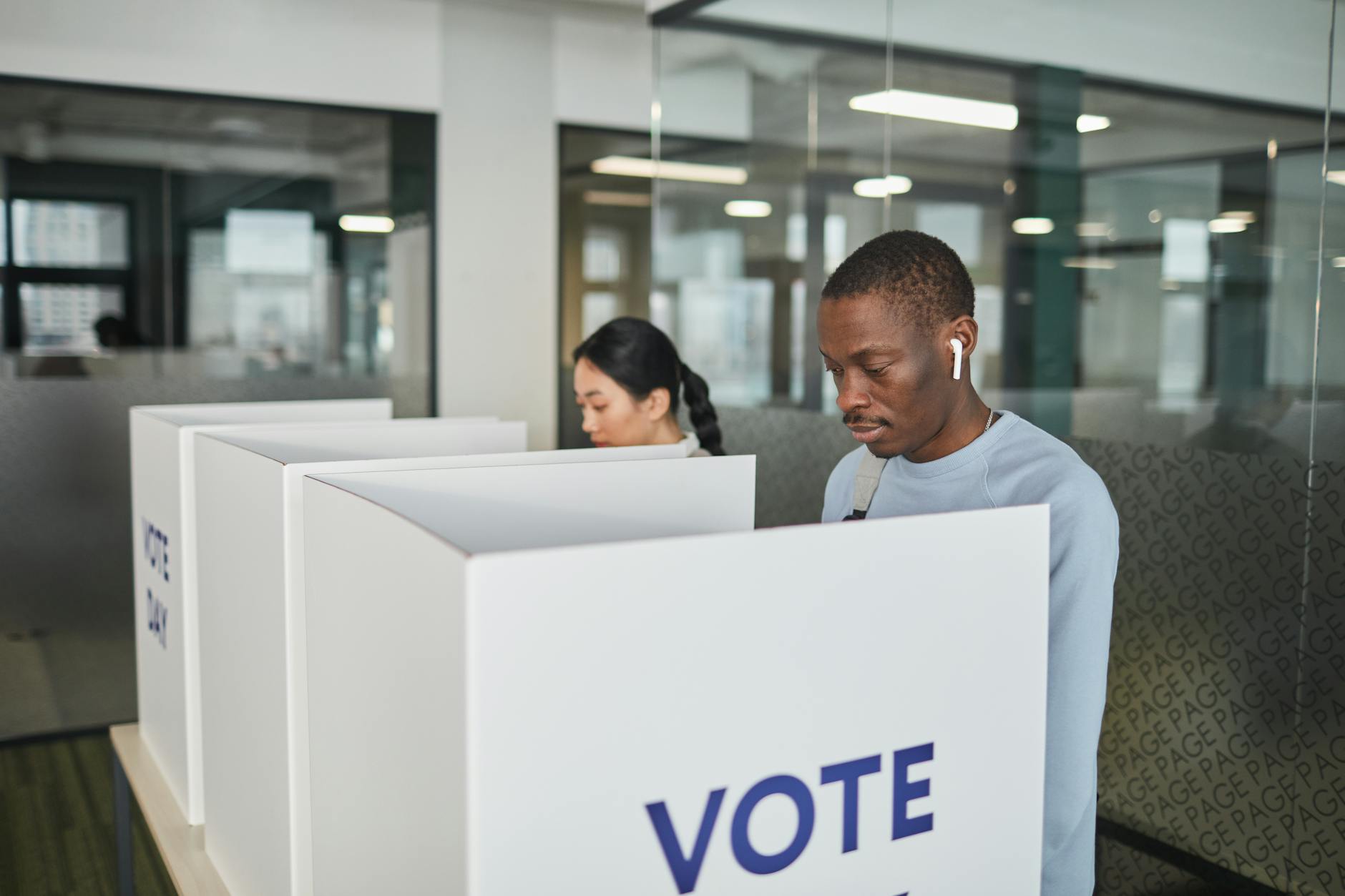
a man wearing a earpod

Last Minute Reminders about Voting

With only seven days to go before Election Day, according to California’s Secretary of State, as of Monday, February 26th, at least 5.7 million Vote By Mail ballots have reached voters’ mailboxes in Los Angeles County. Out of this bunch, some 311,853 ballots, or 5% of all ballots mailed, have been returned. For the 95% of the rest of you, then, here are just a handful of brief reminders from the L.A. County Registrar-Recorder/County Clerk’s office.

On Your Ballot

  • You do not have to vote in every race.
  • Vote-by-mail ballots can be returned by mail, at a drop-off location, or your county elections office.
  • Vote centers open for early in-person voting in all Voter’s Choice Act counties (which applies to L.A. County) beginning on February 24, 2024.
  • Vote-by-mail ballots must be postmarked on or before Election Day and received by March 12, 2024.

Write-In Candidates

  • A voter is entitled to cast a vote for a qualified write-in candidate for any party-nominated, voter-nominated, or nonpartisan office by writing, on the write-in portion of the ballot, the name of the qualified candidate.
  • To add a candidate, fill in the circle to the left of “Write-In Candidate” and write the name on the dotted line.
  • A list of qualified write-in candidates is available eleven days before the election here.

Additional Note On Last Minute Voting

  • Here’s an example to consider. If you’re registered with California’s Democratic Party, but between now and Election Day on March 5th, you have a change of heart regarding your choice for the Presidency and actually want to vote for say, Claudia De La Cruz, of the Peace and Freedom Party. Can you can write her name on the dotted line below the “Write-In Candidate” bubble on your Vote by Mail ballot and have that counted as an official vote for De La Cruz? NO, YOU CANNOT. However, you can still manage to vote for De La Cruz under Conditional Voter Registration (CVR).
  • Find De La Cruz’s name and other Qualified Candidates whose names will appear on L.A. County ballots, including for the presidential race and more here.

Conditional Voter Registration

From the L.A. County Registrar-Recorder/County Clerk’s Office:

  • Any eligible voter can go to any Vote Center in the County during the 11-day voting period.
  • Once at the Vote Center, the eligible voter [can] complete the CVR application.
  • The voter is then issued a CVR ballot to take to the new fully accessible Ballot Marking Device (like a voting iPad).
  • The voter’s experience reading and marking their ballot will be the same, however after the voter prints their paper ballot they will be instructed to return their paper ballot to an Election Worker.
  • As soon as the CVR application is verified, their ballot will be counted and the registration will become active.
  • The voter may then vote in any future election in which they are eligible to participate.

Tracking Your Vote

  • After submitting your vote, you can sign up to know the status of your ballot on the California Secretary of State’s part here.

For other questions, comments, or concerns, you can reach out to your local Vote Center, which should have more specific details on any of these particulars.

Otherwise, happy voting, Los Angeles!

J.T.

JIMBO TIMES returns to El Salvador this January

The land where my papá was born was for the longest time a maligned place in the stories told through the land I called home. In fact, exactly six years ago in a discussion regarding the U.S.’s immigration quotas Trump referred to El Salvador, as well as Haiti and other African nations, as “shit-hole countries.”

That same year I visited El Salvador for the first time. I was 27 then, and nothing would stop me from breaking through to this world I’d heard enough about but which I hadn’t seen for myself yet; instead of “The Violent Animals of MS-13,” I saw the volcanic highlands that enclosed the first pupusas ever known to a people and their pueblos, to say nothing of an entirely new family tree. It was also in San Salvador where I tried pupusas de masa de arroz for the first time, which to this day are still my favorite kind to ask of pupuseras in Los Angeles.

I also learned that the hometown had prepared me over a lifetime to find my way “back.” According to the 2022 Census, just under 1.7 million Central-Americans call L.A. home,* but that’s surely an under-count since the community grows daily in L.A. County while also doing its part to make Southern California one of the richest havens of culture in all of North America.

This January, I return to El Salvador for just the second time ever as an Election Observer for presidential elections taking place there. I’ll be part of a small delegation to show enduring commitment to a free and just El Salvador.

I’m now fundraising to pay for the trip! My fundraising goal covers the costs of the airfare, as well as in-country costs including lodging and transportation, and about $100 for miscellaneous expenses (like a few delicious queso duros). In addition to my role as an Observer, I’ll also be documenting the efforts of my delegation leading up to presidential elections on February 4th, including interviews with my fellow delegates and the Salvadoran people to uplift only more of this pueblo for Los Angeles.

As usual, you’ll be able to find all of these cuentos via jimbotimes.com, J.T. the L.A. Storyteller Podcast, and on Instagram: @jimbotimes. For any questions or comments, please don’t hesitate to reach out. Trust that I’m going to do my best to make you proud, Los Angeles, and thanks so much on behalf of Los Cuentos!

*An earlier version of this article mistakenly noted the Central-American population in L.A. as being at 836,000 people, when in fact the number is significantly higher.*

J.T.

bed of california poppy flower

California leads the States in donations to Trump through Q3

When governors Gavin Newsom and Ron DeSantis held their “debate” this past November, one minor fact missing from the discussion was that donors in “the Golden State” have actually led the nation in supporting Donald Trump’s re-election campaign so far. Data from the Federal Election Commission shows that since August 2022 – September 2023, Californians have made at least 167,000 donations for the 2024 presidential election, $6.2 million of which has gone to the former president. Texan donors came in second for Trump over the last year at $5 million, while Floridians placed third for him at $4.6 million. New Yorkers, by contrast, contributed little more than $1.7 million to Trump, who himself is a former New Yorker. Trump first announced his intention to run for a second presidential term in November 2022.

In 2020, 23 of 58 counties in California went to Trump, including Kern, Shasta, El Dorado, and Placer counties, or where the state is far more rural than Hollywood and San Francisco still lead many to imagine. Trump tallied over 6 million votes from California that year, or more than any Republican candidate in state history. This also helps to explain why even though Trump lost areas like Orange County, there was still growth in support for him through certain segments of it, including in Asian-American and Latino communities there.

California’s 52 Counties and their choice for the presidency in 2020. Image courtesy of Wikipedia.org

Still, $6 million from Trump voters in California during the past year does not mean the state as a whole is friendly to his camp. Instead, it’s indicative of an energized California Republican electorate early in the race, one that is bound to be outmatched at a rate of 2 to 1 by California’s Democratic supporters as the U.S. inches closer to November 2024. Yet the volume of donations from Trump voters across the state over the last year are consistent with California’s towering economic weight going into the 2020 election as well.

At that time, the nation’s most populous state led the nation with presidential campaign contributions at more than $290 million. New York came in second at $141 million, while Texas and Florida doled out $109 million and $103 million, respectively; of dollars from California for Biden or Trump in 2020, more than 3/4ths went to the Democrat.

But where exactly does all this money go?

chicago cityscape
Michigan sky-line. Photo courtesy of by Pixabay.

To the “swing-states,” of course! In the form of television and radio ads, not to mention text messages and social media. This is because the electoral college system, which is a winner-take-all system in which just 51% of a state’s popular vote awards the state to any given candidate, makes it so hundreds of millions of dollars from California or Texas just support Biden or Trump landing slim majorities in a few swing-state counties. As the Washington Post noted recently:

“Former secretary of state Hillary Clinton, who won the 2016 popular vote by 2.9 million votes, or 2 percent, could have won the electoral college if about 80,000 people in Michigan, Pennsylvania and Wisconsin had voted differently. In 2020, about 45,000 votes in Georgia, Arizona and Wisconsin could have changed the outcome of that race, even though Joe Biden won the popular vote by more than 7 million.”

In summer 2023, then, the University of Virginia’s Center for Politics noted that given the last few election cycles and which states were won by a slim majority for the Democratic or Republican candidate, there are likely just four states to watch for 51% going to Trump or Biden in 2024:

“The four Toss-ups are Arizona, Georgia, and Wisconsin — the three closest states in 2020 — along with Nevada, which has voted Democratic in each of the last four presidential elections but by closer margins each time (it is one of the few states where Joe Biden did worse than Hillary Clinton, albeit by less than a tenth of a percentage point).”

In all likelihood, then, those $6 million for Trump from California’s red counties are pouring down in counties throughout Arizona, Georgia, Wisconsin and Nevada. According to the Washington Post, outreach in some of these areas is already focusing on “Black, Latino, and young and female voters.” But to appreciate how much the electoral college system undermines California voters for the presidency, consider that even if the entire population of all four of these swing-states were suddenly combined, the Grizzly bear state would still have nearly 13 million more people to count for taxation and representation.

The Center for Politics also noted that Pennsylvania and North Carolina may also be in the mix in 2024. And it’s key to underline that the Center’s report was published prior to the brutal conflict in Palestine and Israel this fall, which has definitely diminished support for Biden from certain swing-state voters who chose him over Trump in 2020. Nowhere has this been more pronounced than in Minnesota and Michigan, where key swathes of Muslim and Arab American communities are now determined to deny Biden a second term.

For those wondering how Q3’s donations to Trump from California worked out locally, in the city of Los Angeles, out of just over 4,600 donations to presidential campaigns, there was an overwhelming sum of donations to Republican challengers for the office over the last year. But a division between donations to Republican alternatives to Trump and Trump himself reflected the dilemma for the GOP nationally. For example, 842 of donations from this set netted $507,000 for Joe Biden, while just over 1,300 donations from the same set provided nearly $900,000 for Republicans like Chris Christie, Ron DeSantis, Nikki Haley, and Vivek Ramaswamy, among others.

By contrast, while Trump garnered just over $200,000 from the city of Los Angeles over the last year, he did so from more than 2,300 donations, which will also shift soon given his growing lead over the pack during this fall season. For the record, about 162 donations from this L.A. set also went to third-party and long-shot candidates such as Cornel West and Marianne Williamson.

Want to guess how many donations for Trump or Biden sailed out from 90210, or the Beverly Hills area zip code?

Naturally, this is a developing story. To get the scoop on Q4’s reports and hear more, be sure you’re subscribed to J.T. the L.A. Storyteller!

J.T.

city skyline during night time

Read the full report recommending the expansion of L.A. City Council from 15 to 25 Representatives

The “Interim Report of the L.A. Governance Reform Project,” published this June 2023 by a team of researchers and academics from USC, UCLA Luskin, and Cal State, among others, says about the leaked recording from October 2021 of L.A. City officials discussing the city map’s redrawing:

“At the time of the conversation, the city council was exercising its charter authority to draw lines after an advisory redistricting commission had presented its report. (emphasis mine)”

The report also notes about current calls to expand the council that:

“Such a wave of reform energy does not occur very often. Sometimes decades pass between reform eras. Los Angeles is in the midst of one such moment now, and it is not to be taken for granted.”

Regarding the question of exactly how to expand the number of representatives at L.A. City Hall, the report states that this is most likely best advanced through an amendment to L.A.’s city charter, or the city’s homemade version of the U.S. constitution:

“Passed by the voters in 1924 and implemented in 1925, the charter, as amended, has been the city’s governing document for nearly a century. The charter can only be changed by a vote of the people. Charter amendments can be placed on the ballot by the city council or by an initiative based on the signatures of registered voters.”

As to when this and other changes to L.A.’s governing structure might be pursued, the report leaves no room for misinterpretation:

“Our first overall recommendation is that a package of governance reforms be placed on the November 2024 ballot.”

And on the question of how to pay for more offices and salaries, the report points out that the city budget’s current share for funding the council is already a small share of the total annual city budget, which this fiscal year is roughly $13 billion:

“Our research shows that it is a very small share of the city’s budget. A cap on the share of the budget that goes to the council’s operations could be part of the ballot measure as well as a pro-rated reduction in council salaries. A cap on the share of the budget that goes to the council (including member and staff salaries, and offices at city hall and in the field) could be part of the ballot measure.”

Last but not least, the report contends that increasing the number of L.A. City Council Representatives from 15 to 25, including with the introduction of 4 “At Large” offices, should bolster representation for more of the people who make up L.A.’s neighborhoods:

“Communities with a likelihood of gaining representation include those of Korean, Filipino, Guatemalan, and Salvadoran origin.”

J.T.

Excerpts from Zev [Yaroslavsky]’s Los Angeles

Zev Yaroslavsky, the former L.A. City Councilmember (CD-5) and former L.A. County Board Representative (District 3), was first elected to office nearly 50 years ago at the age of just 26 years. He would serve as an elected official for nearly 40 years, retiring in 2014; in 2016, he became the director of the UCLA Luskin School of Public Affairs, where he has remained since.

Yarloslavsky’s memoir is a story replete with his commentary on various ongoing political issues in L.A., including the city’s notorious lack of affordable housing, Proposition 13, rent control (RSO), the 1984 Olympics and L.A.P.D., and even L.A.’s slow-growth movement.

At a talk at Kohn Chapel recently, Yaroslavsky noted that, “There are people who weren’t even born…halfway through my career who are now writing revisionist histories about the things that I was involved in. And I’m not gonna get into an argument with them, but I want to make sure that my side of the story is in print, and people can take it or leave it.”

Below are 10 excerpts from his book for your consideration. You can also hear more from his side of the story in his recent appearance on former L.A. City Councilmember Mike Bonin’s What’s Next, Los Angeles Podcast.

On L.A.’s political climate at the time of his election (1975)


“To be sure, there were problems galore. The city was grappling with rising crime, property tax rates, and rents. Neighborhood groups were angrily pushing back against unwanted development and traffic congestion that was eroding their quality of life. Black people, Gays and other marginalized groups were bitterly protesting their treatment by the Los Angeles Police Department, and a long-simmering dispute over busing and school integration was boiling over.”

On Property Taxes in California before 1978


“At the conclusion of the town hall meeting, one elderly widow approached me, and the ensuing conversation has been etched into my memory ever since. She showed me copies of her 1976 and 1977 property tax bills. The ‘76 bill was for $1,500, an amount she could barely afford, but the ‘77 bill rose to $7,500, a five-fold increase. “I’m going to have to sell my house. I’m going to have to leave the home in which my late husband and I raised our family,” she said. “I don’t want to leave. Where will I go?” She didn’t want to leave her church, her doctors, and her social network. It was a crushing blow. This story was playing out in hundreds of thousands of households across our region.”

On the impact of Proposition 13


“Until 1978, property taxes were the principal source of funding for schools, counties and cities. After Proposition 13, however, there weren’t enough tax revenues to pay for all three. Amid lengthy wrangling in Sacramento, the state took over much of the funding for education, averting a breakdown of the California public school system. This was a seismic change. At the same time, the chastened legislature returned a portion of the $7 billion State surplus to local governments, to help them adjust to the new reality.”

On implementing Proposition 13 locally


“Remaking the budget was hard, the pressure was intense, and the stakes were high. But we made it work. The experience, you’ll excuse the expression, was taxing. It was seared into my psyche for the rest of my career. But there were glaring inequities built into the new law that bedevil California to this day. Longtime homeowners would enjoy a much lower property tax than a neighbor who purchased an identical home next door years or decades later. And thanks to a legal loophole, many new commercial property owners were not taxed based on the purchase price, avoiding a substantially higher tax. Over the years, calls to correct that inequity have proven politically too hot to handle. In November 2020, a State constitutional amendment that would have ended this exemption was narrowly defeated by California voters.”

On Prop. 13’s negative impact on communities of color and future families seeking to become homeowners


“Despite the approval of alternative fees and taxes, local government never fully recouped the financial losses caused by Proposition 13. Adopting budgets became an annual struggle to make ends meet, and vital social, capital, and operational investments were deferred or never made. The consequences fell more heavily on economically and racially marginalized communities, further exacerbating the structural inequities that plague our society.”

On opposition to Rent Control in L.A., including within his own district


“I told them that I understood their concerns. But more than 23,000 voters, many of them renters, elected me and I knew first-hand the financial hardships they faced because of never-ending rent increases. I had knocked on their doors and felt their pain. I was not going to sell them out.”

“Although I was an outspoken advocate for rent relief, the main credit goes to Councilman Joel Wachs for his leadership on this issue. He took on rent control as one of his core causes. His intellect, political acumen and perseverance made him the leading political force behind what ultimately emerged as the city’s landmark Rent Stabilization Ordinance (RSO). Pressure grew for a solution when it became clear that most landlords had no intention of passing on rent savings to tenants. Mayor Bradley, who had not previously spoken out on the matter, finally called for “dramatic action” to halt what he termed “outrageous” rent increases. As a result, the council passed a rollback and moratorium on rents in August 1978. The following year, after a furious battle, the City Council renewed the RSO. It did so each year until it approved a permanent law in 1982.”

“The new [Rent Control] law also exempted all apartment buildings built after June 1978, addressing the argument that rent control would discourage new construction. At the time, it seemed like an easy concession to make in order to get a permanent law on the books. Because of this exemption, however, the tens of thousands of new rental units built in Los Angeles over the next four decades were not subject to rent control. So, what were once “new” units, are today largely unaffordable to middle and low-income renters.”

On L.A. apartment buildings being converted into condominiums in the late 1970s and early 1980s


“I authored legislation putting conditions on conversions, allowing them only in planning areas where the rental vacancy rate was greater than 3 percent. In those days this was considered the equilibrium point between a rental housing shortage and a surplus. We also required owners to provide relocation assistance to renters who could not avert displacement. Still, the conversions continued. They contributed to a higher rent burden and increased poverty in segments of Los Angeles’ elderly population. Some of the most vulnerable tenants had to choose between rent and food, between rent and medicine. It was a dreadful predicament that continues to plague Los Angeles to this day.”

“Los Angeles faced a rent crisis not over the supply of housing, but over the supply of affordable housing, according to a 1981 report by the Rand Corporation. ‘What Los Angeles has, along with most of the rest of the United States, is a double-digit price inflation that increases the cost of producing housing services, and therefore increases rents,’ the report said.”

J.T.