From Venice to Echo Park: Unroot the Red Line

The next time you find another angry message board about unhoused people in Venice, please refer them to these facts.

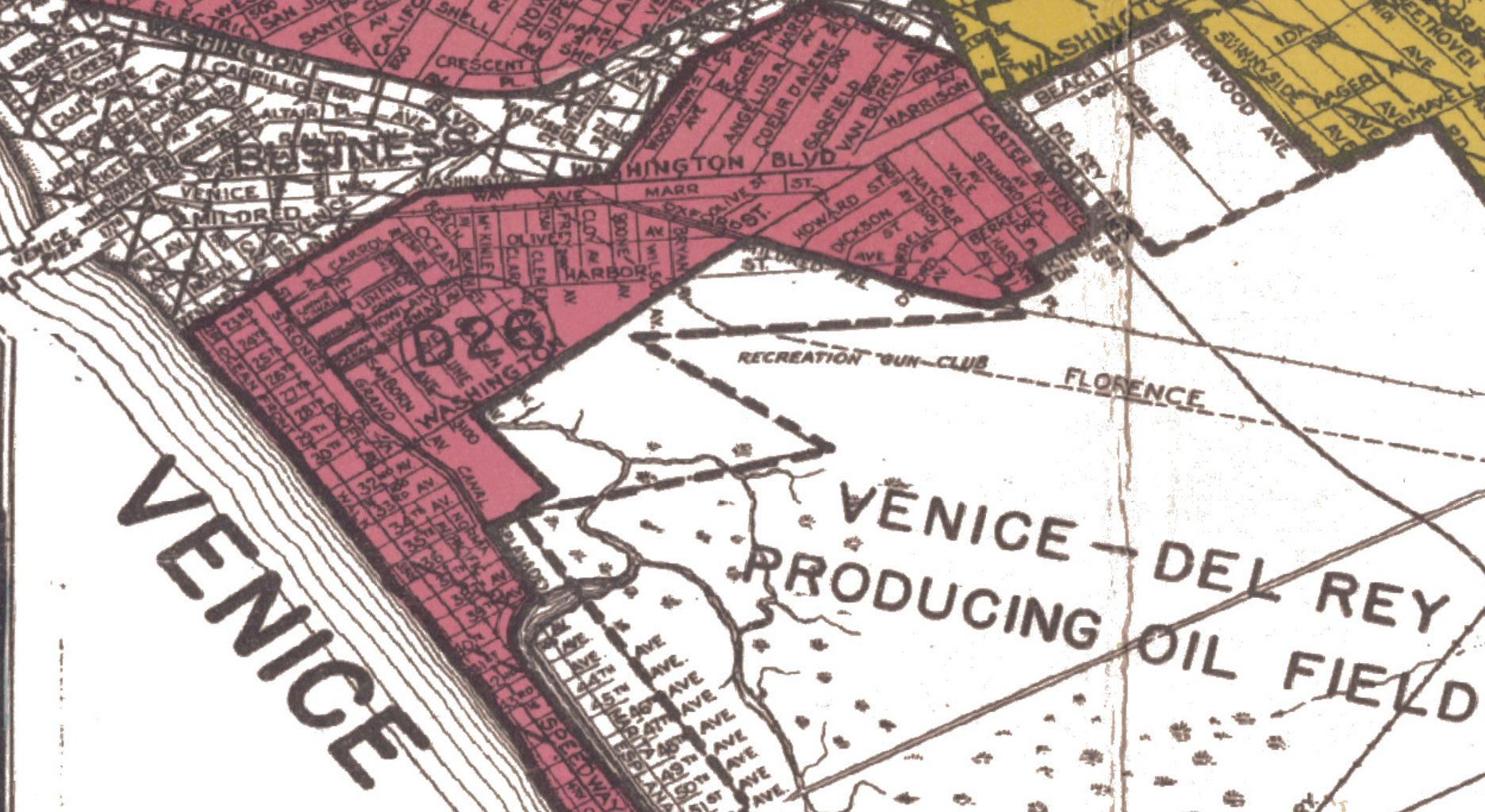
Venice was redlined in the 1930s for 15% of its area containing families of “Mexican, Japanese, and Italian” origins and 4% “Negroes,” according to written records. The decision in the 1940s to funnel federal money for housing away from the area is no small part of why today’s homelessness along its beachsides, followed by policing, have markedly increased over the years.

A screenshot of a map from 1939 by the Home Owners Loan Corporation, marking Venice for disinvestment from federal dollars for housing.

Appraisers for the federal government arrived to Venice in 1939 and misleadingly claimed, “Many mortgage institutions will not operate in area.” They also went on to call the community “blighted” for its multi-ethnic workers and families. At this point, if you’ve read about redlining on this blog, it should be clear that such language by government officials was not only malicious, but consequential in that disparaging language against non-whites was instrumental for states and cities to decide where wealth and poverty would reside, respectively.

Over time, as the militaristic takeover of Echo Park this past March showed, public officials in L.A. would largely choose to expend public tax dollars to formerly redlined areas in the form of policing, that is, policing poor people in these communities on the basis of “Neighborhood Watch” and also “super-predator” theories, which supposed that youth and working age-adults in such “slum” areas were simply more predisposed to commit crime given their impoverished living conditions. Of course, in order for these theories to work, city officials just had to ignore the fact that opportunities for wealth and home-ownership for Black and immigrant communities in “slums” were choices first taken away from them by the federal government and complicit municipal and state actors.

A screenshot of a map from 1939 by the Home Owners Loan Corporation, marking Echo Park for disinvestment from federal dollars for housing.

But don’t let what escaped real estate appraisers in the 1940s escape you in the 2020s: Disinvestment in non-white communities and the inverse for whites was and remains backwards planning since whiteness could not and still cannot survive as an investment without supportive non-white labor pools nearby. The very development of the Venice canals in the early 1900s was only possible because of Black labor. In fact, Black labor was so crucial to the construction of Venice beach that families were moved out to what would become the Oakwood neighborhood in order to speed up work for the grand opening of the famous beachside in 1905.

Canal scene in Venice Beach’s inductive year of 1905; Photo courtesy of the L.A. Public Library

Yet when federal appraisers arrived in 1939, on seeing “Black, Mexican and Japanese” residents alongside white European immigrant households, they were under strict orders from the Federal Housing Administration’s 1936 manual:

“The Valuator should investigate areas surrounding the location to determine whether or not incompatible racial and social groups are present, to the end that an intelligent prediction may be made regarding the possibility or probability of the location being invaded by such groups. If a neighborhood is to retain stability it is necessary that properties shall continue to be occupied by the same social and racial classes.”

Ironically enough, this logic, claiming that any and all whites interested in a home near Venice beach would turn away from the area on learning of Black and immigrant communities like Oakwood, was proven false by white influxes into Venice starting in the 1980s. Yet it’s nevertheless the logic of entitled homeowners associations in the neighborhood today, who assert as unscientifically as their peers did when “separate but equal,” or Jim Crow policy, was still law, that the very existence of unhoused people in the area depresses property values and “brings in crime,” something we’ll get back to in a moment.

For now, just note that housing shortages for Black and non-white immigrant communities in Oakwood would only be exacerbated after the population boom spurred by the end of World War II because of the pseudoscience of real estate assessments over the “compatibility” of such communities with the dominant white order.

Racial disinvestment against areas like Oakwood would continue well after the Fair Housing Act of 1968, when redlining was outlawed, with one exception: investment in policing budgets and details to patrol Black and Latino families in the vicinity. Like their contemporaries to the Southeast in Watts, then, despite the Fair Housing Act families were still discriminated in housing as well as in employment and educational opportunities, thus making them more vulnerable to L.A.’s expanding carceral state.

A real estate boom would hit the community in the late 1980s, abetted by an accompanying surge of policing, pushing major swaths of Blacks out of the historic neighborhood in particular. By 1990, the Black population in Oakwood fell by eight percentage points down to 22% of the area, a substantial drop from a high of 44% in 1970. Latinos and whites, by contrast, increased by five and three percentage points, to make up 50% and 26% of the Oakwood population in the years before the Rodney King rebellion, respectively.

By 2000, the Black population in Oakwood fell again by another seven percentage points to 15% of the area, while the Latino population saw its first decline after four decades of growth by three percentage points down to 47%. Over the course of the new millennium, however, Latinos would continue to leave Oakwood, following in the footsteps of Blacks, whose displacement from the area began as early as when Latinos grew to comprise half of households there in 1970. As of 2019, the percentage of Black families in the area was less than 12%, while the Latino population decreased to 30%. White families, by contrast, now form 73% of the Oakwood neighborhood, something that must have seemed unimaginable to many Black and Latino youth policed up and down its corners in the early 1990s.

A gang injunction by the LAPD in Oakwood was initiated in 1999, even as research showed that “gangs” across L.A. by the 2000s were largely inactive compared to the 1970s and 1980s.

An LAPD gang injunction map from 2013, allowing them to stop, harass, and arrest any “suspected” gang members.

Compounding a dearth of housing and employment opportunities, the injunction would harass and jail generations of working-age Black and Latino residents in the area until an ACLU lawsuit slowed it down in 2016. Yet by the early 2010s, as Brown families to the northeast in Echo Park would also find, the damage was done. In the words of one life-long resident of Oakwood from a 2018 interview:

“Families moved out to get their kids away from the gang injunction because you couldn’t be anywhere in Venice and not get stopped or harassed or arrested by the police if they deemed you a gang member.”

Additionally, an inspection of data from the Million Dollar Hoods project shows that over a five year period, from 2012 – 2017, police made over 3,300 arrests in the Venice beach area, with Black and Latinos accounting for 57% of arrests despite making up just 27 percent of the area’s population by 2008. Black men in particular were arrested at a rate seven times higher than their share of the population.

Conservative estimates of LAPD expenditures on arrests in the Venice beach neighborhood from 2012 – 2017.

Today, Council District 11, where Venice and Santa Monica are based, stands to see a continued decline of Black and Latino households at the same time that homelessness continues to soar for these two groups across Los Angeles. Since 2011, CD-11’s rate of unhoused people has grown by 160% to more than 3,200 people, making it the sixth most impacted district in Los Angeles today, and by extension, another resourceful hub for police activity.

This is because while the number of unhoused people in L.A. grew by leaps and bounds over the 2010s, research suggests that homelessness, followed by policing apparatuses and their budgets, grew most in formerly redlined areas.

For example, in 2019, just three of fifteen districts in L.A. contained 41% of the city’s homeless population, all three of which were heavily redlined or marked for disinvestment for their Black and immigrant residents during the federal housing administration’s development programs; neighborhoods in these areas include Skid Row and Boyle Heights, South Central or South Los Angeles, and Leimert Park and the Crenshaw corridor, where rapper Nipsey Hussle was slain in March 2019.

We also now return to the question of “crime,” particularly as it’s said to concern unhoused people. In the 1980s and 1990s, white liberal and conservative politics asserted that crime in L.A. was largely due to Black and immigrant “gangs.” Today, homeowners associations and their backers increasingly attribute crime to unhoused people, nearly 3/4ths of whom are Black and Latino in Los Angeles. Yet since the early 1990s through 2019, while homelessness increased in the city, reports of violent and “property crimes” across the nation–and in L.A. County–generally fell by more than half.

As recently as 2019, there were approximately 555 violent crimes per 100,000 people, compared to nearly 1,800 such crimes reported in 1990. There were also 2,200 property crimes per 100,000 people (not including arson) in 2019, though compared to 5,700 such crimes reported in 1990.

The point is so important it merits repetition: While homelessness in Los Angeles County has increased yearly since the early 1990s, both violent and property related crimes here have largely continued to fall since their 1990 levels.

An analysis of the crime rate by the Pew Research Center showing fallen crime rates from “’93 to…infinity?’”

But might the drop in crime be explained by the increased police budgets after all? Contrary to such rhetoric from police unions and their public official liaisons, “more cops” have not equaled more public safety. As Aya Gruber recently noted in a brilliant essay on “bluelining,” or police-patrol as a new form of redlining against historically discriminated communities of color, experts have long held that random preventative patrols, along with rapid response time to calls, neither reduce crime nor induce fear in people considering a criminal act. Additionally, Gruber points out:

“Researchers have also determined that ‘proactive policing,’ which includes ‘quality of life’ offenses, street sweeps, and stop-and-frisks, does not reduce, and in fact, may increase, crime (emphasis J.T.’s).”

If not for the continued policing of non-white bodies via gang injunctions and increasingly due to “homelessness,” then, exactly where would police have gone over the last 30 years? Something tells this writer that “preventing,” or rather responding, to 500 violent crimes and 2,200 property crimes per 100,000 households to the tune of billion$ would be more difficult for police unions and public officials in L.A. to justify annually. Yet it’s increasingly the case as more of us bear down on the city and county’s historic over-expenditures on its police state.

As author Alex Vitale noted in The End of Policing (2017): “The reality is that the police exist primarily as a system for managing and even producing inequality by suppressing social movements and tightly managing the behaviors of poor and nonwhite people: those on the losing end of economic and political arrangements.”

Moreover, in Los Angeles, there is overwhelming evidence to show why policing non-white communities into submission is not a sustainable path for the city, state or federal government. This August will mark 56 years since the war-zone in Watts, when the LAPD and Mayor Yorty called on National Guard troops to descend on Black bodies in the South L.A. community after their rebellion against continued police brutality there. The reign of fire led to the police murder of 26 civilians, the injuries of thousands more, and subsequent “riots” in response to over-policing and disinvestment against Black communities in sister cities over the following years.

This past April marked 29 years since 64 people lost their lives across Los Angeles, including ten murdered by police, while 54 others were killed amid looting and civil unrest; 3/4ths of those killed were Black, Asian-American and Latino. And as with thousands of other deaths and damages in cities all over the U.S. following the 1960s–each loss of life and damage was preventable, pronouncing the indignity of the “red line” against non-white communities well beyond the 1930s.

What’s also true is that a major part of why L.A. & Cali have always operated–dangerously–in isolation is because of Washington D.C’s refusal to rein in their correspondents when acting unilaterally against “poor” people. Yet as the progenitor or “forefather” of the Federal Housing Administration program that has segregated Black and immigrant neighborhoods in the inner city for nearly 100 years now, Washington D.C. is not extricable from discussions of equity, reparations, and reconciliation for housing, employment, and other opportunities taken from us.

In concert with a new civil rights movement, then, picking up where our first civil rights leaders left off, it’s now time for communities, from Oakwood and all of Venice, to Echo Park and beyond, to mark every dollar lost on policing rather than resourcing our neighborhoods. In a fair hearing, whether on the streets of D.C., or before the United Nations, each dollar represents what we are owed—with interest—in a new, New Deal for the 21st century.

J.T.

California Sold Bonds to Pay for Indian Genocide Orchestrated by White Militias

Referring to wholesale massacres of California Indian tribes by self-organized white militias as “expeditions,” early California’s legislature figured that the U.S. federal government would eventually pay for rifles, food, wages and other expenses for the men of these deadly campaigns, going as far as to print bonds with George Washington’s portrait on them before officials in Washington D.C. even approved of the operations. Their assumption ultimately proved to be correct.

According to Indian-American historian and UCLA professor Benjamin Madley’s American Genocide: “On May 3, 1852–less than fifteen months after raising $500,000 for ranger militia expeditions against Indians–legislators passed a new $600,000 bond ‘for the payment of the expenses of the Mariposa, Second El Dorado, Utah, Los Angeles, Clear Lake, Klamath, and Trinity, and Monterey Expeditions against the Indians.‘” Madley adds: “The bond issue lured many Californians into financially supporting the [state] killing machine.”

Los Angeles itself was founded on the land of native Californians in 1781 by people who themselves were also “throwaways” for the Spanish crown. Yet before “La Reina del Pueblo de Los Angeles…” was born, there was the San Gabriel Valley mission, established in 1769, where the Tongva (or Kizh) woman Toypurina’s people were held captive. European-Spanish law ruled over this proto-version of L.A. for at least 50 years, after which Mexican and Latin American Independence in 1821 wrested power away. The new Mexican government was supposed to change the mission system which held hostage many native people, but not so unlike today, change took time. Then, it actually wasn’t change anymore.

As UC Merced professor Adam Torres-Rouff tells it in Before L.A.: “After a decade of debate, the territorial authorities, together with the Mexican government, ultimately closed the missions and secularized mission lands, between 1834 and 1836…Once approved, however, California officials failed to implement secularization as designed. Rather than equitably dividing mission property among the former neophytes, they engineered a bonanza for select Mexican Californians.”

This result was not good for native folks in the state, including in the Southern California area. Torres-Rouff points out that: “Rather than a liberal redistribution, secularization effectively dispossessed Indians from their ancestral and mission lands, and tens of thousands left California’s coastal areas for the less populated interior.” Moreover, these laws would not last more than a decade due to the U.S. invasion of Mexico, and in California, a revolt that was actually in violation of the U.S.’s 1794 Neutrality Act.

The select Mexican-Californians were Californios, or elite families in Mexico mostly of old-world Spanish heritage. But rather than ruling over California, these families mostly kept to themselves and their ranches, which led to a rather weak system of government. The 2,000+ miles between say, the city of Monterey in Northern California and Mexico City didn’t help either. Ambitious tradesmen and political forces to the east took note of this, and eventually became a crucial part in taking “Manifest Destiny” all the way to the west coast under President Polk.

On the morning of June 14 1846, a band of white U.S. settlers in the Northern California town of Sonoma were spurred by rumors of Mexican officials expelling them before Polk’s declaration of war on Mexico. They seized and trapped key Mexican generals, including General Mariano Vallejo, his brother Salvador Vallejo, and other officers.

According to Joseph Warren Revere’s A Tour of Duty in California (1849): “The next day a proclamation was issued by the patriots at Sonoma, setting forth their grievances, assuring the peaceable inhabitants of protection, and declaring their intention to establish a republican government, independent of Mexico, or perish in the attempt. A flag was also hoisted bearing a Grizzly Bear rampant, with one stripe below, and the words ‘Republic of California’ above the bear, and a single star in the Union.”

A photo of the original California state flag of American making; Photo-image from the Museum of the City of San Francisco.

California was officially inducted into U.S. jurisdiction on September 9th, 1850, but even before then, a cast of delegates for the state had already ensured that violence against natives would be fair game. Nothing speaks to this more clearly than the California Act for the Governance and Protection of Indians (1850), which was one of the first laws passed by the state’s first legislature, modeled after those from earlier colonies turned U.S. territories. An American Genocide describes how: “In December 1849, a number of delegates met in Monterey, California to debate about whether or not California Indians should be granted citizenship and/or suffrage. Most of the delegates were against suffrage…” As a result, on April 21st, 1850 the official dehumanization of others–most of all, Native Californians–was written into state law by Governor Burnett; this report prepared by the California Research Bureau (CRB) for the California State Library details more of the specifics of just what the legislation approved:

Page 6 of Early California Laws and Policies Related to Indians (2002), by the CRB.

These U.S. laws (or policies)–like the Mexican laws (or policies prior to them)–had irreversible effects on the lives of the original stewards of the lands from San Francisco through Southern California, whose cultures existed here thousands of years prior to European, Mexican, and American conquests. As a result, Madley notes that: “…between 1850 and 1873 California state judges found whites guilty of very few crimes against California Indians and sentenced only a handful of whites for such crimes.”

An L.A. Times article by Bill Boyarski in 1970 also noted the change in attitude and policy in California’s shift from Mexican to U.S. law: “In the city’s earliest years, when Spaniards and Mexicans ran things, California society was open. Blacks, descendants of Spanish slaves, helped found Los Angeles. Indians were subjected to the strict, paternalistic control of the Franciscan fathers. But at least the priests never engaged in the Indian slaughter favored by Americans who came West during the Gold Rush.”

That Gold Rush, which earned California its moniker as “The Golden State,” can and should be understood as a primary catalyst for the bloodbaths that would follow in the decades after 1846. In Los Angeles alone, Madley recounts that: “…between 1850 and 1870, Los Angeles’s Indian population fell from 3,963 to 219…”

This document from the California Tribal Court-State Court Forum likewise notes that “Before the missionary, fur trapping, and gold rush era migrations, California’s Native American population was estimated at about 200,000…Between 1840 and 1870, [the California Native] population declined to 12,000 due to disease, removal, and death.”

To a great extent these histories are rather esoteric to most of us, given that traditional education in the U.S. has buried them for centuries. As Californians, we’re also not frequently known for expertise in our own state’s history. But the state, as the keeper of laws–including officialized or sanctioned violence–has to be held more accountable. Our media coverage, or any official retelling of these facts, also plays an important role in our understanding–or lack thereof–when it comes to the places we come from, how they’ve been made, and how they might be remade.

J.T.

a man holding a magnifying glass

Who is Reelecting Mitch O’Farrell? New GIS Map Shows Contributions by Zip to Reelection Campaign for 2022

An analysis of data from the L.A. Ethics Commission shows that at least 75% of funds for Mitch O’Farrell’s reelection campaign for Council District 13 (CD-13) in 2022 are from outside of District 13. At the end of 2020, O’Farrell’s office reported a total of just under $110,000 in funds for his reelection campaign. CD-13, made up of Atwater Village, East Hollywood, Echo Park, Elysian Valley, Glassell Park, Historic Filipinotown, Hollywood, Little Armenia, parts of Koreatown, Thai Town and Silver Lake, is up for an election on June 7, 2022.

The choropleth map below, shaded from light to dark-red to highlight least to largest quantities, shows which zip codes have contributed the most dollar sums to Mitch O’Farrell’s reelection campaign in 2022 as of December 31st, 2020.

Zip codes on the choropleth map represent donations in aggregated sums, meaning that zip codes do not represent individual households, but the total sum of donations from different households within the given zip code.

Council District 13 is roughly contained on the map by the red 90068 and medium red 90028 segments to the west, the dark-red 90026 segment to the south-east, the red 90065 segment to the north-east, and the medium red 90039 and 90027 segments in the center. All other segments highlighted on the map around these “flank” segments are not a part of CD-13 but are segments containing donors to the 2022 campaign.

Donors within Council District 13 and donors not within the district marked and separated by a yellow line.

Zip codes for Council District 13 are: 90004, ranging from Rampart Village to Hancock Park; 90026, where Silver Lake and Elysian Valley are based; 90027, including Little Armenia and parts of Los Feliz; 90028, or the Hollywood area; 90029, where East Hollywood and Thai Town are located; 90038, representing Melrose Hill through Hollywood up to La Brea; 90039, spanning from north of Elysian Heights through Atwater Village; 90057, including Historic Filipinotown; 90065, for Glassell Park; and 90068, for the Hollywood Hills.

While households in zip codes for Echo Park, Glassell Park, and Hollywood form the top three areas for donations to Mitch O’Farrell’s reelection campaign with nearly $17,000 between them, fourth in contributions are households from 90210 ($4,200), where Beverly Hills is based. The only zip code in the 13th district not listed for donations to the reelection campaign was 90029 (let’s keep it this way, East Hollywood).

Households in area 90210, or Beverly Hills, donated at least $4,200 to Mitch O’Farrell’s reelection campaign for CD-13 in 2022.

To the west of Hollywood, only ten zip codes, not including 90210, contributed nearly $15,000 to O’Farrell’s reelection campaign in the roughly two months since the Council Member announced his intention to run for his third term as CD-13’s representative. O’Farrell publicized his intention to run for a third term at the helm of the 13th district in an email to constituents as early as November 2020.

Only 10 of roughly 20 zip codes west of Hollywood donated $15,000 for Mitch O’Farrell’s 2022 reelection campaign for the office of CD-13.

A total of 83 zip codes reflecting just under 200 donations for O’Farrell’s reelection were included in the analysis, including zip codes from as far out as Westport, Connecticut ($250), West Bradford Township, Pennsylvania ($1,600), and even Washington D.C. ($500). Find the Excel sheet for donors listed from highest to lowest here.

O’Farrell’s pool of “outsider” funds for reelection in 2022 virtually mirrors the rate of “outside” donors for his campaign when he ran for his second term for the office from 2016 – 2017. The Los Feliz Ledger reported in 2016 that nearly 75% of donations in support of O’Farrell’s second bid for office came from outside of the district.

Challengers to O’Farrell’s incumbency in 2017
also called attention to the Council Member’s fealty for outside money. Local housing activist and Neighborhood Council aficionado, Doug Haines, was quoted as saying:

“It’s not just development or planning. Mitch has isolated himself from the people he is sworn to serve.”

Doug Haines, East Hollywood Neighborhood Council

A month after O’Farrell won his second term for CD-13 in 2017, an investigation of donations to O’Farrell’s first campaign for the 13th district in 2013 led to real estate investor Leeor Maciborski being fined $17,000 for a number of discreet donations to O’Farrell from limited liability companies (LLCs).

Maciborski exceeded the $700 limit at the time–now $800–for individual donors by at least $3,000. According to the L.A. Times, who originally uncovered the discreet donations, Maciborski was tied to several apartment buildings in both the East Hollywood and Los Feliz areas. He was not listed among O’Farrell’s donors list as of the end of 2020.

But accounting for just under $15,000 for O’Farrell’s 2022 campaign are at least 24 other donors identifying themselves as real estate developers or investors. Zip codes listed for these donors were as far north as Santa Clarita, and as close to the coast as Manhattan Beach.

Households in area 90266, or Manhattan Beach, donated at least $2050 to Mitch O’Farrell’s reelection campaign for CD-13 in 2022.

In 2019, after FBI agents raided former Council Member Jose Huizar’s home in a bribery scheme between him and a downtown real estate mogul, L.A. City Council voted to ban real estate developers from donating to candidates for political office while their projects are pending approval from the council. However, the ordinance was called a “skeleton” of what was originally proposed by groups focused on getting money out of politics, and does not actually go into effect until after the 2022 elections.

This “late start” for the light restrictions on donations from realtors is a major part of why virtually all of the incumbents at L.A. City Hall for elections in 2022 are enjoying major head starts in finance against their challengers, ranging from tens of thousands more to hundreds of thousands of more dollars to spend on ads, mailing campaigns, and staff. At the end of 2020, the only other candidate in the race for CD-13 who reported raising funds, Albert Corado, listed just slightly over $11,000 for his upstart campaign against O’Farrell. As Rob Quan, of the Unrig L.A. organization once put it:

“Developer money tends to follow the people holding power, not the people challenging power.”

Rob Quan, Unrig L.A.

It’s for this reason that conspicuously absent from the O’Farrell reelection campaign’s donation list are people who actually live in the 13th district but are exceedingly priced out of its boundaries and Los Angeles altogether, including bus-drivers, cooks, nannies, hotel maintenance workers, people representing street-vendors, tenants unions, teachers, food and retail workers, immigrant rights coalitions, advocacy groups for the unhoused, and more; or the kinds of people police officers didn’t hesitate to forcibly remove from Echo Park at Mitch O’Farrell’s direction this past March 25th.

Mitch O’Farrell has held the office for CD-13 since 2013, and is now seeking his third and final term as the district’s representative for L.A. City Hall. The previous Council Member for the seat, Eric Garcetti, held the office from 2001 – 2013. Support for our map was provided by friends at the Institute of Digital Education and Research at UCLA.

J.T.

What to Communities of Color in America Is White “Insurrection”

Dear Colleagues, Friends, and Loved Ones,

There has been an expected wave of statements from higher education administrators, academic departments, research centers, and prominent individuals affiliated with our fields of work regarding the armed deadly takeover of the United States Capitol by self-declared “patriots” on January 6, 2021. I must be honest that I dread adding to this noise, which is why I have waited a few days to send this note. I do not write on behalf of the American Studies Association (ASA) or its leadership body, but rather out of a humble sense of accountability to the communities of radical and abolitionist movement that nourish me.

Last week’s spectacular white nationalist coup attempt may have been exceptional in form, but (for many of us) it was entirely familiar–utterly “American”–in content. It is misleading, historically inaccurate, and politically dangerous to frame this event–and the condition that produced it–as an isolated or extremist exception to the foundational and sustained violence that constitutes the United States. As the surging neo-Confederates in the Capitol building made clear, there is a long tradition of (fully armed) populist, extra-state, and (ostensibly) extra-legal reactionary movement that holds a lasting claim of entitlement on the nation and its edifices of official power.

Further, the steady trickle of information from January 6 indicates that police power–including the prominent presence of (former) police and “Blue Lives Matter” in the coup itself–animated and populated this white nationalist siege. Contrary to prevailing accounts, this event was not defined by a failure of police power, but rather was a militant expression of it.

People in the extended ASA community have organized their lifework around practices of freedom, knowledge, and teaching that unapologetically confront this physical and figurative mob in, before, and beyond 2021. I write as your colleague, comrade, and “ASA President” to urge you to invigorate and expand your scholarly, activist, and creative labors in this time of turmoil. The ASA is but one modest apparatus at your disposal.

Finally, I encourage a collective embrace of an ethnic and practice that is common to some, though under-discussed by far too many: collective, communal self-defense. This robust ethnic and practice is not only central to abolitionist, liberationist, Black (feminist, queer, trans) radical, and indigenous self-determination traditions of mutual aid and community building, but is also a necessary aspect of “campus life” for many of us in the ASA. The need to develop well-deliberated, mutually accountable forms of self-defense cannot be abstracted, caricatured, or trivialized in this moment of asymmetrical vulnerability to illness and terror. Get your back, and get each other’s backs, in whatever way you can.

D.R.

Dylan Rodríguez (@dylanrodriguez) is Professor in the Department of Media and Cultural Studies at UC Riverside.  He was named to the inaugural class of Freedom Scholars in 2020 and is President of the American Studies Association (2020-2021).  He recently served as the faculty-elected Chair of the UCR Division of the Academic Senate (2016-2020) and as Chair of Ethnic Studies (2009-2016).  After completing his Ph.D. in Ethnic Studies at UC Berkeley in 2001, Dylan spent his first sixteen years at UCR in Ethnic Studies before joining Media and Cultural Studies in 2017.

Defund Jeff Bezos for your Health and nothing less

If there’s still any question as to how serious this year’s health crisis has become, particularly in the richest nation on earth, consider that according to a report from the Washington Post, after the deadliest war in U.S. history, the four-year U.S. Civil War from 1861 – 1865, an estimated 750,000 lives were lost.

This year alone, as cases from the virus continue to surge, the U.S. has already lost at least 276,000 people to the crisis and counting. THAT’S ABOVE 1/3RD of the total lives lost during the Civil War in a fourth of the time that conflict lasted.

Consider also just a few differences between now and the U.S. 155 years ago:

In the 1860s, when the U.S. was made up just 33 states and less than 31 million people, “germ theory of disease was still a controversial idea and not yet widely accepted” among the predominantly white (27 million), working-class nation.

At the federal level in the 1860s, the 13th amendment, which outlawed chattel slavery–except where people convicted of a crime were concerned–was proposed only during the last year of the civil war in 1865 and not ratified until December of that year, seven months after the war was concluded; also in the 1860s, the 14th amendment, which granted citizenship to any persons born on U.S. land, was only passed by the U.S. Senate a year after the civil war in 1866 and not ratified until two years later in 1868.

More locally in Los Angeles, by 1860, when the county was made up of no more than an estimated 12,000 people (more than 11,000 of which were white, according to records), the L.A. County Sheriff’s department was only ten years old.

Likewise, the L.A. City Council, then known as the Common Council, was made up of just seven members and was also just ten years established; the LAPD, by contrast, originally made up of only six armed patrolmen, would not be founded until 1869.

In effect, as Jeff Bezos alone stands to add nearly $100 billion to his portfolio from the pandemic this year, the U.S. healthcare system is on track to count more casualties than the deadliest conflict in U.S. history in the 1860s, at the time of which the nation’s population count was only about 1/10th its size today, and before the advent of the telephone, mass production of Colgate toothpaste, or Ford automobiles, as well as 100 years before Lyndon B. Johnson would sign Medicare and Medicaid into law.

That’s the world we’re living in in 2020, and the one that, if communities and the “silent majority” don’t continue to demand change for, future generations across this country will have the unenviable burden of coming to grips with. If U.S. history shows anything, it’s that 100 years–or even 200 years–of discrimination can go by very quickly.

J.T.