Matriarca

“La reducción de espacios para las tradiciones de mujeres y niños Indígenas y sus descendientes mestizos que han levantado esta tierra, así como nuestros ancestros también lo han hecho por milenios atreves de todo el continente americano, es una profanación.

Sacar a la gente Indígena de sus hogares, y sus negocios y sustentos, es sacar a la tierra de sus raíces. Reducirlos a objetos es inhumano e irrespetuoso a la vida misma. ‘Que no se olviden: Esta tierra pertenece a la tribu Tongva.

Cada figura en este mural está basada en una personal real que vive en los pueblos y las reservaciones a lo largo de Los Angeles, Sonsonate, El Salvador, Quetzaltenango, Guatemala, Oaxaca, Mexico, y más.

Es por ellos que estamos aquí.”

Declaración en Comunidad,

Interpretación por Samanta Helou-Hernandez.

J.T.
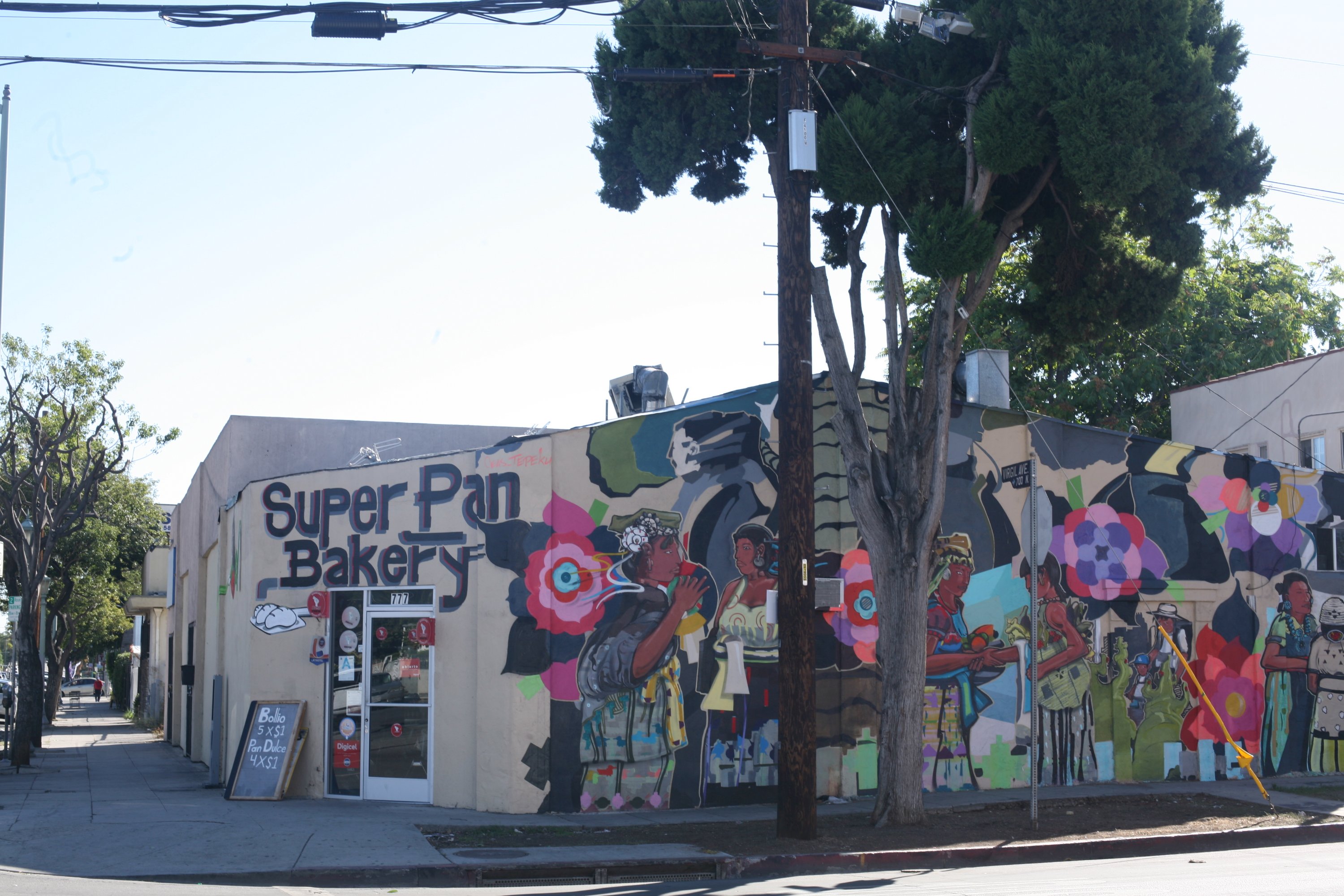
Matriarch at Super Pan Bakery on Virgil Avenue

The reduction of space for the traditions of indigenous women and children–and those of their descendants–whose footsteps have grazed and raised land here for generations, as our ancestors have done across the American continent for millennia, is a desecration.

To push them away from their home(s), and their businesses and livelihoods, is to push the land itself from its roots. To reduce them into objects is less than human; it is to reduce life itself. ‘Don’t forget: These are Tongva lands.’

Each figure in this mural is based on a real person, present and living among pueblos and reservations throughout Los Angeles, California, Sonsonate, El Salvador, Quetzaltenango, Guatemala, Oaxaca, Mexico, and more.

It is because of them that we’re here.

J.T.

La Gentrificación del Pueblo Continuará

Hasta que el pueblo se levanta y dice ya basta.

A walk through any neighborhood is the most effective way to take in a culture. This afternoon through my own, at the intersection of Madison and Willow Brook avenue, I took a moment to photograph the complex above, which is now in the process of redevelopment. Around the abandoned buildings, power lines idle next to nestles of leaves from tall trees branching out through air. East of the complex, a crosswalk away, is Lockwood Elementary school, where my old friends and I went to school, and where now even some of the children of those old friends go to school.

Today Lockwood Elementary is no longer just one school, but ‘two in one,’ as the site is now split between the traditional Los Angeles Unified School District program (LAUSD), and a charter school overseen by Citizens of the World – Silver Lake Charter (CWC), which serves ‘qualified’ students whose enrollment is based on a ‘lottery.’ But Lockwood Elementary is actually not located in the famed Silver Lake area; instead, it’s in what’s known officially, according to the L.A. City Clerk, as ‘East Hollywood.’

When my peers and I finished fifth grade at Lockwood, our next stop was Thomas Starr King Middle School (King MS). King MS was located East of Virgil avenue on Fountain avenue, and at just under a mile away from Lockwood, if one made the trek to King MS on foot from say, Madison and Willow Brook Avenues, they might reason that the school was actually better situated to serve students located in the wealthier Los Feliz area.

An urban planner might say this distance would be an easy fix, however; all the parents at Madison and Willow Brook Avenues had to do was drive their kids to King MS. Of course, that just meant the parents had to be able to afford a car, which wasn’t always the case for many of the single Latina mothers who oversaw many of my peers and I. In 2008, according to the L.A. Times, the median household income for families in East Hollywood was $29,927, while only 13.4% of adults in the neighborhood had a college degree.

Even so, at just under a mile of walking distance to the school, the daily trek couldn’t be that bad of a slog, right? Some mamas did it. Indeed, some had to. There wasn’t a whole lot of support for them otherwise.

When my peers and I finished at King MS, what followed was John Marshall High School (JMHS) for ninth through twelfth grade. At just about two miles walking distance from the old apartment complex at Madison and Willow Brook avenues, Marshall High School was unquestionably farther east of Virgil avenue. Unlike King MS, which an urban planner could argue was located between ‘East Hollywood’ and Los Feliz to serve both areas, Marshall High School was definitely located in the Los Feliz and Silver Lake areas.

As such, Marshall High School was definitely designed to serve the students of parents there. According to the L.A. Times, in Silver Lake, the median household income in 2008 was almost twice that of East Hollywood’s, at $54,339, with nearly three times the rate of adults in Silver Lake with a college degree at 36.2%. In neighboring Los Feliz, the median household income was $50,793. Los Feliz also had more than three times the rate of adults in East Hollywood with a college degree, at 42.7%.

Despite lacking much in terms of income versus these neighboring areas, and hailing straight out of our homes as “first generation” students, many of my peers and I made it in through the gates at Marshall, either by carpooling with one parent or another, or by taking the Metro 175 bus for those of us who could catch it early enough in the mornings.

Only 48% of the class that my peers and I entered into Marshall with in 2004 would walk out of the school with their diploma in 2008.


Was that paltry graduation rate planned? With ten years of hindsight from the day of graduation, it’s clear it certainly wasn’t planned against. From the time my peers and I were at Lockwood, all the way through our time at Marshall, there wasn’t exactly a cultural plan from the urban policy planners around us and the elected leadership at the time–Mayor Garcetti was the local Council Member for East Hollywood from 2001 – 2012–to get young people from our neighborhood successfully to college and back.

Should that have been the work of urban planners for the area in the first place? One may argue that it was not; yet it’s precisely that same lack of accountability which leads me to believe that in a significant way, the neighborhood surrounding the old complex at Madison and Willow Brook avenues, like many neighborhoods all across Los Angeles, was either supposed to get with the program, or just get lost. Parents in our vecindad were supposed to run with the market, or be Left Behind.

Similarly, today’s redevelopment of the old complex at Madison and Willow Brook avenues is a matter of getting with the program. Except that the program of the new complex at the intersection will be one of sleek buildings, the flaunt of which will be accentuated by bold fonts, and the grounds of which will be guarded by steep fences shrouding the complex in seclusion and high visibility at once, thereby earning its owners the right to ask for the unenviable rent prices it’s destined for; rent prices that virtually none of the trabajadores now reconstructing the complex day by day, nor any of their vecinos in the pueblo surrounding the complex, will be able afford for themselves and their children.

Asi es. Y asi sera, me dirian tantos compadres en los trabajos por ahi. Pero asi es hasta que nosotros decimos no mas, Los Angeles.

Despite the odds, there is reason to be only more optimistic about challenging this lack of accountability for L.A.’s neighborhoods, or this lack of protection for so many of the working families who make them. Everywhere in Los Angeles a resistance is growing to the “old” order of power, which has stifled pueblos like those of my peers and I, and our movements throughout The City, for decades.

I’ve got a feeling, then, that even at the intersection of Madison and Willow Brook avenues, a resistance to pricing out the pueblo and its children can grow here too. It may not do so overnight, nor even over the course of tomorrow. But it will rise and make its voice heard, one day at a time.

Asi es. Y asi sera, Los Angeles.

J.T.

From Los Angeles to Gaza, Resist

Today in Gaza the U.S. and Israeli governments stole the life out of yet another generation of Palestinians, adding to the banks of lives they’ve taken in their bid to control the fate of yet another terrain through sheer violence, one funded by billions of U.S. tax dollars in military aid to Israel each year, implicating every American alongside their government.

This, on the very anniversary of the forceful taking of Palestinian land for the formation of the Israeli state in 1948, or the same year in which racial covenants in the U.S.–which played a huge role in shaping the neighborhoods of Los Angeles now mired in gentrification–were outlawed by the Supreme Court in Shelley v. Kraemer. It’s anyone’s guess whether the irony was lost on the Supreme court then, but it’s certainly lost amid the nation’s highest office now.

No space on the planet forced into being for the sake of capital or the reign of bigotry, and at the expense of life, will ever be legitimate and actually free. Indeed, in stratified Los Angeles and throughout cities in the U.S. and all over the world, capitalism has been undergirded by the backs of millions of history’s ‘otherized’ people since time immemorial. But we do not forget.

We are the land, and from Los Angeles to Gaza we resist occupation by hostile states, their elitist benefactors, and those who would be their imitators. Our only demand is to be free. Until that day arrives, all of our bodies remain on the line.

J.T.

Deed Restrictions in Los Feliz and East Hollywood

T-RACES, or the Testbed for the Redlining Archives of California’s Exclusionary Spaces, is a powerful map and treasure cove of historical documents whose archives contain ‘area descriptions’ of L.A. neighborhoods as seen by former L.A. county and federal officials of the national Home Owners’ Loan Corporation (HOLC); basically, these officials distinguished which areas were “desirable” and which were “undesirable” for investment from private banks and government loans based on the areas’ racial makeup.

I’ve gathered a few of the area descriptions of the “Los Feliz” and “East Hollywood” neighborhoods, respectively, all of them dated from 1939. It’s fascinating to see the old vecindades distinguished by their racial and class makeup. For example, in the Los Feliz neighborhood, the absence of “foreign families” or “negros” based on the “deed restrictions” banning their presence, as well as single-family residential zoning, led to a “high green” or attractive rating for the HOLC:

“[In Los Feliz] …Deed restrictions cover both improvement costs and racial elements. Zoning is single-family residential. Conveniences are as available as is desirable in a multi-car garage neighborhood. This area was subdivided some 15 years ago, and was engineered and platted to contour resulting in well arranged and improved streets. Construction, maintenance and architectural designs are of the highest quality. Population is of a high character and many of the city’ s wealthiest citizens reside here. Values shown above are somewhat conjectural as size and location of homesite affects prices. This also applies to rentals as quality of tenant is a large consideration. With a convenient location, ideal building sites and high caliber deed restrictions, this area should continue indefinitely to attract a substantial type of resident. On the basis of present development and future prospects area is accorded a “high green ” grade.”

By contrast, in East Hollywood, to the Western Side of the area, because of the ‘concentration of Jewish families,’ along with 5 & 6 room dwellings, or apartment buildings with 5 to 6 units, a “medial yellow” or “only fairly” attractive grade was accorded.

“[In East Hollywood] …There are no deed restrictions and zoning, while mainly single-family, also permits all types of multi-family residential structures in different parts and is also “spot zoned” for business and provides for numerous institutional developments. Two of the largest hospitals in the city are located within the area. Conveniences are all readily available. This area was originally largely occupied by the old Sullivan Farm and was subdivided approximately 25 years ago. Divided by and surrounded with business thoroughfares this far-flung area contains a miscellaneous array of multi-family residential development; however, the pre-dominating type of residence is 5 & 6 room dwellings which are generally of standard construction and fairly well maintained. It is said to be one of the community’s best rental districts. Rumors of scattered Japanese and Negro residents were not confirmed as none were located except upon the business thoroughfares. There is a concentration of Jewish families between Melrose and Santa Monica Blvd. east of Western Avenue. The population in general is heterogeneous, as is also the aspects of the improvements. There is a fair percentage of owner occupancy and many homes are still occupied by original owners. There is a decided trend at present toward business and income properties; however, it is thought that the major part of the area will remain predominantly single-family for many years to come. The area is accorded a “medial yellow” grade.”

Such standards beg the question, just who was the HOLC describing these conditions to? That is, just who determined that ‘negros,’ ‘foreign’ and ‘Jewish’ people and their dwellings reduced the overall quality of life? In literature it’s called the white gaze, or the white imagination that dictates a certain narrative or reality as though it were a universal understanding, when in fact nothing could be further from the truth.

“Los Angeles and Vicinity – Residential Security Map”

With these frameworks in mind, I was excited to read about just how the vecindad my family and I would come to call home during the eighties when mom and pops arrived here fared ‘in the ratings.’

In the eyes of the HOLC, East Hollywood towards the East side was considered ‘blighted’ for 15% of its residency consisting of ‘foreign’ families, and for 10% of it consisting of ‘negros,’ as well as for the neighborhood’s multiple family dwellings and bungalows. This led to a “medial red” rating, meaning bank lenders were advised against issuing loans for homeowners or prospective homeowners here.

“[In East Hollywood] …The few deed restrictions which have not expired are irregular and largely non-effective. The major portion of area is zoned for single family dwellings, but multiple family dwellings are permitted in scattered sections. Conveniences are all readily available. This district was subdivided over 25 years ago as a popular price home district and has largely maintained the characteristics. Many of the improvements are of substandard construction and maintenance is spotted, being generally of a poor quality. Scattered throughout the area are a number of small “B” grade apartments, bungalow courts and other multi-family dwellings. The population is highly heterogeneous with more than a sprinkling of subversive racial elements, there being several concentrations of Japanese and Negroes within the district. There is also quite a Jewish population adjacent to the synagogue which is located in the northern part. While by no means a slum district, the area is definitely blighted and is accorded a “medial red” grade.”

On the one hand, it’s astounding to think that there used to be more Japanese and Black people in the neighborhood. But it’s also sobering to consider how World War II and the Japanese interment which followed violently displaced such communities from the area. When one considers these events and the subsequent or concurrent modernization that followed or accompanied the war, such as the building of L.A.’s first freeway in America in the Arroyo Seco Parkway in 1940, one can see how modern development has always been a matter of some violence on communities and restrictions of their space for the benefit of wealthier, more privileged groups.

It’s rarely ever easy to take another field trip through the historical foundations which led to our modern dilemmas with access to space in the inner city. But in order to know where we’re going, we have to know where we come from, Los Angeles.

J.T.