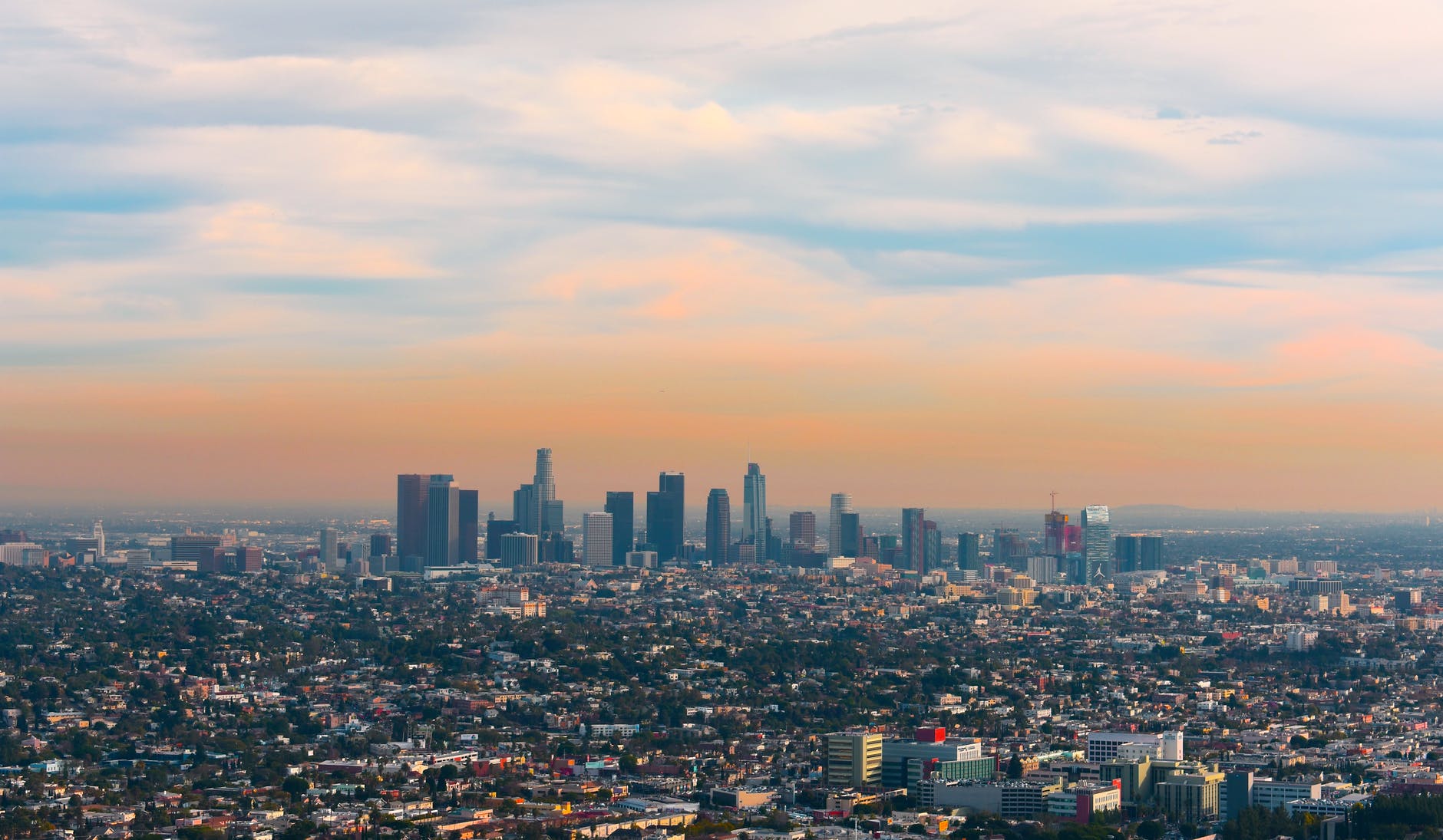
aerial view of city buildings

Dear Nury, let me tell you about this side of K-Town

This article was originally published on October 20th, 2022 for our Making a Neighborhood Newsletter. Please consider becoming a paid subscriber today to get more stories like it, plus work from our colleagues Samanta Helou Hernandez and Ali Rachel Pearl.

Diana Mabel Cruz and her mom in Koreatown, or Little Bangladesh, in 2018. Photo by JIMBO TIMES.

Because it bears repeating: Los Angeles was founded 241 years ago by red, Black, and brown hands, among others, or by a cast of characters who some might call “short, dark people.” You can head over to 8th street and Irolo in Koreatown for a blast from this past as a new wave of fervent colors do their part to feed, lift, and maintain the concrete jungle’s lifespan for another day, and soon enough, for 242 years.

Perpendicular to 8th and Irolo, or at a right angle at Wilshire Blvd and Catalina St., “K-Town” also holds the former grounds of the Ambassador Hotel, where Senator Robert F. Kennedy–the Democratic candidate for president in 1968–was shot and killed, taking with him some thirteen years of a dream for the Civil Rights era. The RFK Community Schools now on those grounds enroll over 4,000 students; aged five to eighteen within a nine block radius, these students hail from homes where they speak not only English and Spanish–the principal languages of the current Los Angeles–but also Arabic, Bengali, Burmese, Tagalog, Indonesian, Korean, Urdu, and Zapotec, among others! In 2021, RFK high schools graduated at least 89% of this dynamic student body. RFK would be proud.

Perpendicular line from G-Maps by J.T., who admittedly failed 8th grade Algebra and wasn’t quite Beethoven at Geometry in 9th grade, either.

Once upon a time, yours truly attended school in Ktown, too, making friends with youth from Black, Korean and Central-American localities for how they exuded the resiliency of The City in every step of their stride; and little did I know then that I was actually part of this chunk of The City representing no less than the future of Los Angeles and even the nation; but my ffriends and I did have some intuition of how the area harbored a past not yet past as people there persevered through a blockade on their representation at City Hall in effect for decades (Until 2022, the Koreatown neighborhood was divided to fall into three different City Council member offices, making it especially difficult for communities there to receive sufficient and coordinated resources from City Hall).

Tlacolulokos (Mexico, Dario Canul b. 1986 & Cosijoesa Cernas, b. 1992) – Smile now, Cry later, 2017.

But of course, I don’t have to tell you how Ktown isn’t an easy pie to slice given its geography as the “dead center” of Los Angeles, connecting places like East Hollywood to the Crenshaw Corridor, MacArthur Park and downtown, not to mention Mid-City, West Adams, and South Los Angeles. And in case you’ve never seen these connections via the Metro’s 204 and 754 bus lines starting at Vermont avenue and Santa Monica Blvd, you’re missing out big time.

Should you want to see about the very latest in Ktown times, though, I suggest you follow Mellyyt_, a Oaxacan-American’s “Wildest Dream” who documents family and young professional living for L.A.’s born and bred along the renowned Pico-Union area. Melly’s stories uplift her neighborhood’s artistry and street-smarts in no ambivalent terms; undoubtedly, she’s keenly aware that she and her community aren’t simply standing atop gold in real estate terms from Ktown to Pico-Union, but reflecting gold like the kaleidoscope of hands in motion at 8th street and Irolo.

The next time I pick up another cup of fresh tejate there, then, or some chicken mole at Pico Blvd and Van Ness, I’ll think of you, Nury; of how you flew too close to the sun for yourself but still cast a beam into our neighborhood for the whole world to see its radiance; of how your words, rather than dividing Los Angeles, a city most people first met through televised smoke and ashes for its halls of power, brought us closer together for another inflection point, one more firmly rooted than the last; of how thousands of young people in Ktown are ready in the wings to lead our city onto better days as soon as they get to fly, too, a showing like only L.A. can give. Tan bell@s.

J.T.

This article is also dedicated to Daniel Morales Leon, otherwise known as Chapulín, or GeeHop213, a major poet and ambassador for the Oaxacan-American community in L.A.. Daniel passed away unexpectedly this summer, but something tells this writer he’s now surely waging a rhyme attack for the soul of City Hall from the other side. Thank you, Daniel.

EPISODE 107 – HELEN H. KIM ON KOREATOWN AS OAXACAN-KOREAN + GIVING TUESDAY

Yours truly sits down with Helen H. Kim (@theotherhelenkim) to discuss our vision for K-Town Is OK and how donor support on #GivingTuesday can make all the difference. We reflect on Helen’s family life in Koreatown, going on to learn that her dad–like my mom–worked at a sowing factory in downtown Los Angeles during her youth. We also discuss the catalyst for our shirts: the racist L.A. City Council recordings published by the L.A. Times just this past October; other notes include the shirt’s design process, design accessibility for immigrant communities in L.A., local community shop Virgil/Normal’s support, and our privileged position to facilitate each of these processes. To donate to K-Town Is OK, please do so HERE. 100% of donations go towards commissioning more interviews for the project, a new website, and miscellaneous expenses like ink, paper, and other items in the effort to reach Los Angeles.

J.T.

Pandemic in Los Angeles: Day 05

Is it still safe for my mother to go out to open her newsstand? Should I continue to walk alongside her when I’m able to make it to her right as she closes shop? If I do, what are the odds of our walking home safely at this point? Is our community more at risk because of Coronavirus, or because of gun violence on our streets? These are questions I ask myself in the wake of another shooting in the neighborhood which has unnecessarily taken yet another life from our community.

Does poverty meet the definition of a disease? It’s certainly been passed down by many generations and is spreading throughout our country. In Los Angeles, this has become ever clearer with the rising number of tents erected by young, old, Black, White, Asian and more people locked out of housing in an increasingly wealth-driven city. But unlike encampments, shootings in our neighborhood take place more covertly. While they cost families and neighborhoods far more than makeshift tent cities, their scene is registered quickly before vanishing into our memory banks. But we do not forget these terrors once we’ve seen them up close. Death sprawled on the street casts a shadow nearly as long as the night.

A quick search through the L.A. Times HOMICIDE REPORT will show that the overwhelming majority of fatalities in Los Angeles are of Black and Latino males.

It will also show that in the last twelve months, 510 people in L.A. lost their lives due to armed violence, which is a preventable crime. The majority of these deaths don’t make the daily paper anymore, but Fernie’s shooting was the third fatality in less than six months within a 1.5 mile radius for my neighborhood, and the the sixth fatality in twelve months for the East Hollywood area overall.

Are we able to call an intervention with our L.A. city councilmember and other leaders on this situation over Zoom, or does that remain impractical? On the list of priorities for the city in lieu of COVID-19, just where does gun violence inflicted on our young men rank for our city? I know I’m not the only one asking these questions, but if COVID-19 has shown anything, it’s that a community’s net health is determined by every single person who comprises that community. Here is to lifting up once again our call for a better way.

J.T.

Temp

Madison Block Loses a Little Brother for the Ages, Fernie “Belok” Puga

(Pandemic in Los Angeles: Day 04)

It was hardly before 7 pm when my mom heard the shot on her way home from work. She described it as something like a loud thunderclap. She is now sixty years old. The harrowing clap terrified her and forced her to turn her cart back racing the opposite way. The path along the street is one I’ve walked with her over a thousand times throughout the 18+ years that her stand’s doors have opened for the world on Santa Monica boulevard. The newsstand is a fixture, like the sign that marks the name of the boulevard itself, or the lights that guide the road. But mom’s stand is also subject to a window of time. One day, time will close its doors on the stand’s wooden frames too. The stand will also leave its place as any fixture is destined to do.

When I think back to when I first met Fernando (or Fernie), I remember the hopefulness of his greeting. There was a way that he lifted his whole chin to salute you, accentuating his cheeks and arching his eyes back as he focused them on yours while letting out an unhesitating smirk. This let you know that he was completely in the space with you as a kindred spirit. Fernie’s ability to hear you out was just as affirming. There was a way that you could express yourself with him without fearing that he’d use it against you. In a crowd of many friends–mostly teenage boys–it was difficult to find that. But Fernie was consistent. He was never out to get anyone unnecessarily. He was a loyal little brother to a pack of young men without many fathers to count among the ranks. He was there for you in any case, and was also bold on his own, which he often had to be, without flinching.

Whether you knew it or not, if you frequented Cahuenga Public Library, you were literally his neighbor. Whether you knew it or not, Fernie wore all the goodness of his neighborhood proudly on his chin. His violent loss now marks the end of an era for the community. His pack of brothers are grieving for him, praying to escape from the nightmare of a thousand memories now flowing out in his name. I salute these brothers–and also every sister and mother and father who Fernie leaves behind–and uplift Fernando “Belok” Puga’s name. Whether it’s clear or not, Fernie now walks with each of us as a giant among the stars as we continue past the boulevard on our way to a home which is still our home. A home we have to continue to claim for a community to keep surviving.

J.T.