Threats from within the United States include alcoholism, fentanyl, and poverty wages, but not We the People

Today in Quantico, Virginia, Trump and Hegseth gave what will go down as the most treasonous speech since the South’s Declaration of secession in the 1860s, when South Carolina, Mississippi, Florida, Alabama, Georgia, Louisiana, and Texas declared the end of their allegiance to the United States of America.

There are already plenty of commentators noting just how traitorous their words were, but also for the record, I’d like to point out that Hegseth utterly misrepresented none other than Thomas Jefferson’s actual contribution to the Declaration of Independence.

On the subject of toxic leadership, which Hegseth either unironically fails or flatly refuses to grasp is actually epitomized by himself and every last member of this administration, he claimed that: “Real toxic leadership is promoting destructive ideologies that are an anathema to the Constitution and the laws of nature and nature’s God, as Thomas Jefferson wrote in the Declaration of Independence.”

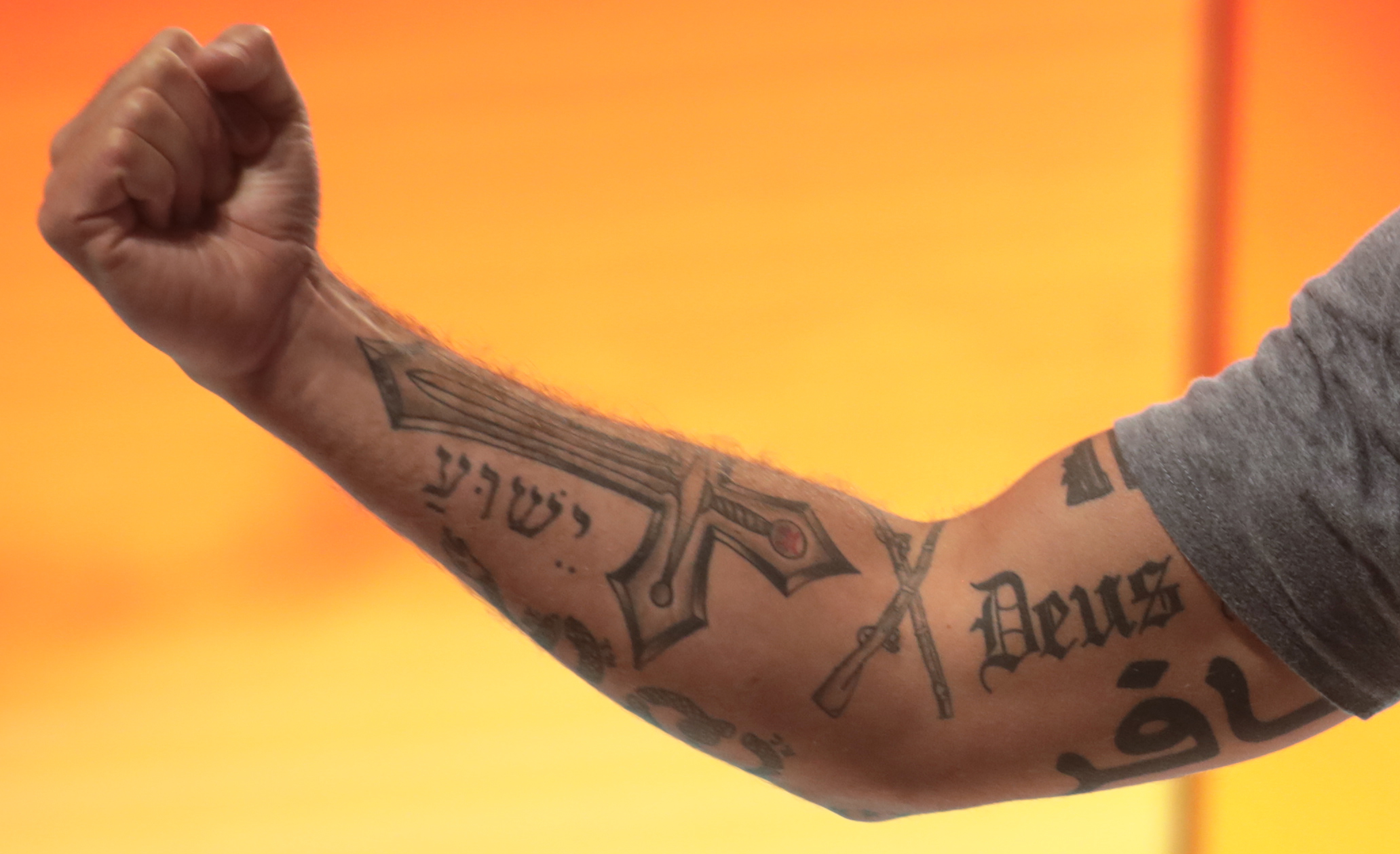
The trouble is that to Hegseth, who is a Neo Nazi, ”nature’s God” is actually code for white people’s Christian God. To be sure this isn’t conjecture, look no further than the tattoos inscribed on Hegseth, including his “Deus Vult” *tattoo,* which is Latin for “God wills it,” and which is said to have originated from the first Christian Crusades of the 11th century.

Pete Hegseth. Former Platoon Leader, Weekend Fox News Host, and now U.S. “Secretary of War.”

Hegseth, or whoever else wrote his speech, must have thought they were being very clever by invoking Thomas Jefferson, a dead white forefather, in their attempt to pretend like they were simply carrying out “his vision” in 2025. But Jefferson is actually not credited for authoring this portion of the Declaration, and rightly so, since he actually wasn’t even known to believe in the Christian god. In fact, perhaps the most diplomatic quote of Jefferson’s on the whole idea of it goes as follows:

“Our particular principles of religion are a subject of accountability to our god alone. I enquire after no man’s and trouble none with mine; nor is it given to us in this life to know whether yours or mine, our friend’s or our foe’s, are exactly the right.”


But if you believe, as I do, that Jefferson was a simple statesman for the press when it was time, but far more complicated in his thought processes during his privacy, then the following quote from the Jefferson Monticello archives feels like a more accurate summation of his thoughts on Hegseth’s apparent religiosity:

“The Christian god can easily be pictured as virtually the same god as the many ancient gods of past civilizations. The Christian god is a three headed monster; cruel, vengeful and capricious. If one wishes to know more of this raging, three headed beast-like god, one only needs to look at the caliber of people who say they serve him. They are always of two classes: fools and hypocrites.”


In other words, it should be clear to any modern reader that Jefferson at the very least appreciated how much religious wars wreaked havoc on the world in centuries past, which is why he and the founding fathers enshrined the U.S. as a secular state through the 1st Amendment (1791). Thus, there should be no doubt that Hegseth’s conflagration of Jefferson and god in the Declaration of Independence is the very type of foolishness and hypocrisy Jefferson abhorred.

Nonetheless, Hegseth, like Stephen Miller, is ahistorical and has no interest in freedom of thought or religion, but seeks the very opposite of these things. Their sermonizing in Quantico today was a thinly veiled attempt to have the military fall in line for the latter’s vision of a white Christian ethnostate, which it should go without saying is the very anathema to the Constitution the “Secretary of War” was originally and actually supposed to stand against.

The gloves are officially off, then, but to be forewarned is to be prepared.

Let the city, each state, and every last one of the American people know.

J.T.

*This photo showing a partial view of Pete Hegseth’s right forearm, which includes the “Deus Vult” phrase, was taken by Gage Skidmore at an event by Turning Point USA in 2021.*

Pandemic in Los Angeles: Day 11

Although I’ve been able to adapt well to the lengthy silences of so many days in isolation, I understand the same is not true for many others out there. I realized this earlier when on stepping outside for a jog, my first in the two weeks since the shutdown began, I suddenly came across a familiar yet only recently estranged sight a stone’s throw down the street: it was my neighbors. Not the neighbors from next door, but the neighbors from across the vecindad.

I saw the tios, the borrachitos, and the quiet loners who–shutdown aside–have clearly still simply kept lugging their bodies and belongings past the concrete to progress through the days given them.

There must have been nearly 15 of these vecinos, together forming a cluster of shoulders, voices and laughter that only gleamed more brilliantly due to the sunshine of a fresh Spring afternoon in Los Angeles–something that’s been deeply missed after a long winter.

For a moment, I wondered, was I–and all of those like me who’ve spent the last few weeks faithfully following the updates and abiding by their requests to keep hunkering in–was I the one playing the part of the sudden stranger, or was it these compadres? If by chance another stranger–say, America’s esteemed Thomas Jefferson–was also a neighbor, or at least somehow nearby, and I asked him about the meaning behind this haphazard gathering in our community, might Tomas say the men were simply enjoying life, liberty, and the pursuit of happiness?

If so I’d be compelled to inform Tomas that during the present moment of COVID-19, life, liberty and the pursuit of happiness are not only not good enough, but quite careless and possibly catastrophic for the general welfare of the society. To his question of why, I’d say because the current big idea is the sense of all of us taking care of each other, not just ourselves.

I’d then point out to Señor Jefferson the conundrum of my situation: that it probably wasn’t fair for me to assume that these compadres got the memo to stay at home just like everyone else. To his question of why, I’d apply the following deductive reasoning:

Exactly when were these men supposed to get the memo? If they were supposed to learn about the orders via the TV, what if a few of them didn’t own a television? And if they were supposed to learn about the orders through their cell phones, what about the few who owned none? And if the men were supposed to learn about it at home or through a family member somehow, what should we expect of the men who owned neither a television, nor cellphone, nor even a rental to call home, and who could claim no kin within range?

I’d then present my central argument regarding these compadres: that while it’s tempting to look at these times as being especially critical for us to exercise thoughtfulness and compassion towards such vecinos by asking ourselves the aforementioned types of questions in the interest concerning the well-being of the whole society, the fact of the matter is that this has always been the case, and that it’s in no small part the refusal of many government policies over many decades following Lincoln’s Proclamation to successfully “bring in to the welfare of the society” such compadres which led to my predicament over what to make of their gathering.

Because even then, I’d emphasize to Tomas, it’s not just the compadres who are still out there, but it’s also Black neighbors in South Central Los Angeles, Immigrants of other tongues across downtown L.A., teenagers on many sides only two steps removed from being placed into the Department of Children and Family Services, veterans, and a myriad of other people our government chose not to “bring into the welfare” of the society long ago.

Perhaps many in these groups have heard of the orders just like everyone else–because they’re certainly capable of being as educated as anyone else on the matter–and are even openly defying the orders to stay home and keep their distance because in their minds they go too far. But even if that were the case, is it fair to expect that these groups, which are really sub-groups, whom in large part have always lived on the margins of our society, is it fair to expect them to suddenly heed the orders of a government which has never concerned itself with their inclusion?

I believe not exactly. Because I’ve learned that governments and societies don’t simply get to “leave the past” in the wake of a new day–coronavirus notwithstanding–which in this case is a past made up of our constantly turning our backs to comprehensive immigration reform, to affordable housing for those who need it most, to livable wages, and more. Now, if some of the people most affected by these absent policies choose to turn their backs on us, it’s important to be mindful of maybe just why.

To the question of what then, then, I’d say, first let’s get this information to the people and then hear what they have to say. I’d then get to my jog around las cuadras, as I did earlier today, and let the rest of the pieces fall where they may, as I also did on returning to the block.

Imagination can run past me sometimes, but I believe this: change is a step by step process. But before we can change anything, we have to account for just what it is we want to change.

So now the question for Los Angeles, is simply what it’s going to be. In my humble opinion, I’d say it’s time to complete Lincoln’s emancipation with amelioration.

J.T.