
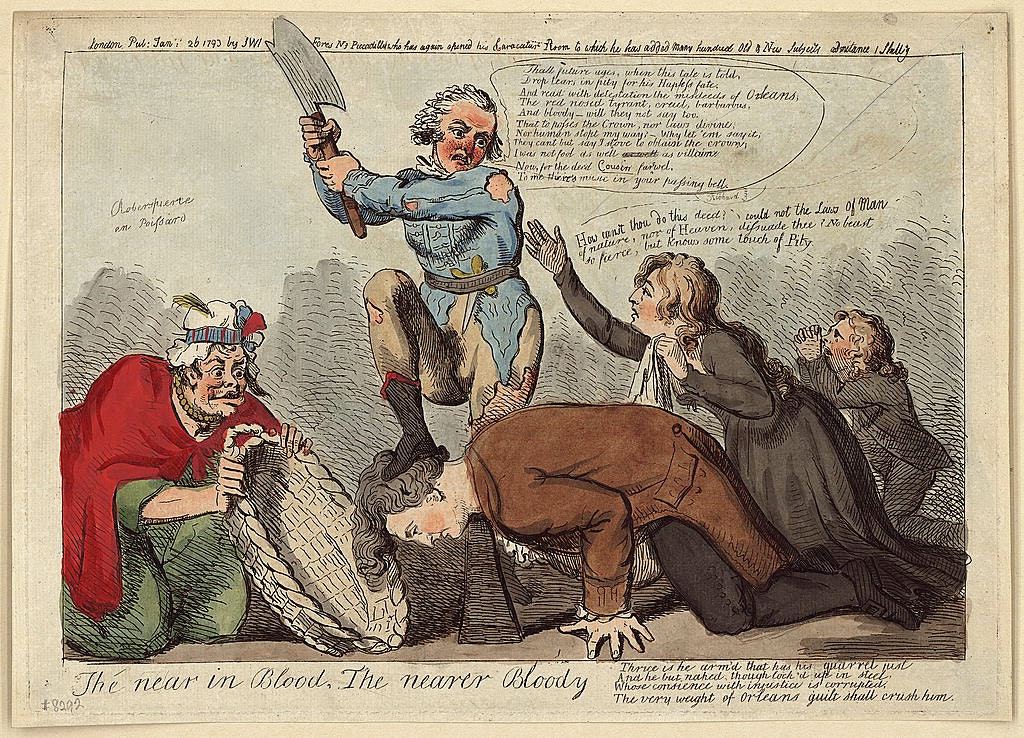
231 years ago, El Pueblo de Los Angeles was just 12 years old, while 5,600 miles away in France, the trial of Louis XVI began. 37 days later, he was found guilty of treason by the national convention and sentenced to death. On January 21st, 1793, at La Place de la Révolution in Paris, the former “Sun King” was beheaded before an estimated crowd of 100,000 people. In October of the same year, his widowed wife Marie-Antoinette was herself convicted of treason, conspiracy against the state, and stealing from the treasury. She was also subsequently beheaded.
These events shook the global order to its core, since before France’s “Declaration of the Rights of Man” in 1789, most people considered monarchs like Louis XVI answerable only to God. As such, the swift execution of him and his wife ended at least 1,000 years of monarchical rule in France and paved the way for the first French Republic, as well as the Napoleonic wars that reshaped the balance of power, including for the newly-minted United States.
Speaking of republics, in 1793, the American republic was made up of only 15 states. California was not among them, belonging instead to a consortium of territories then known as New Spain.

A census from 1790 also notes that 13 of the 15 U.S. states counted slaves among their population, with Maryland, North and South Carolina holding more than 100,000 slaves each, while Virginia–where the first slave ships first docked in 1619–held nearly 300,000 enslaved people. (An additional map below also shows the order in which the states ratified the U.S. Constitution. You’re welcome.)

A year after the 1790 census was recorded, a massive slave revolt began in Saint-Domingue, which formed the eastern side of “Hispaniola,” or the first island permanently settled in 1493 after Columbus’ arrival to the “New World.” In 1665, French and Spanish companies divided the island in two, with Saint-Domingue to the west (red) and Santo Domingo to the east (yellow). From then until the revolt, the French plantation system had forced an estimated 800,000 enslaved Africans to work sugar and coffee fields there, where conditions were so brutal that the average life expectancy for a slave was just 21 years old.

By 1801, Toussaint L’Ouverture, a former slave himself who turned out to be a military genius, successfully kicked French rule out of his homeland, made himself governor, and abolished slavery under a new constitution he drafted. The revolt would ultimately take 12 years to complete and would be the only successful one of its kind in the Americas. But it was not the first. Historians today trace the first recorded slave rebellion in Saint-Domingue back to Christmas Day of 1521, when African and Taíno peoples united trying to free themselves from a plantation on the island owned by Christopher Columbus’ own son.

Those 12 years were extremely bloody, however. More than 350,000 Black people were killed to that of 75,000 French whites in the effort for independence from the latter’s inhuman plantation economy. And his new constitution notwithstanding, Toussaint L’Ouverture would experience a “freed” nation of his homeland for just over a year. In the summer of 1802, he was captured by French forces and subsequently imprisoned. But his contributions to the freedom of his people and all “colonized subjects” by that point were priceless. As Toussaint was taken into custody, he is famously said to have told his captors:
“By overthrowing me, you have only defeated the trunk of the tree of freedom; it will grow back because its roots are deep, numerous, and vivacious.”

The governor was right! On January 1st, 1804, this “original” colony in the Americas exploited by European conquest became just the second independent nation in the western hemisphere after the United States, declaring itself as Haiti, with respect to the indigenous Taíno-Arawak name for the entire island of Hispaniola.
Meanwhile, by that point, back in the west coast El Pueblo de Los Angeles was still a small assortment of cattle ranches and Missions, faintly 22 years old and still only a pin in the coat of New Spain. But that wouldn’t last for much longer, either. On September 16th, 1810, a Catholic priest named Miguel Hidalgo issued his Grito de Dolores, calling for an end to 300 years of Spanish rule in the Americas, the end of the caste system or casta, and a redistribution of land, which itself sparked an 11-year war culminating with the independent nation of México.
But that’s another cuento for another day. Subscribe for more soon.
J.T.