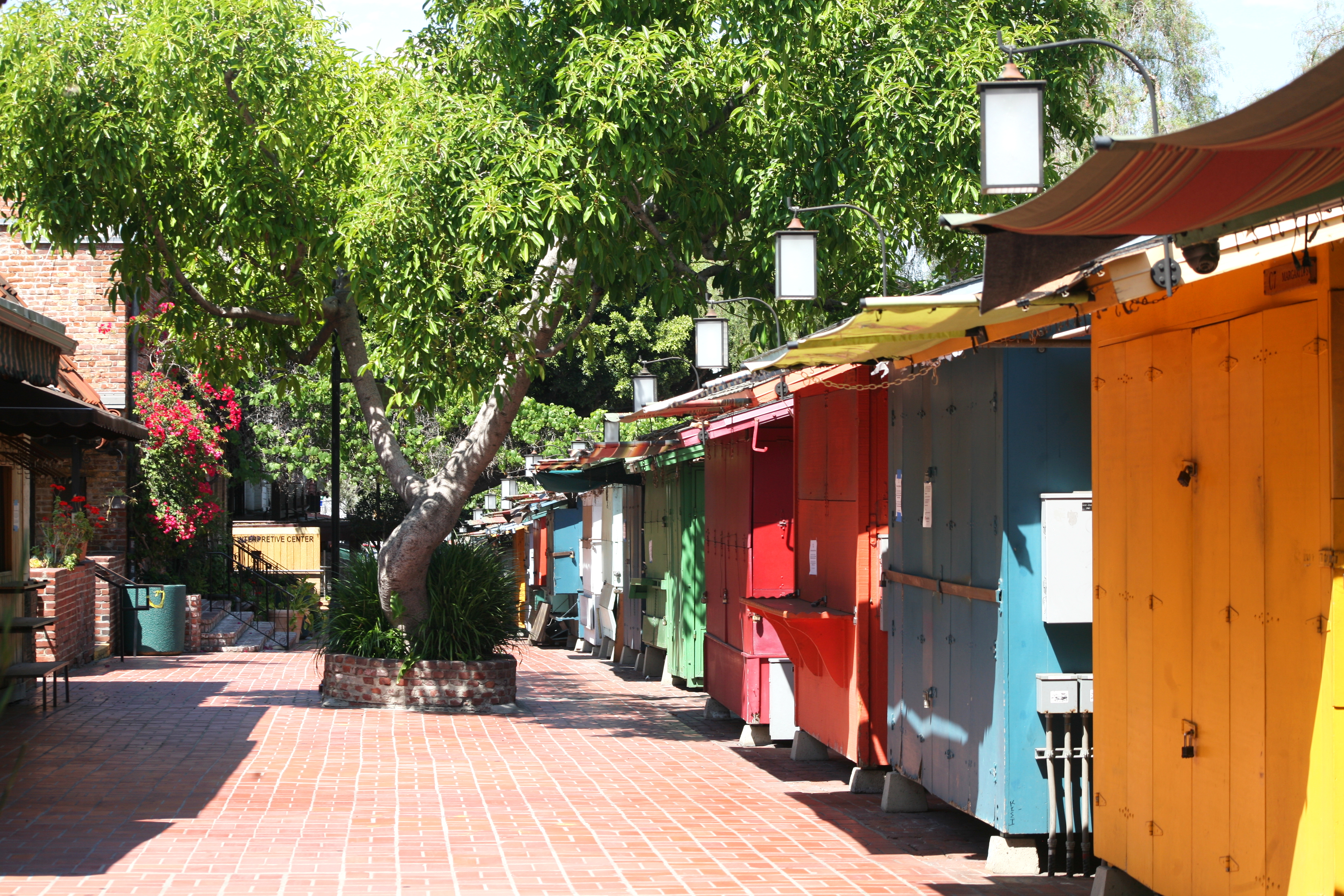
Plazita Olvera near Union Station in downtown Los Angeles

The Time Has Now Come to Remake Los Angeles, While Still Remembering its Roots

(Pandemic in Los Angeles: Day 79)

A brief glance at the history of the world and civilizations shows that every world and civilization has its time, until each gives way to another.

Indeed, long before the infamous racism of the United States our nation must come to terms with today, there were whole other people and places here. At a certain point, even a historian can forget the basic fact of it.

I can still remember yearning to learn about the history of the American continent before it became ‘America’ out of a simple yearning to imagine what it might have been like. Now that this week has passed, I believe I may finally have a sense of what it felt like too. That is, as it changed.

Make no mistake about it: in the days going forward, I am only more prepared to defend Los Angeles from any individual or group seeking strictly to exploit it, or to keep it benefiting a few at the expense of far more.

But I can also see that Los Angeles, like all of our country, is changing, as the world has changed many times, simply because that’s how the world we arrived at today came to be. Many generations and voices have fought for precisely this type of change, while many other generations and voices have consistently resisted it. But eventually, enough pressure accumulates against all things, until before we know it: one world and civilization give way to another.

A case in point: the picture for this column is from a recent visit to Olvera Street, a place which is more popularly known as “the oldest” street in Los Angeles since the city’s founding–though not its settlement–in 1781 under Spanish rule. On a “regular day,” the street would be filled with music in the air while shops displayed goods and treats for the world to see, and as crowds of shop-goers bustled past one another from shop to shop.

By contrast, on this most recent visit, nearly every shop was closed due to the impact and restrictions from COVID-19 over the last three months. There was no music in the air, and walking through, I pictured all of the people who would be there as if they were ghosts, or figures whose imprints were still there even if they were removed; the original settlers of Los Angeles were the Gabrielino/Tongva nation, of whom there are still living descendants in Los Angeles today.

But even without the familiar crowd of bodies along the corridor, and despite the closing of nearly all of the shops, at the end of the street I was pleased to find that Cielito Lindo was still open.

While it might not be the oldest restaurant in Los Angeles, at 86 years, it’s still far older than most of L.A.’s restaurants today. I ordered a familiar beans and cheese burrito, and even sat down to enjoy it despite the unfamiliar space of a six feet distance between a few others and their lunch.

It was still Los Angeles, just as it was still Gabrielino/Tongva land. But it was ready for a change.

J.T.

To subscribe to jimbotimes.com, add yourself to the list HERE.

Meet these L.A. Stalwarts at our Back to School Party this August 25th,

Together anything is possible. Every bit of support counts!

J.T.

Preserving Los Angeles Is Critical to Our History

IMG_2075
L.A. Times Building; J.T., 2015

This past June all L.A. Times staff and personnel moved from the historic L.A. Times building in downtown Los Angeles to a new headquarters in El Segundo after the Times’s lease expired with the building’s owners at the end of the month. The building was sold by Tribune Media, the former owners of the L.A. Times, to the Canadian real estate Onni Group in 2016.

Now The L.A. Times building as it stands on 1st and Spring street is slated for a seismic redevelopment if the Onni group has its way, as the firm looks to convert the 1973 Pereira installment of the building into a high-rise residential and retail space.

Preservationists have called on the L.A. City Council to grant a landmark status to the structure, the cornerstones of which were erected in 1937, but even if approved, the specter of demolition of at least some of the structure will still loom large. The city council can ‘encourage’ or incentivize the Onni group about how to move forward with its redevelopment plans, but the firm is not known for its preservation records. What a show of the power of ownership in the face of the public interest.

When I visited Chicago in the summer of 2016 it was an eerie sight to observe an absolutely empty Tribune building in the middle of the city’s highly developed downtown area. Now, as our very own media company here on the West coast meets the same fate, the swiftness with which modernization undermines the foundations of our institutions dawns once again. And yet, Los Angeles does not have to go the way of Chicago. If the city’s leadership can consider the long-term benefits of preserving this piece of our local history, future generations just may get to experience the magnitude of the structure for themselves.

Indeed, when much of the leadership in California likes to tout the state as a beacon of forward-mindedness, the act of preserving our history should be a no-brainer. And if L.A. Times reporting and storytelling has shown me anything over the years, it’s that someone is always paying attention to the movements swirling through our society, and that the more we can place the parcels such movements leave behind into perspective, the more fully we can grasp just where we come from and thus know ourselves better.

Moreover, this same forward-mindedness, or respect for both present and future, is what many of the movements against gentrification in cities like Los Angeles are also centered around: to resist displacement for the sake of chic new markets is not just to be facetious, it is to herald what is already here, what is already provided by what’s (t)here, and what might still be borne from its preservation when measured not by market values, but human values.

J.T.

California Primary Elections: June 2018 Recap

According to the Washington Post, just over 6.9 million people in California cast a vote for the state’s June 2018 Primaries–the largest recorded in the state’s history for a primary election–out of a total of over 19 million registered voters, to make for a 36% ‘return’ rate.

However, when considering the total number of all potential voters in the State’s Registrar, listed by Secretary of State Alex Padilla’s records as being at 25 million eligible voters, the turnout rate becomes 27%, or just over a fourth of the possible turnout.

To make things more interesting, when considering the total population of California, the most recent census records show that the Golden State is comprised of over 39.5 million people. To be sure, the census also counts people who are imprisoned, undocumented immigrants, and other non-voting citizens such as youth under eighteen years old. Nevertheless, if the total population is considered, it makes the Primary’s ‘turnout’ rate even smaller, at 17% of all the citizenry in the state, or less than a fifth of the ‘democratic’ or participating possibilities.

In contest for June 2018’s primary elections was the state’s Governorship, a seat for one U.S. Senator’s position, various seats for the U.S. House of Representatives, local courtroom positions, measures or ordinances varying from county to county, and more, like the recall of Judge Aaron Persky in Santa Clara County, for one.

Now, a quick glance at which groups comprise the California population:

From the U.S. Census Bureau’s ‘Quick Facts’ online:

At 15.4 million, Latinos account for 39% of California’s population.

At 14.6 million, Whites hold 38.8% of California’s population.

At 5.9 million, Asian-Americans maintain 15% of California’s population.

And at 2.5 million, African-Americans constitute 6.5% of California’s population.

At 633,000, Native Americans compose 1.6% of California’s population. And at 198,000, Native Hawaiian and Other Pacific Islanders form 0.5% of California’s population.

My favorite data for this election, however, is Political Data, Inc’s Absentee Vote Tracker (AVT), which tracked the early return of ballots on both the day before the Primary election as well as the day of, tracking up to 2.8 million returns of the 6.9 returns overall.

We’ll take a look at some of the numbers, particularly the following about which groups were mailed a ballot for the primaries, and which groups actually submitted those ballots.

According to the AVT, the day before and the day of the election, the percentage of ballots held by the states voter’s along ethnic lines were:

Latinos: 2.2 million (25% of the total)
Asian-Americans: 1.05 million (12% of the total)
African-Americans: 312,000 (4% of the total)
Whites: 5.2 million (59% of the total)

What the numbers suggest is reason for pause: similarly to L.A. County’s Special and Municipal Elections, voting at the State level is still a matter of disparity between the White and Non-White populations who make up California.

Remember our Census data: at 15.4 million of the overall population in California, Latinos outnumber Whites, even if by only less than a percentage point. When it comes to ballots held between Latinos and Whites before election day, however, there are more than two White voters for every Latino voter, and nearly five times as many White voters for every Asian-American voter.

On the day of the Primary election, the numbers are more startling.

Latino returns: 367,000 (13% of the total)
Asian-American returns: 295,000 (11% of the total)
African-American returns: 75,000 (3% of the total)
White returns: 2.04 million (76% of the total)

Of course, one should also note that these numbers are from just the day before as well as the day of the vote, which makes them slightly incomplete for ballots that take a few more days to get in. But in midterm elections like these, which are usually less popular and thus more predictable, early returns are indicators of a normal distribution more often than not. In other words, after counting the total overall, the 76% rate of Whites who voted in this last election is probably off by only a few percentage points in one direction or the other.

The implications are that the current disparities throughout California between white voter rates and those of people of color when considering the larger voter eligibility pool of the latter is not just unfortunate, but something of a public safety concern. If recent trends in U.S. politics show us anything, it’s that very few groups feel adequately represented by the country’s current institutional makeup. Just as relevant: although many California officials certainly like to claim they welcome immigration and the diversity of the land, when it comes to the distribution of power between its various groups, California’s white population is as much in control of the state as whites are in places like Tennessee or Arkansas, where residents voted overwhelmingly for the current administration.

It was in 2014 that the PEW Research center identified Latinos as the largest ethnic group in California, which is considered a preview for the overall direction of the U.S.’s ‘majority-minority‘ poised to arrive in the next twenty-five years or so. But if the current trends in California’s voting disparity between whites and non-whites here continues, one can only reasonably calculate for an even more radical disparity at the national level in terms of power and policy between the groups than what we’re seeing today.

J.T.

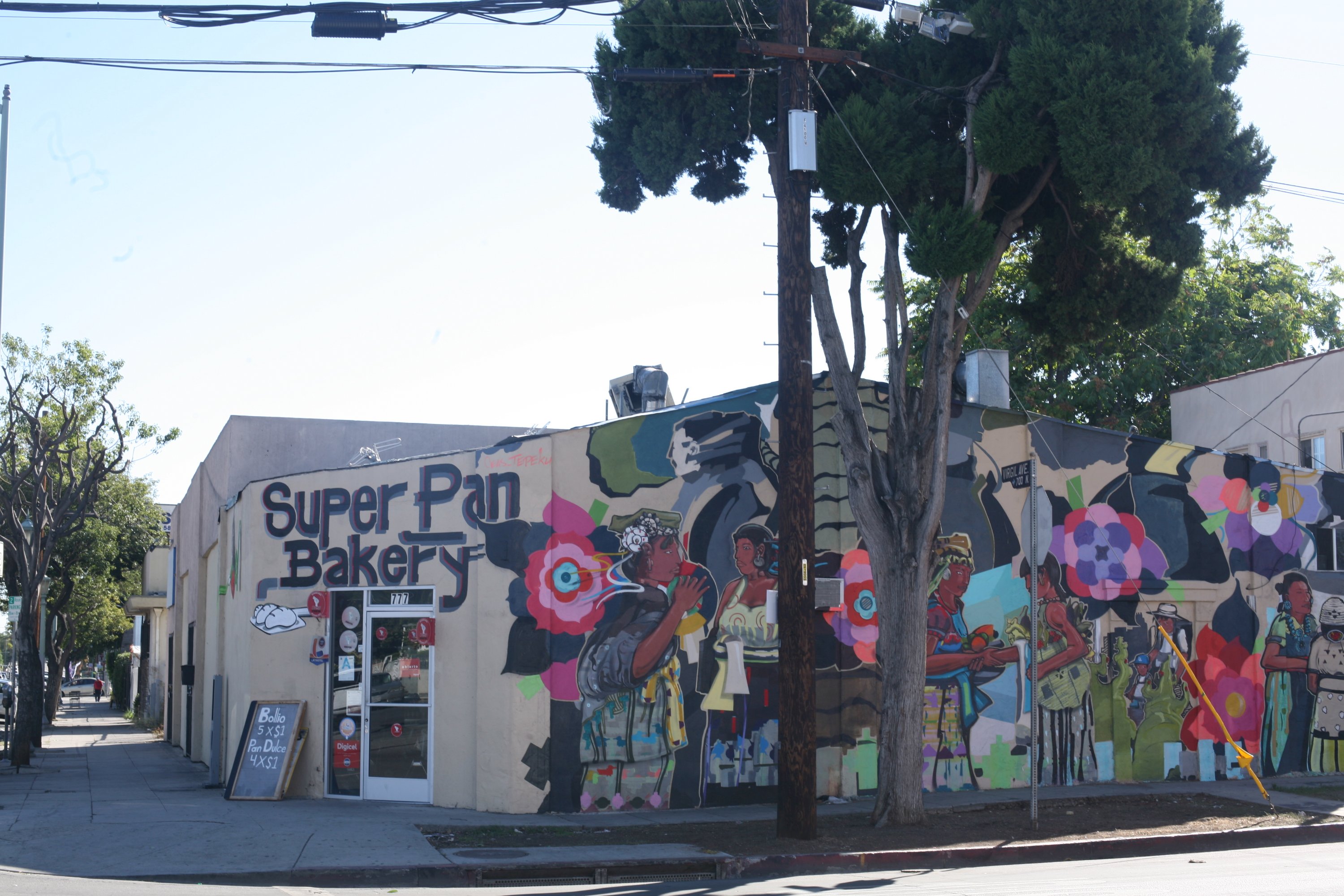
Matriarch at Super Pan Bakery on Virgil Avenue

The reduction of space for the traditions of indigenous women and children–and those of their descendants–whose footsteps have grazed and raised land here for generations, as our ancestors have done across the American continent for millennia, is a desecration.

To push them away from their home(s), and their businesses and livelihoods, is to push the land itself from its roots. To reduce them into objects is less than human; it is to reduce life itself. ‘Don’t forget: These are Tongva lands.’

Each figure in this mural is based on a real person, present and living among pueblos and reservations throughout Los Angeles, California, Sonsonate, El Salvador, Quetzaltenango, Guatemala, Oaxaca, Mexico, and more.

It is because of them that we’re here.

J.T.