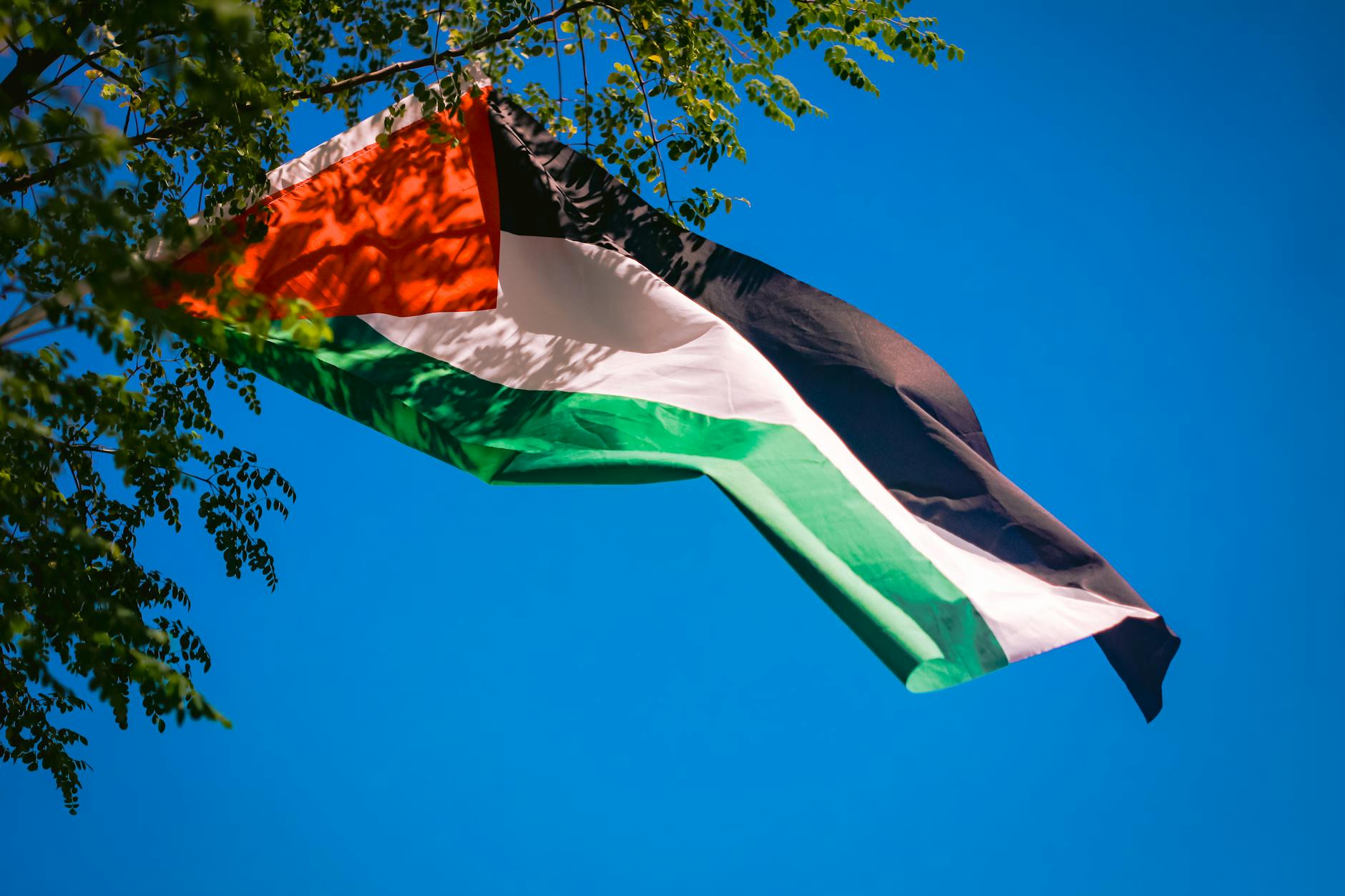
palestine flags waving behind tree

KEEPING OUR EYES ON GAZA

In the midst of everything else going in the world, yes, it takes work to remain engaged.

Yes, it’s not fair to you.

Nonetheless, yes, simply remembering is still one of the most important acts we can take part in as citizens of the world.

Earlier this week I was fortunate enough to be connected to Shmily Shatha, an artist from none other than Gaza whose life has been upended going on nearly two years now, yet who still finds a way to express hope through her artwork. Along with her friends in Los Angeles, Shmily is selling her original illustrations, one sticker and tee shirt at a time. To learn more about her and how you can support, please find her heartfelt message below.

A map of historic Palestine overseen by a white dove. Shmily Shatha, November 2024.


J.T.

landscape people flag signal

Over 65% of Americans Support a Cease-Fire in Gaza Now, per U.S. Representative Rashida Tlaib

Today in the U.S. Capitol Michigan Democratic Representative Rashida Tlaib, the sole Palestinian-American member of Congress, held a news conference alongside Rabbis for Peace and several colleagues calling for an immediate ceasefire in Gaza.

J.T.

California Sold Bonds to Pay for Indian Genocide Orchestrated by White Militias

Referring to wholesale massacres of California Indian tribes by self-organized white militias as “expeditions,” early California’s legislature figured that the U.S. federal government would eventually pay for rifles, food, wages and other expenses for the men of these deadly campaigns, going as far as to print bonds with George Washington’s portrait on them before officials in Washington D.C. even approved of the operations. Their assumption ultimately proved to be correct.

According to Indian-American historian and UCLA professor Benjamin Madley’s American Genocide: “On May 3, 1852–less than fifteen months after raising $500,000 for ranger militia expeditions against Indians–legislators passed a new $600,000 bond ‘for the payment of the expenses of the Mariposa, Second El Dorado, Utah, Los Angeles, Clear Lake, Klamath, and Trinity, and Monterey Expeditions against the Indians.‘” Madley adds: “The bond issue lured many Californians into financially supporting the [state] killing machine.”

Los Angeles itself was founded on the land of native Californians in 1781 by people who themselves were also “throwaways” for the Spanish crown. Yet before “La Reina del Pueblo de Los Angeles…” was born, there was the San Gabriel Valley mission, established in 1769, where the Tongva (or Kizh) woman Toypurina’s people were held captive. European-Spanish law ruled over this proto-version of L.A. for at least 50 years, after which Mexican and Latin American Independence in 1821 wrested power away. The new Mexican government was supposed to change the mission system which held hostage many native people, but not so unlike today, change took time. Then, it actually wasn’t change anymore.

As UC Merced professor Adam Torres-Rouff tells it in Before L.A.: “After a decade of debate, the territorial authorities, together with the Mexican government, ultimately closed the missions and secularized mission lands, between 1834 and 1836…Once approved, however, California officials failed to implement secularization as designed. Rather than equitably dividing mission property among the former neophytes, they engineered a bonanza for select Mexican Californians.”

This result was not good for native folks in the state, including in the Southern California area. Torres-Rouff points out that: “Rather than a liberal redistribution, secularization effectively dispossessed Indians from their ancestral and mission lands, and tens of thousands left California’s coastal areas for the less populated interior.” Moreover, these laws would not last more than a decade due to the U.S. invasion of Mexico, and in California, a revolt that was actually in violation of the U.S.’s 1794 Neutrality Act.

The select Mexican-Californians were Californios, or elite families in Mexico mostly of old-world Spanish heritage. But rather than ruling over California, these families mostly kept to themselves and their ranches, which led to a rather weak system of government. The 2,000+ miles between say, the city of Monterey in Northern California and Mexico City didn’t help either. Ambitious tradesmen and political forces to the east took note of this, and eventually became a crucial part in taking “Manifest Destiny” all the way to the west coast under President Polk.

On the morning of June 14 1846, a band of white U.S. settlers in the Northern California town of Sonoma were spurred by rumors of Mexican officials expelling them before Polk’s declaration of war on Mexico. They seized and trapped key Mexican generals, including General Mariano Vallejo, his brother Salvador Vallejo, and other officers.

According to Joseph Warren Revere’s A Tour of Duty in California (1849): “The next day a proclamation was issued by the patriots at Sonoma, setting forth their grievances, assuring the peaceable inhabitants of protection, and declaring their intention to establish a republican government, independent of Mexico, or perish in the attempt. A flag was also hoisted bearing a Grizzly Bear rampant, with one stripe below, and the words ‘Republic of California’ above the bear, and a single star in the Union.”

A photo of the original California state flag of American making; Photo-image from the Museum of the City of San Francisco.

California was officially inducted into U.S. jurisdiction on September 9th, 1850, but even before then, a cast of delegates for the state had already ensured that violence against natives would be fair game. Nothing speaks to this more clearly than the California Act for the Governance and Protection of Indians (1850), which was one of the first laws passed by the state’s first legislature, modeled after those from earlier colonies turned U.S. territories. An American Genocide describes how: “In December 1849, a number of delegates met in Monterey, California to debate about whether or not California Indians should be granted citizenship and/or suffrage. Most of the delegates were against suffrage…” As a result, on April 21st, 1850 the official dehumanization of others–most of all, Native Californians–was written into state law by Governor Burnett; this report prepared by the California Research Bureau (CRB) for the California State Library details more of the specifics of just what the legislation approved:

Page 6 of Early California Laws and Policies Related to Indians (2002), by the CRB.

These U.S. laws (or policies)–like the Mexican laws (or policies prior to them)–had irreversible effects on the lives of the original stewards of the lands from San Francisco through Southern California, whose cultures existed here thousands of years prior to European, Mexican, and American conquests. As a result, Madley notes that: “…between 1850 and 1873 California state judges found whites guilty of very few crimes against California Indians and sentenced only a handful of whites for such crimes.”

An L.A. Times article by Bill Boyarski in 1970 also noted the change in attitude and policy in California’s shift from Mexican to U.S. law: “In the city’s earliest years, when Spaniards and Mexicans ran things, California society was open. Blacks, descendants of Spanish slaves, helped found Los Angeles. Indians were subjected to the strict, paternalistic control of the Franciscan fathers. But at least the priests never engaged in the Indian slaughter favored by Americans who came West during the Gold Rush.”

That Gold Rush, which earned California its moniker as “The Golden State,” can and should be understood as a primary catalyst for the bloodbaths that would follow in the decades after 1846. In Los Angeles alone, Madley recounts that: “…between 1850 and 1870, Los Angeles’s Indian population fell from 3,963 to 219…”

This document from the California Tribal Court-State Court Forum likewise notes that “Before the missionary, fur trapping, and gold rush era migrations, California’s Native American population was estimated at about 200,000…Between 1840 and 1870, [the California Native] population declined to 12,000 due to disease, removal, and death.”

To a great extent these histories are rather esoteric to most of us, given that traditional education in the U.S. has buried them for centuries. As Californians, we’re also not frequently known for expertise in our own state’s history. But the state, as the keeper of laws–including officialized or sanctioned violence–has to be held more accountable. Our media coverage, or any official retelling of these facts, also plays an important role in our understanding–or lack thereof–when it comes to the places we come from, how they’ve been made, and how they might be remade.

J.T.

American

American Removal begins with a language.

It starts with Indians as “uncivilized” “savages.”

It expands with Black bodies deemed as “niggers” and “3/5ths.”

It proliferates with “providence” but only for Aryan destiny, “by the millions.”

American Removal embraces its robes with an “Indian Removal Act,”

Followed by a war on “Dirty Mexicans,”

Followed by a “Chinese Exclusion Act,”

Followed by Filipinos as “niggers.”

Then with “Japs Keep Moving.”

American Removal tests its first PSAs with “public enemies,” “hobos, tramps, and vagrants,” but ultimately settles for Black & Brown youth in inner cities as “gangs.”

It then sows its modern seeds with a “red line.”

Red line maps delineate our colors, separating “undesirables” and “subversive racial elements” from “homogeneous,” “[white] single-family homes.”

Until a war to end them all. Two atom bombs dropped on “Japs,” but none on German Nazis or Italian fascists.

Afterwards, American Removal incorporates “Un-American,” “Black radicals,” and “communist hippies” into its lexicon.

Once these ring hollow, it deploys a new lingua franca: “[Black] drugs and gangs,” “[Black] welfare queens,” [Latinx and Asian] immigrant “invasion,”

Don’t forget [Black] “super-predators.”

American Removal then sanctifies itself, calling on “[white] property owners” to “revolt.”

Followed by calls in California to “Save Our State,”

Followed by “English (Only) For Our Children.”

At the dawn of the twenty-first century, American Removal finds yet more life-blood: A global war on Muslims as “terrorists,” “extremists,” and once again “radicals.”

A generation later, American Removal relishes in “good people on both sides,” “shit-hole countries,” and “stand back and stand by.”

But when you ask about a million bodies burned by drones in the Global South since 2001,

Or when you ask about civil uniforms shooting down Black men, women and children,

When you ask about forced sterilization of incarcerated Brown mujeres in private prisons,

Or when you ask about the gentrification of our neighborhoods, and Los Angeles’s homeless “clean-ups” while new police patrol new hotels around the corner,

When you ask American Removal if it may dignify these acts with so much as an acknowledgement,

That’s when all you get is silence.

American Removal ends with silence.

J.T.