aerial view of a bridge

L.A. County’s GDP is ahead of 43 U.S. States

As of Quarter 4 of 2020, while accounting for only three percent (4,753 square miles) of California’s land mass (155,959 square miles), L.A. County’s total Gross Domestic Product (GDP), or value of economic output was at least $659 billion, larger than that of 43 different U.S. States and Washington D.C. in the same year.

StateGDP
Vermont$34 billion
Wyoming$37 billion
Alaska$51 billion
Montana$53 billion
North Dakota$55 billion
South Dakota$57 billion
Rhode Island$63 billion
Maine$72 billion
Delaware$77 billion
West Virginia$80 billion
Hawaii$83 billion
Idaho$88 billion
New Hampshire$92 billion
New Mexico$101 billion
Mississippi$118 billion
Arkansas$135 billion
Nebraska$140 billion
Washington, D.C.$147 billion
Nevada$176 billion
Kansas$181 billion
Oklahoma$192 billion
Iowa$202 billion
Utah$207 billion
Kentucky$220 billion
Alabama$234 billion
Louisiana$238 billion
Oregon$250 billion
South Carolina$254 billion
Connecticut$283 billion
Missouri$340 billion
Wisconsin$348 billion
Minnesota$383 billion
Tennessee$384 billion
Arizona$389 billion
Indiana$389 billion
Colorado$391 billion
Maryland$417 billion
Michigan$532 billion
Virginia$565 billion
Massachusetts$599 billion
North Carolina$608 billion
Washington$620 billion
New Jersey$632 billion
Georgia$637 billion
Los Angeles County$659 billion
Ohio$698 billion
Pennsylvania$793 billion
Illinois$877 billion
Florida$1.1 trillion
New York$1.7 trillion
Texas$1.8 trillion
California$3.1 trillion

The only states with a larger GDP than L.A. County’s in 2020 were Ohio, Pennsylvania, Illinois, Florida, New York state, Texas, and California itself. If L.A. County were its own nation-state, California’s Quarter 4 GDP would shrink from $3.1 trillion to $2.3 trillion, retaining its number one position in the U.S. economy, but lying just $500 billion dollars away in output from second-place Texas instead of its current lead against the lone-star state of $1.3 trillion. Also, as of 2020, L.A. County contained at least 10 million residents; the 43 states behind in terms of GDP, and Washington D.C., by contrast, contained under 183 million people, or 55% of the U.S. population.

Source: U.S. Bureau of Economic Analysis, March 2022

J.T.

city near mountain during golden hour

L.A.’s 88 Cities, Smallest to Largest by Population

For your reference, Los Angeles.

CityPopulation
Vernon96
Industry803
Bradbury963
Irwindale1,717
Rolling Hills1,974
Hidden Hills2,025
Avalon3,559
La Habra Heights6,161
Rolling Hills Estates8,157
Westlake Village8,872
Sierra Madre11,099
Signal Hill11,465
San Marino13,415
Commerce13,581
Malibu13,765
Palos Verdes Estates14,085
Hawaiian Gardens15,884
El Segundo17,049
Artesia17,608
Santa Fe Springs17,929
Hermosa Beach19,599
Lomita21,015
La Canada Flint21,261
South El Monte22,627
Duarte23,124
Agoura Hills23,387
Calabasas23,788
San Fernando25,366
South Pasadena25,881
Cudahy26,029
Maywood30,034
Walnut32,659
Lawndale33,641
La Verne34,051
Temple City35,892
Beverly Hills36,224
Manhattan Beach36,773
San Dimas36,946
Claremont37,608
West Hollywood37,805
Bell38,867
Monrovia39,984
Culver City40,722
Rancho Palos Verdes42,893
San Gabriel42,984
La Puente43,355
Bell Gardens47,002
Azusa49,207
Covina49,662
La Mirada50,015
Glendora52,830
Cerritos54,946
Arcadia56,719
Rosemead57,756
Paramount57,989
Diamond Bar61,019
Gardena61,927
Huntington Park64,219
Monterey Park65,027
Montebello65,781
Pico Rivera66,967
Redondo Beach68,105
Lynwood73,295
Bellflower77,312
Baldwin Park81,604
Lakewood83,636
Whittier87,128
Alhambra89,501
Hawthorne90,145
Santa Monica92,703
Carson98,047
Compton99,769
South Gate101,914
Burbank108,469
Norwalk109,817
West Covina112,890
Downey113,715
Inglewood119,053
El Monte126,424
Lancaster145,875
Torrance149,717
Pasadena151,576
Palmdale152,622
Pomona163,683
Santa Clarita177,641
Glendale207,902
Long Beach494,709
Unincorporated Areas1,095,276
Los Angeles4,094,764
Los Angeles County10,441,080

With over 10.4 million residents, Los Angeles County holds a larger population than 42 different U.S. states and the District of Columbia; our residents also make up 25% of California, whose annual GDP amounted to some $3 trillion as recently as 2020; this means that L.A. County made at least $750 billion in gross domestic product or economic output in 2020.

Source: California Department of Finance, January 2010

J.T.

Use these Maps To Show Your Neighbors the Rate of Homelessness in Your District Since 2011

In 2011, the Los Angeles Homeless Services Authority (LAHSA) published a map and sheet showing homelessness rates per district in Los Angeles.

On LAHSA’s 2011 map, districts with the highest numbers of unhoused people were shaded dark-blue and included:

I. CD-9, where the historic Skid Row area was based before a change to the district map, or redistricting, in 2012. The district was overseen by Jan Perry when an estimated 5,800 people in the community were reported without shelter.

II. CD-14, where Boyle Heights was based. The district was overseen by Jose Huizar–who vacated his seat recently after being arrested on charges of bribery–when an estimated 2,200 people in the community were reported without shelter.

III. CD-13, where East Hollywood was based. The district was overseen by Eric Garcetti when an estimated 1,900 people in the community were reported without shelter.

IV. CD-8, where Leimert Park was based. The district was overseen by Bernard C. Parks when an estimated 1,600 people in the community were reported without shelter.

A list of homelessness rates in Los Angeles per district as of LAHSA’s count in 2011.

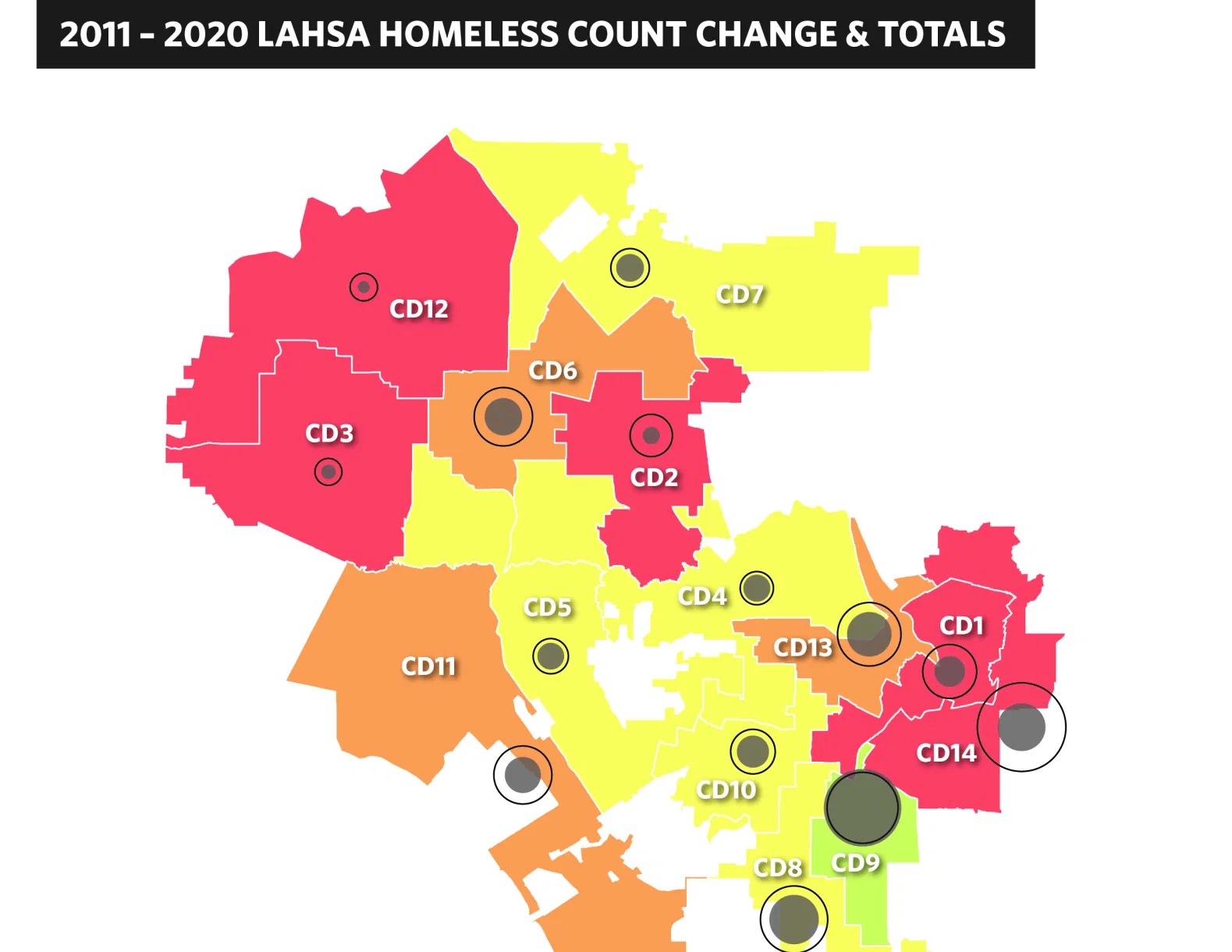
Nine years later, for the 2020 count, LAHSA did not publish a map showing district per homelessness, but that didn’t stop a band of looky-loos from publishing another one for Los Angeles on their behalf. The choropleth map below notes percent changes for homelessness rates per district in a bivariate color scheme from green to red. Listed further below is a sheet ranking homelessness rates in order of highest to lowest per district based on LAHSA’s most recent count.

By 2020, a year after L.A. County reported $727 billion dollars in gross domestic product, fourteen of L.A.’s fifteen council districts, or 93% of the city, saw an increase of homelessness since 2011. As well, the districts with the highest numbers of unhoused residents actually included the same four districts from ten years earlier, though in a slightly rearranged order. These districts were:

I. CD-14, where Skid Row, along with much of downtown, was moved to after city redistricting in 2012. The district is now overseen by Kevin De Leon, and an estimated 7,600 people were reported without shelter as of last year, an increase of more than 245% since 2011.

II. CD-9, where historic South Central is still based. The district is now overseen by Curren D. Price, in which an estimated 4,900 people were reported without shelter as of last year, a decrease of 15.5% since 2011.

III. CD-8, where Leimert Park is still based along with the Crenshaw Corridor. The district is now overseen by Marqueece Harris-Dawson, in which an estimated 4,400 people were reported without shelter as of last year, an increase of 175% since 2011.

IV. CD-13, where East Hollywood is still based. The district is now overseen by Mitch O’Farrell, in which an estimated 3,900 people were reported without shelter as of last year, an increase of 105% since 2011.

A list of homelessness rates in Los Angeles per district as of LAHSA’s count in 2020.

Also note that while our choropleth map shows that District 9 was the only district that didn’t see an increase of homelessness since 2011, the lack of an increase did not change the district’s status as the second of the four areas with the most pronounced homelessness in Los Angeles over the last ten years.

While the growth of this issue may not be promising, a new day may be on the horizon. As of today, voters in Los Angeles have less than 397 days to pick eight new City Council Members, a new Mayor, City Attorney, and City Controller. But with over thirteen months to go, these races have already seen up to $2.5 million in campaign donations, more than a few of which ring peculiar.

Special thanks to Mehmet Berker, L.A.’s local cartographer, for this report’s map.

J.T

a man holding a magnifying glass

Who is Reelecting Mitch O’Farrell? New GIS Map Shows Contributions by Zip to Reelection Campaign for 2022

An analysis of data from the L.A. Ethics Commission shows that at least 75% of funds for Mitch O’Farrell’s reelection campaign for Council District 13 (CD-13) in 2022 are from outside of District 13. At the end of 2020, O’Farrell’s office reported a total of just under $110,000 in funds for his reelection campaign. CD-13, made up of Atwater Village, East Hollywood, Echo Park, Elysian Valley, Glassell Park, Historic Filipinotown, Hollywood, Little Armenia, parts of Koreatown, Thai Town and Silver Lake, is up for an election on June 7, 2022.

The choropleth map below, shaded from light to dark-red to highlight least to largest quantities, shows which zip codes have contributed the most dollar sums to Mitch O’Farrell’s reelection campaign in 2022 as of December 31st, 2020.

Zip codes on the choropleth map represent donations in aggregated sums, meaning that zip codes do not represent individual households, but the total sum of donations from different households within the given zip code.

Council District 13 is roughly contained on the map by the red 90068 and medium red 90028 segments to the west, the dark-red 90026 segment to the south-east, the red 90065 segment to the north-east, and the medium red 90039 and 90027 segments in the center. All other segments highlighted on the map around these “flank” segments are not a part of CD-13 but are segments containing donors to the 2022 campaign.

Donors within Council District 13 and donors not within the district marked and separated by a yellow line.

Zip codes for Council District 13 are: 90004, ranging from Rampart Village to Hancock Park; 90026, where Silver Lake and Elysian Valley are based; 90027, including Little Armenia and parts of Los Feliz; 90028, or the Hollywood area; 90029, where East Hollywood and Thai Town are located; 90038, representing Melrose Hill through Hollywood up to La Brea; 90039, spanning from north of Elysian Heights through Atwater Village; 90057, including Historic Filipinotown; 90065, for Glassell Park; and 90068, for the Hollywood Hills.

While households in zip codes for Echo Park, Glassell Park, and Hollywood form the top three areas for donations to Mitch O’Farrell’s reelection campaign with nearly $17,000 between them, fourth in contributions are households from 90210 ($4,200), where Beverly Hills is based. The only zip code in the 13th district not listed for donations to the reelection campaign was 90029 (let’s keep it this way, East Hollywood).

Households in area 90210, or Beverly Hills, donated at least $4,200 to Mitch O’Farrell’s reelection campaign for CD-13 in 2022.

To the west of Hollywood, only ten zip codes, not including 90210, contributed nearly $15,000 to O’Farrell’s reelection campaign in the roughly two months since the Council Member announced his intention to run for his third term as CD-13’s representative. O’Farrell publicized his intention to run for a third term at the helm of the 13th district in an email to constituents as early as November 2020.

Only 10 of roughly 20 zip codes west of Hollywood donated $15,000 for Mitch O’Farrell’s 2022 reelection campaign for the office of CD-13.

A total of 83 zip codes reflecting just under 200 donations for O’Farrell’s reelection were included in the analysis, including zip codes from as far out as Westport, Connecticut ($250), West Bradford Township, Pennsylvania ($1,600), and even Washington D.C. ($500). Find the Excel sheet for donors listed from highest to lowest here.

O’Farrell’s pool of “outsider” funds for reelection in 2022 virtually mirrors the rate of “outside” donors for his campaign when he ran for his second term for the office from 2016 – 2017. The Los Feliz Ledger reported in 2016 that nearly 75% of donations in support of O’Farrell’s second bid for office came from outside of the district.

Challengers to O’Farrell’s incumbency in 2017
also called attention to the Council Member’s fealty for outside money. Local housing activist and Neighborhood Council aficionado, Doug Haines, was quoted as saying:

“It’s not just development or planning. Mitch has isolated himself from the people he is sworn to serve.”

Doug Haines, East Hollywood Neighborhood Council

A month after O’Farrell won his second term for CD-13 in 2017, an investigation of donations to O’Farrell’s first campaign for the 13th district in 2013 led to real estate investor Leeor Maciborski being fined $17,000 for a number of discreet donations to O’Farrell from limited liability companies (LLCs).

Maciborski exceeded the $700 limit at the time–now $800–for individual donors by at least $3,000. According to the L.A. Times, who originally uncovered the discreet donations, Maciborski was tied to several apartment buildings in both the East Hollywood and Los Feliz areas. He was not listed among O’Farrell’s donors list as of the end of 2020.

But accounting for just under $15,000 for O’Farrell’s 2022 campaign are at least 24 other donors identifying themselves as real estate developers or investors. Zip codes listed for these donors were as far north as Santa Clarita, and as close to the coast as Manhattan Beach.

Households in area 90266, or Manhattan Beach, donated at least $2050 to Mitch O’Farrell’s reelection campaign for CD-13 in 2022.

In 2019, after FBI agents raided former Council Member Jose Huizar’s home in a bribery scheme between him and a downtown real estate mogul, L.A. City Council voted to ban real estate developers from donating to candidates for political office while their projects are pending approval from the council. However, the ordinance was called a “skeleton” of what was originally proposed by groups focused on getting money out of politics, and does not actually go into effect until after the 2022 elections.

This “late start” for the light restrictions on donations from realtors is a major part of why virtually all of the incumbents at L.A. City Hall for elections in 2022 are enjoying major head starts in finance against their challengers, ranging from tens of thousands more to hundreds of thousands of more dollars to spend on ads, mailing campaigns, and staff. At the end of 2020, the only other candidate in the race for CD-13 who reported raising funds, Albert Corado, listed just slightly over $11,000 for his upstart campaign against O’Farrell. As Rob Quan, of the Unrig L.A. organization once put it:

“Developer money tends to follow the people holding power, not the people challenging power.”

Rob Quan, Unrig L.A.

It’s for this reason that conspicuously absent from the O’Farrell reelection campaign’s donation list are people who actually live in the 13th district but are exceedingly priced out of its boundaries and Los Angeles altogether, including bus-drivers, cooks, nannies, hotel maintenance workers, people representing street-vendors, tenants unions, teachers, food and retail workers, immigrant rights coalitions, advocacy groups for the unhoused, and more; or the kinds of people police officers didn’t hesitate to forcibly remove from Echo Park at Mitch O’Farrell’s direction this past March 25th.

Mitch O’Farrell has held the office for CD-13 since 2013, and is now seeking his third and final term as the district’s representative for L.A. City Hall. The previous Council Member for the seat, Eric Garcetti, held the office from 2001 – 2013. Support for our map was provided by friends at the Institute of Digital Education and Research at UCLA.

J.T.