a silhouette of a microphone

Grassroots Candidates for L.A. Voters Chat Live this Saturday, March 26th

“Black Lives Matter-Los Angeles and the People’s Budget LA Coalition has been sounding the alarm about backwards budgeting for years now. We’re bringing together candidates running for offices across the city to discuss critical issues facing Black people and Los Angeles at large.”

For those who cannot attend in person, you can still view the event via livestream on the BLM-LA Facebook page.

J.T.

Kaiser Permanente Los Angeles Medical Center Pharmacy in East Hollywood, Los Angeles

West Hollywood Makes Way: All Black Lives Matter in Los Angeles

(Pandemic in Los Angeles: Day 87)

This Sunday, June 14th, marks the first All Black Lives Matter march in Hollywood, beginning at 11:00 AM. The march will commence at Hollywood and Highland boulevard, proceed through West Hollywood, and consolidate at West Hollywood Park on San Vicente boulevard, marking the first large-scale march of its kind between the Black Lives Matter movement and the LGBTQ+ community in Los Angeles.

In its press release for the public, the organizing board for the march states:

On June 7, 2020, an Advisory Board, made up of all Black LGBTQ+ leaders was formed to move forward in organizing the All Black Lives Matter solidarity march on Sunday, June 14, 2020 at 11:00am in Los Angeles, in honor of our beloved trans brother Tony McDade, who was murdered by police at that time. The protest is in direct response to racial injustice, systemic racism, and all forms of oppression.”

Why is the march taking place in West Hollywood? Apart from being the most popular destination for the queer community in Los Angeles, West Hollywood is 80% white, while the Black community there makes up less than 3.6% of the population, according to U.S. Census data. This plays a major role in the policing of non-white bodies through the area, as well as their invisibility from representations of queer culture. In an interview with the L.A. Times, Brandon Anthony, a gay Black man who is co-organizing the march, explains:

“The most shocking aspect of West Hollywood for me is going to every club there, every bar, and hearing them play our music, but not seeing me in there.”


For more information, visit the All Black Lives Matter website, or follow updates from the L.A. Times.

J.T.

To subscribe to jimbotimes.com, add yourself to the list HERE.

Helen Bernstein High School from Sunset boulevard, East Hollywood

A Generation of Leadership That Has Failed the City of Los Angeles Is Now Unraveling

(Pandemic in Los Angeles: Day 82)

In her motion to consider withdrawing support for the LAPD’s $100 – 150 million raise last week, L.A. City Council President Nury Martinez stunned both activists as well as the LAPD police union and its supporters with a statement accompanying the motion which can read like a page out of Michelle Alexander’s famous magnum opus from 2010:

We need a vision for our city that says ‘there is going to be justice.’ American society is founded on a racial hierarchy, one that is born out of slavery followed by Jim Crow segregation and corporate abuse of labor. As such, police departments are asked to enforce a system of laws that are designed to reinforce and maintain economic and racial inequality.”

– Nury Martinez, L.A. City Council, June 3rd, 2019

One can thank the activists, including Black Lives Matter – Los Angeles, as well as the People’s Budget for Los Angeles, for stirring the L.A. City Council out of slumbering obsequiousness or deference to the police union’s raises amid the threat of COVID-19, even if we forget for a moment that Mayor Garcetti’s added $150 million for LAPD was agreed to before the coronavirus slammed the brakes on the economy.

Coronavirus or not, and the police raises aside, the $1.7 billion of taxpayer dollars that LAPD was set to receive while Housing & Community Investment were to get less than 4.8% of that sum, was all any resident of Los Angeles needed to know to be concerned. But if not for the BLM movement’s years of work in relative silence, or years of activism in what might be said to be a vacuum, L.A. would be in a completely different political environment right now, one far less equipped to deal with our representatives accordingly.

Shortly after Ms. Martinez’s motion, the Los Angeles Police Protective League, or L.A.’s police union, released a blistering statement in retaliation:

“Los Angeles Council President Nury Martinez has failed the true test of leadership; the ability to bring Angelenos together to problem solve and heal after the tragic killing of George Floyd. Rather than creating a space to come together and have the necessary and difficult dialogue on how best to move our city and nation forward, all we got was a Tweet aimed at creating a deeper division between our police officers and the community we serve. To declare that the work police officers perform, that we’ve been directed to do, is designed to harm people of color while Ms. Martinez repeatedly sends us into harm’s way is divisive, disrespectful, and certainly is no profile in courage.”

The police union’s statement is a text-book case of the lengths that powerful interests go to in order to maintain control, even as they lose control. Be honest with yourself: In what fundamental way is the statement different from a press release out of the Trump White House?

The statement attacks personal character, claims the union has been “disrespected,” and implies that police bear all the weight of the real work” while Ms. Martinez “tweets.” Perhaps most importantly, the statement doesn’t even try explaining its argument that the LAPD losing its raise “creates division” between police and the communities it’s supposed to serve. Newsflash: police violence and incarceration are what create division. Since 2013 alone, the LAPD has shot and killed more than 600 civilians in Los Angeles, overwhelmingly unarmed Black and Latino males.

Moreover, instead of the police union accounting for its role in jailing, fining, and fatally shooting predominantly Black & Latino bodies in Los Angeles, or releasing a statement accepting those extra $150 million going towards other city services right now, or offering to work with activists to end all police violence against citizens, the union simply defends itself. It laments over a salary issue. Never-mind the scores of protesters the LAPD injured during their peaceful protests this past summer, and never-mind 600 fatal shootings since 2013.

Those hundreds of millions of dollars, though.

Towards the end of the union’s statement, there’s even a veiled threat to answer the phone “a little late” next time Council Member Martinez calls their number.

This only makes more sense when readers consider that the Los Angeles Police Protective League Political Action Committee (PAC) has donated finances to Nury Martinez’s tenure at L.A. City Hall since at least 2013, according to the L.A. Ethics Commission website, not to mention virtually every other City Council member, too. Remember: the Center for Responsive Politics defines a PAC as “a political committee organized for the purpose of raising and spending money to elect and defeat candidates.” Clearly, the “investments” the police union made in Ms. Martinez’s campaigns was not working out according to their plan.

In any case, at the L.A. City Hall Budget & Finance committee this Monday, activists learned that the motion regarding the police raises–which was originally set to be approved or disapproved by the committee this week–would have its meeting postponed to the following week on June 15th, 2020 in order for the council to “hear from more stakeholders,” as in, apart from the tens of thousands of marchers standing outside city hall over the last few weeks.

But what the postponement did make clear was that after two weeks of protest against the police state all across Los Angeles, the council did, in fact, hear the demands far more clearly than it has in some time.

If you’re in East Hollywood, Los Angeles, which is known at L.A. City Hall as the 13th district, here’s the contact information for Mitch O’Farrell’s office, your City Council representative, to facilitate some of that additional feedback from stakeholders:

DISTRICT 13 — MITCH O’FARRELL:

City Hall: (213) 473-7013

District Office: (213) 207-3015

Email: councilmember.ofarrell@lacity.org 

Twitter: @MitchOFarrell

J.T.

To subscribe to jimbotimes.com, add yourself to the list HERE.

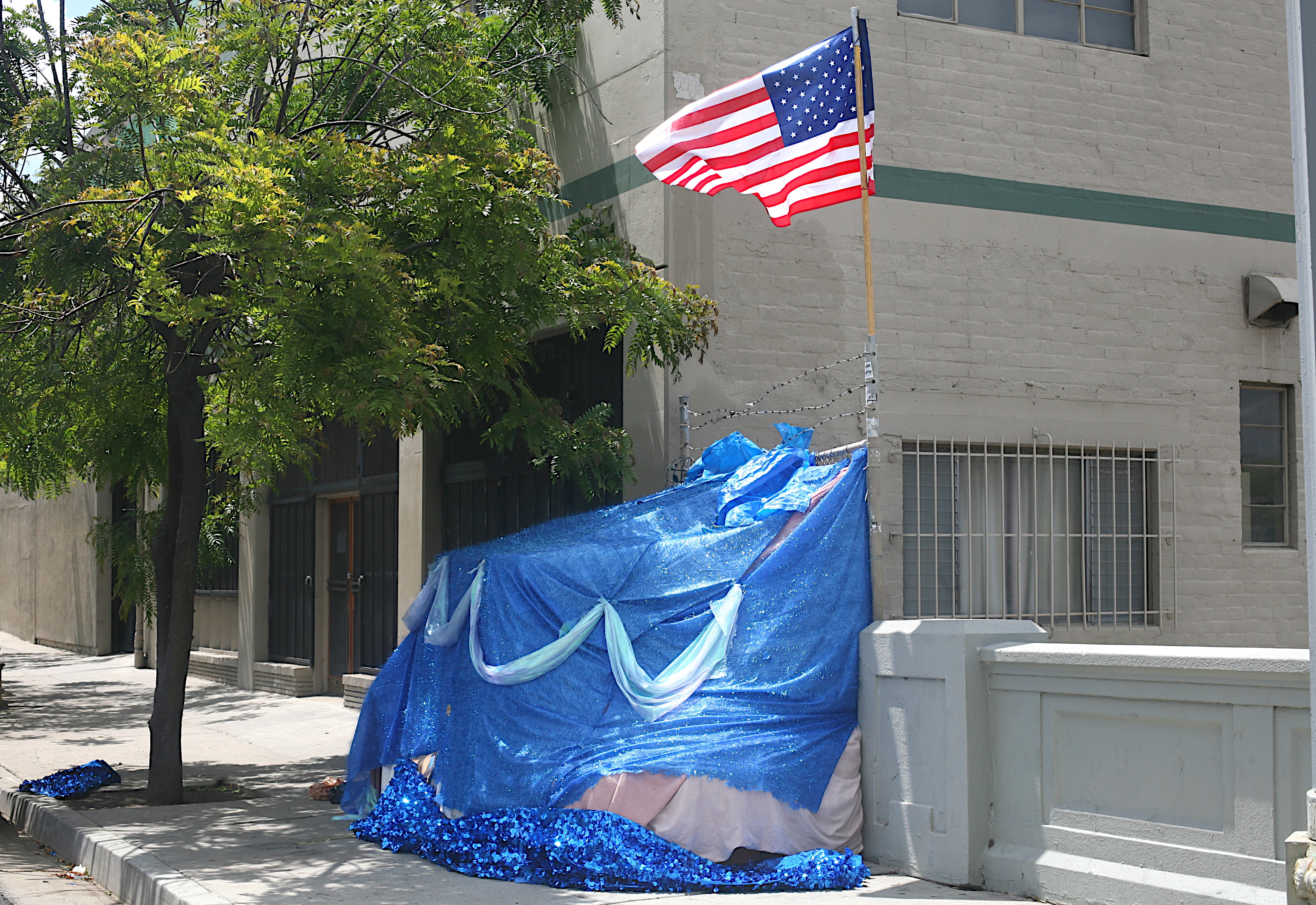
An encampent along Sunset boulevard and Manzanita street in Los Angeles

You can Now Make Your Voice Heard On L.A.’s Budget For Next Year with A New Survey for Residents

(Pandemic in Los Angeles: Day 72)

Today I’d like to encourage every reader in Los Angeles to take approximately seven minutes to fill out a critical survey regarding priorities for L.A.’s proposed budget this upcoming year. The form, facilitated by The People’s Budget for L.A., is a simple yet comprehensive set of questions for residents in Los Angeles gauging opinion on which resources to prioritize with our tax-dollars at this time. Find the form HERE.

In what’s now clearly a historic juncture for our nation, there are a litany of opinions over the best way to advance better policies for our society, but also many questions about the best way to get started. I can assure each reader that filling out the survey is one key way to just activate one’s own thought process on the issues, regardless of where they may stand on each issue. In fact, after submitting my thoughts on the survey’s opinion section, I copied and pasted them onto the city council’s public comment section for the mayor’s proposed budget and submitted them there as well. It was a two-for-one special. Now that’s a deal in democracy you can’t pass up!

J.T.

To subscribe to jimbotimes.com, add yourself to the list HERE.

Kaiser Permanente Los Angeles Medical Center, from Sunset boulevard and Edgemont street

Racial Inequality Today Results from the same U.S. Policies that have just cost 100,000 Americans their lives

(Pandemic in Los Angeles: Day 71)

I am thankful, once again, for Black America leading the cry for dignity and justice in our country at a time when many Americans might forget that in less than four months the wealthiest nation on earth has lost more than 100,000 lives to a health-care system built on class and therefore racial lines.

The American ideal of equality for all, and indeed an attempt at democracy anywhere, cannot survive if not for protest at the first sign of unequal justice. Black Americans have reminded us of this burden for centuries, and are rightfully angry at still having to carry such a burden into the 21st century, when instead of perpetuating racialized inequality our nation should be leading the charge towards meeting the more existential crisis of global warming and rising sea levels on the horizon.

Protests over these last few days—similarly to protests from six years ago following Eric Garner’s death at the hands of yet another white police officer in Staten Island–may remind some readers of the radical 1960s, but for this column, an earlier call beckoning the American government to honor its promise to all Americans, however preposterous the notion of governments actually honoring their oaths to their people may have sounded even then, is also instructive.

In Frederick Douglass’s first speech against slavery in the U.S. south, delivered in Nantucket Island, MA in 1841, Douglass begins his lecture by describing one of his experiences at a New Bedford church with newly Christianized white and Black residents:

…among those who experienced religion at this time was a colored girl; she was baptized in the same water as the rest; so she thought she might sit at the Lord’s table and partake of the same sacramental elements with the others…[the deacon] handed the girl the cup, and she tasted. Now it so happened that next to her sat a young [white] lady who had been converted at the same time, baptized in the same water, and put her trust in the same blessed Saviour; yet when the cup containing the precious blood which had been shed for all, came to her, she rose in disdain, and walked out of the church.

The anecdote demonstrates how the American psyche separating humans by race affected life in both “northern” and “southern” states. The New Bedford church was in “Northern” Massachusetts, and Douglass went on:

Another young lady fell into a trance. When she awoke, she declared she had been to heaven. Her friends were all anxious to know what and whom she had seen there; so she told the whole story. But there was one good old lady whose curiosity went beyond that of all the others–and she inquired of the girl that had the vision, if she saw any black folks in heaven? After some hesitation, the reply was, ‘Oh! I didn’t go into the kitchen!’

I admit that however laughable and “backwards” such attitudes may seem for life in this country circa 1841, I only have to remember walking out towards Virgil avenue or Sunset boulevard on “a regular day” in 2020 to see whites–many of whom are clearly not from Los Angeles–casually taking seats at one of the posh new restaurants in town while Black and Brown hands serve them their plates of food.

On a sunny day, Los Angeles can certainly gleam like heaven. And I can recall on my walks through the neighborhood stepping past white patrons eating well, growing large, and running up bills that most of the Black and Brown bodies around them couldn’t dream of spending on food.

Is it inherently wrong for people to eat? No, but it is ironic when only a few can eat well in a country that’s supposed to afford equal opportunity to all.

More importantly, even when many patrons like those of my anecdote haven’t been in L.A. long enough to know who their local council member is, they still quickly grow used to being served by those familiar Black and Brown bodies in the kitchen! And those Black and Brown hands cleaning up the tables after them! And those same Black and Brown bodies getting out of the way when they see them on the street! As Amy Cooper in Central Park expected.

If some of them were asked what their conception of heaven today might be, I can’t even imagine what they might say. But such realities thus show that people in Los Angeles have much to share with people protesting in cities all across the country today, in the same way that our country still bears so much resemblance to that church in New Bedford 179 years ago.

In that case, thank you Mr. Douglass, Black Lives Matter-L.A., and all purveyors of justice still calling for a better way of life in this scarred land.

J.T.

To subscribe to jimbotimes.com, add yourself to the list HERE.