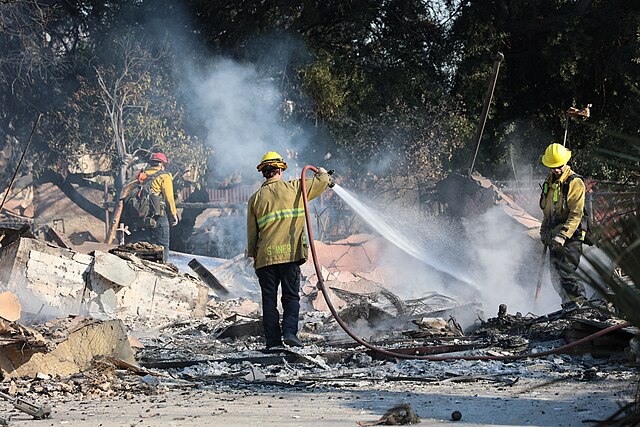
Petition for Immediate Action to Address Firestorm Catastrophes in Los Angeles County

From the brilliant minds of Lauren Bon, Metabolic Studio, Patrisse Cullors, The Center for Art and Abolition, Anawakalmekak, Chief Ya’anna Vera Rocha Regenerative Learning Village,  Gabrielino-Shoshone Nation of Southern California:

“The January 2025 firestorms have devastated the mountains and basins of Los Angeles County, underscoring the dire consequences of climate change, insufficient land and water management, and a lack of coordinated preparedness. Entire communities have been displaced, ecosystems decimated, and lives forever altered.

We, the undersigned, call upon the following entities to take immediate and transformative action:

Los Angeles County Board of Supervisors and City Councils:

  • Develop comprehensive water collection systems to capture and retain rainwater during storm events, ensuring availability for:
    • Firefighting efforts during wildfire seasons.
    • Cultivating and sustaining green corridors that act as natural firebreaks and habitat restoration zones.
    • Dust suppression in burned or arid areas to mitigate health impacts and protect vulnerable populations.
  • Incorporate Traditional Ecological Knowledge (TEK): Partner with local Indigenous tribal nations, communities, organizations and knowledge holders to guide restoration efforts, drawing on time-tested practices for managing land, water, and fire in ways that align with natural systems.
  • Appoint a Special Liaison for Land and Water Governance to oversee the integration of TEK and contemporary science into long-term strategies for fire prevention, water conservation, and ecological resilience.
  • Develop a systemwide strategic response plan in all school districts, inclusive of charter schools, to consider and prioritize the needs of children and youth by providing emergency resources and guidance to school level emergency response actions.
  • During recovery, halt evictions and sweeps of unhoused people as communities recover, a drastically increased number of local people find themselves without safe, forever housing, and seven+ people die daily on the streets of Los Angeles.

State of California:

  • Coordinate efforts to prevent and manage landslides in burn areas by:
    • Installing erosion control measures such as wattles, sediment basins, and plantings of fire-resistant vegetation.
    • Salvaging displaced soil following landslides to regenerate brownfields and restore degraded landscapes.
    • Funding research into long-term, regenerative strategies for mitigating debris flow and restoring soil health in post-fire regions.
  • Support TEK Integration: Provide grants to Indigenous-led organizations and communities for ecological restoration projects, ensuring that their expertise informs statewide fire and water management policies.
  • Provide grants and funding for local governments and institutions to implement labor and study programs that integrate ecological recovery with workforce development.
  • Offer incentives and accessible education through the CA Energy Commission and other statewide entities for construction with earth blocks, adobe, cob, and other natural.

Federal Government:

  • Establish a modern version of the WPA focused on climate resilience, supporting large-scale employment opportunities in fire recovery, water conservation, and landscape restoration.
  • Provide emergency funds and technical expertise for post-fire debris management, including soil salvage and toxic runoff mitigation.
  • Partner with Indigenous tribal nations and communities to develop national frameworks for integrating TEK into land and water governance.
  • Climate emergencies and disasters such as these should include defense of all community residents including the unhoused and migrant communities that live, work, worship or study in our communities. All exploitive deportation activities must stop.

Global Climate Advocacy Groups:

  • Partner with local and federal governments to implement innovative soil and water restoration technologies in burn zones while supporting education and employment initiatives focused on long-term ecological stewardship.

Key Requests:

  1. Management of Toxicity in Burn Zones: Test and remediate soil and water near burn zones to address contamination caused by fires, protecting public health and ecosystems.
  2. Landslide and Debris Management: Establish protocols to stabilize burn areas, collect displaced soil from landslides, and repurpose it for regenerating brownfields and degraded lands.
  3. Labor and Study Programs: Incentivize programs that employ local residents and train the next generation to restore ecosystems, enhance fire resilience, and create sustainable infrastructure.
  4. Traditional Ecological Knowledge (TEK): Partner with Indigenous communities to implement restoration practices that align with natural systems, ensuring sustainable land and water governance for future generations.
  5. Special Liaison for Governance: Appoint a dedicated leader to integrate TEK, scientific research, and community input into cohesive strategies for long-term ecological resilience.
  6. Water as a Resource: Ensure rainwater is retained and used strategically to prevent and fight fires, establish green corridors, and rehabilitate burn zones.
  7. Prioritizing keeping, restoring, and creating housing and safety for people of this place by pausing all evictions, sweeps, and identify and transfer land for earth-abiding housing by/for houseless people.

Why TEK and Governance Matter:

The integration of Traditional Ecological Knowledge (TEK) into fire recovery and prevention is essential for fostering harmony between human activity and natural systems. Indigenous knowledge offers invaluable insights into sustainable land and water management that can enhance resilience and promote biodiversity. Appointing a dedicated liaison ensures long-term, coordinated governance that honors both traditional practices and modern science, addressing the challenges of today while planning for future generations.

This is a collective plea for bold action to protect our communities, our natural landscapes, and future generations from the accelerating impacts of climate change. The time for incremental solutions has passed—this is a crisis that demands immediate, systemic change.”

Please sign your name on this petition HERE, which takes less than a minute to complete.

Thank you, and we’ll be in touch again in no time, Los Angeles.

J.T.

Secret Agent: How to Discover Your Neighborhood in Los Angeles

Kev with the new Los Cuentos Black & Gold Cap; Summer 2019

So it’s the second week of summer and you read How to Beat Summer 2019 Parts I III, 10 Ways Not to Beat Summer 2019, and even How to Outline Summer 2019, but you’re still not quite sure what to do with all this newfound time on your hands.

In this case, you’re likely making it just a tad more complicated than it needs to be (I know from experience). But with this blog, we’re going to give it one more shot in a last-minute challenge for you.

The only requirements for this challenge are a few hours of time on your hands, permission to go out for a few of those hours, and either a parent, friend, sibling or pet turtle to accompany you. Okay, maybe not the pet turtle. Sorry pet!

Ready? You’re now officially a secret agent going on an adventure. Your mission: to explore the second most populous city in the world and bring some of its top secrets back to headquarters. Your key ‘weapons’ for the mission are: walking shoes, a smart-phone, a Los Cuentos hat, and a water bottle.

There are also no cars allowed for the assignment. Metro buses and rail-lines only.

Ready to find out where you’re going? You will choose one of the following places for this mission:

  1. Little Tokyo
  2. Plazita Olvera
  3. Koreatown

In true secret-agent fashion, you’re not visiting these places just to ‘have fun.’ You’re going to ‘excavate’ them for some classified info like a world class spy. Sure, you can go with your people, get some ice cream at the stores, and check out the stuff on sale like a lookie-loo. But the real purpose of your visit to these other places will be to find out the following:

I. Where is ‘the heart’ of the neighborhood? (As in, where is the public square, or main area? What kind of businesses are there? Is there any kind of art you see there?)

II. How does it differ from your side of town? (What kind of people are there? How many languages do you hear spoken? And what can you tell about the ‘other’ kids at this other part of town?)

III. How might your neighborhood ‘be’ more like this one? (Could there be a different Metro Station to make it easier to get to your side of L.A, like with these other neighborhoods? If you could choose the stores you’d have in your neighborhood’s main area, what would they sell? And apart from the stores, where would the kids in your neighborhood hang out? Would they have their own main area too, or public square?)

That’s it! It’s true that these are quite a few different questions to remember during your visit to the assignment, but we both know you can glance at this blog while you’re out there on assignment.

We also both know that this is a mission you can definitely accomplish in three to four hours. Metro’s lines were made for you to use for exactly this kind of challenge, just as these ‘other’ places were made for you to visit and learn about.

At the end of the assignment, you’ll feel accomplished for learning about a new part of Los Angeles for yourself, send me the answers to your questions for a top-secret review, and receive a brief follow-up mission, if you so choose.

So, what are you waiting for? Give this last-minute challenge a shot and get out there, young storyteller. Your city is counting on you!

J.T.

Still Resilient in Los Angeles

JT_Red
Metro Red Line Station; Vermont Ave and Santa Monica Blvd.

When you’ve known a place your whole life, a place that you take pride in, where you’ve found love in, and where you’ve found yourself in, what do you do as that place is taken from you? When the people who comprise this place are people who look like you, or who speak the same language as you, who hail from that same “otherness” like you, what do you do as they’re taken from you, too?

I think of the local Metro’s Vermont and Santa Monica Red Line Subway station. A place where thousands of people pass one another by each day, past the flocks of pigeons nestled above in the station’s arches, and past the heaps of other people laying by the entrances to the terminal.

The birds cradled in the station’s altitudes are conditioned to the factors of the environment, which are often rather unfriendly to their livelihood: Food is scarce, competition for food is abundant, and the winds push people and traffic through their huddled masses daily.

The humans below, whether moving with the traffic or anchored to the sidewalk, are conditioned to the factors of the environment, too: Food and housing are expensive, finding decent work to afford decent food and housing is likewise competitive. As people push through flocks of pigeons in the race to get to it all, we push past one another too; over time, this has the effect of insulating us from the environment and from one another as a whole.

I think of my own experience in this sequence, in terms of just how many people I’ve walked past over the dozen or so years I’ve stepped foot through Metro’s Vermont and Santa Monica corridor. Past people conflicted by mental health disorders, addiction, or no place for shelter at night. Past people trapped in abusive relationships, police violence, or no access to a steady meal each day. Past children who had no choice. I’ve got a feeling that this is an experience which binds me with millions of other people in the U.S. today.

In the 21st century, America isn’t just pushing people away from its borders. It’s also pushing them from their homes, their livelihoods, and even from its street corners. In the pending displacement of Super Pan, my pueblo is dealing with wealth in this country, and the power of wealth to shove human beings out of the way instead of using it to uplift them and our community together as a whole; a legacy as old as the country itself.

But all around us are more mom and pop shops at risk of displacement, just as there are more Metro stations serving as shelters for more people with less than us. Not far off are also those individuals with wealth who simply want to take each of these spaces for their own benefit without pausing to consider how others can be harmed by such obnoxious claims to space.

If I’m somewhere in between, that is, not enamored by the power of wealth, but also not forced to sleep by the Metro stations at night, then just where do I stand? I pass by the less fortunate like everyone else, and simply try to be mindful, which is for the most part what I have to do. But I don’t believe I’ve always got to do things this way.

I believe there’s still a world to build right through the one we see now, both with and alongside others: a world that’s been here before, actually, and which still glimmers through the shadows in moments each day out there; a world of people helping each other, uplifting each other, and building great things as a result.

A world we have to fight for, and which we continue fighting for each day: Nuestro Pueblo, Los Angeles.

More on Super Pan in the Virgil Village SOON,

J.T.

Get Yourself Some L.A. Photography at our Back to School Party this August 25th,

I’m very happy to announce that for our Back to School Party I’ll be installing printed photographs of the L.A. community in what may be called the first “official” exhibit of four years’ worth of L.A. Stories through JIMBO TIMESThe exhibit will be one of several, as we are not playing about art by the community, for our community!

This is how it gets done Los Angeles,

J.T.