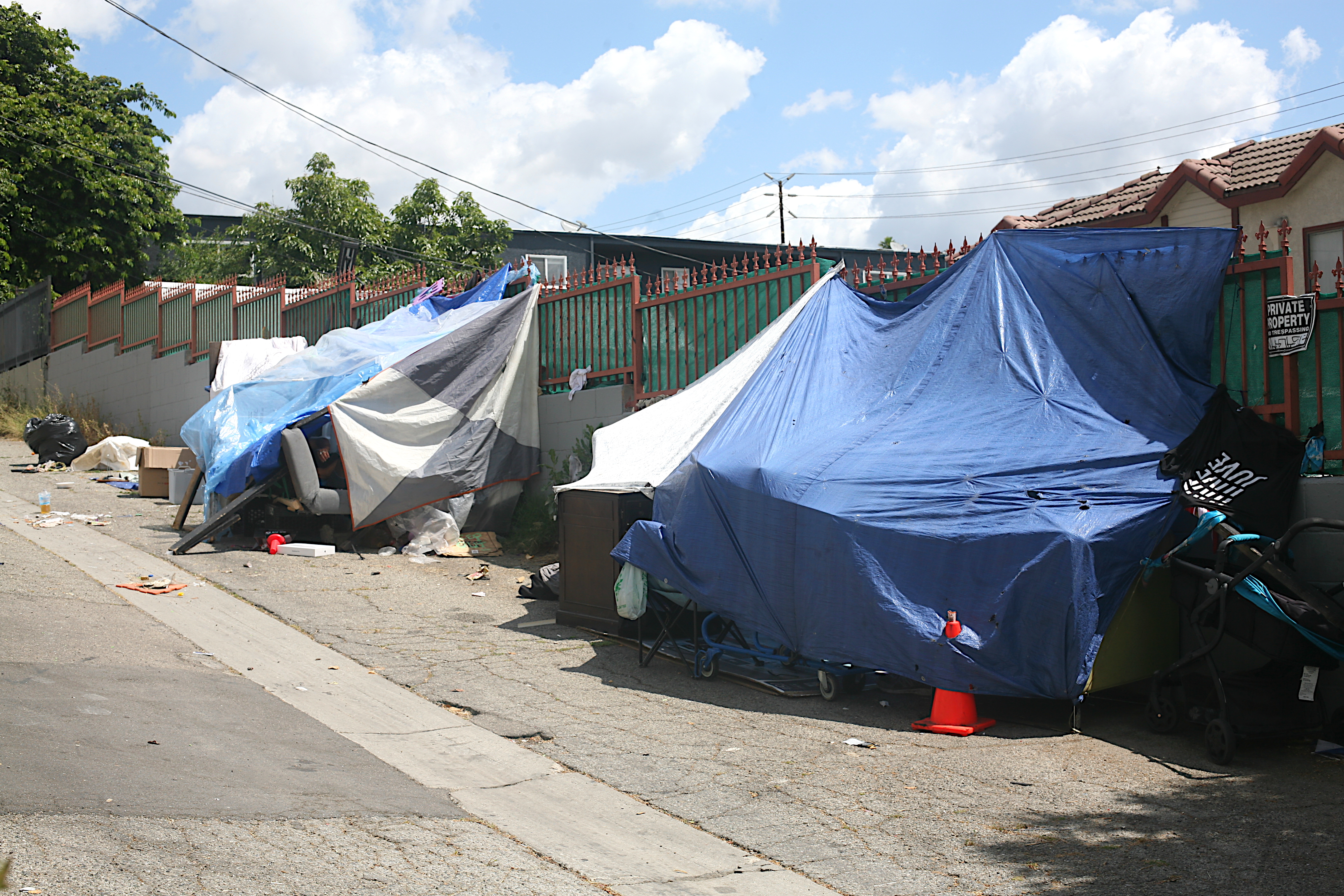
A homeless encampment in East Hollwood, Los Angeles

Los Angeles is not represented by its elected officials. It is trembling on the knees of dying men & women on its sidewalks

(Pandemic in Los Angeles: Day 90)

Earlier today walking through the city I witnessed something like never before in my nearly thirty years through Los Angeles, which almost took my breath away. As I made my way through a sidewalk, a gray-bearded, African-American man, who couldn’t have been less than 65 years of age, sat on his knees in the middle of the sidewalk, his penis sticking out.

Before I knew it, as my legs crossed in front of him, the man began to pee. I turned my head in his direction then, almost in disbelief, but he did not return the look. He seemed almost unconscious. Of course, from the outset it was clear that the instance was nothing malicious on his part, but that it was from a pure need to relieve his body at a time when public restrooms in Los Angeles have been severely reduced in number, affecting most of all the unhoused.

What did feel malicious was that Mayor Eric Garcetti, the L.A. City Council, the L.A. County Board of Supervisors, City Attorney Mike Feuer’s office, and more of our elected officials have allowed this throughout Los Angeles after decades in public office.

In particular, history wont be kind to Mayor Garcetti. “In real time,” meaning right at this very minute, under Mayor Garcetti the rate of unhoused people in L.A. is on track to reach more than 100,000 bodies on the streets over the next few years, up to nearly 700 civilians shot and killed by police, and well over tens of thousands of more empty high-end lofts than occupied affordable housing units.

In turn, by the time Garcetti leaves office in 2022, Los Angeles will likely be a poorer, more unhealthy, and thus more hostile city for its working-class than when he became mayor in 2013. For yours truly, this begs the question:

What is it to truly love Los Angeles?

I contend that it is not to love Dodger baseball, or to follow Lakers basketball, or to adore Kings hockey. And I contend that it is not to build luxury lofts, or to celebrate Hollywood films, or even to promote its multiple ‘cultures,’ notwithstanding those of its working-class masses.

I contend that loving Los Angeles is loving its most vulnerable, represented most of all by our nearly 70,000 unhoused, the last count of which was released by the Los Angeles Homeless Services Authority just a week ago. What a name, for that matter, with the word ‘authority’ in its title.

What authority can a city-funded organization tasked with serving its unhoused legitimately claim, when its efforts have failed to serve the thousands of bodies, overwhelmingly African-American, abandoned on the city’s sidewalks?

Make no mistake about it: In the same amount of time that the city drove tens of thousands of its residents down to helpless tents over the barren concrete, elected officials like our L.A. City Council members have taken home millions in taxpayer dollars.

They were not alone, joined by other officials tasked on paper with the public good. Take police like chief Michel Moore, for example, who, in 2018, retired briefly to collect $1.27 million in taxpayer dollars, to be rehired by Mayor Garcetti just a few weeks later. Our elected representatives were also joined by non-elected big wigs such as the California Correctional Peace Officers Association, which, in 2018, contributed over $1,000,000 to then-candidate Newsom’s campaign for governor.

In the end, however, the fact is that such men are still small fries compared to billionaires like the real estate tycoon Geoffrey Palmer, a known Trump supporter, whose “Da Vinci” apartments in downtown Los Angeles go towards funding a $21 million mansion of his in Beverly Hills, not to mention properties in Malibu, St. Tropez, France, and more.

Palmer is one of a generation of men who, over the last twenty years in Los Angeles has benefited tremendously from a cataclysmic “transfer”–but more like high-jacking–of wealth that will play a decisive role in determining the next eighty years for our city & country, that is, unless something is done about it, and brazenly fast.

What will we do, then, Los Angeles, while a handful of men sit atop empires? Will we stand by as only more of our neighbors, and as more of our families, collapse under their weight? Is such a loveless city, and country, what we want history to remember us by?

The choice is ours.

J.T.

To subscribe to jimbotimes.com, add yourself to the list HERE.

A tattered and damaged building at Vermont & Beverly stands next to a recently renovated hotel in Los Angeles

You Are Allowed To Press Reset, Los Angeles

(Pandemic in Los Angeles: Day 89)

For nearly two hours today a disruption hampered phone networks all across Los Angeles and throughout the country. It was almost a glitch in the whole observable universe, as our once-familiar smart-phones were bereft of function and exposed for their hollow cores. One had to simply put the phone down and figure to try again later. It was strange. It was suspicious. It was also quite liberating.

The fact of the matter is that at the speed at which information now travels, there can never be enough ‘keeping up’ with the latest development just as there can never be enough ‘doling out’ of it. But it is helpful to take a break. Your memory, and perhaps even your skin, will thank you for it, according to some experts.

This Tuesday, I personally don’t plan to wait for another glitch to ease my mind from the day’s infinite stream of events. I have much to read, before much more to write.

While resetting my mind may not be as simple as doing so with my phone, I’ve got a feeling that for that same reason, making the effort can prove far more rewarding. Now, if only more of that L.A. City Council would come to the same reasoning.

J.T.

To subscribe to jimbotimes.com, add yourself to the list HERE.

A fence with barbed wire barricades the site of the former Super Pan Bakery at Virgil avenue and Monroe street

We Raise It: A Poem for Los Youngs During These Times

(Pandemic in Los Angeles: Day 88)

I know. It’s not fair. It’s been more than three months since everything up and changed. And since then, nothing has changed. Everything is still a mess. Home is stressful.

I know. Even if someone says otherwise, still feels like there’s nowhere else to go. Even when we step out, everything is weird. Strangers are stranger. It’s not fun anymore.

I know. The pupuserias are not the same. The panaderias take forever to get into. The burger joints aren’t even there anymore. Pockets don’t have enough to get much anyway.

I know. You didn’t get to say goodbye to your friends. Everyone knew this was the last year you’d get to see each other. Now everyone is fighting. Everyone online is just going at each other.

I know. Summer’s coming up and there’s no pool at the house. No AC. Not enough fans. All the sockets are taken.

I know. Family is stressful. Everyone says the same about how we’ll get through this. Doesn’t feel like we’re getting through.

And I know. It can’t be long before some more riots pop off. Cops killing Black people. Whites got no love. How are you supposed to walk around when they can get you any minute. Racism’s worse than corona.

I know. Everyone online is just stressing. And if there’s just one more argument–

It’s not fair. Everyone is scared. It’s no love. Can’t get any love.

I know it’s like a war that’s coming. It’s dirty. But rules are rules. If they hate us, gotta hate back.

I know it feels this way. And I know it feels like it just stays this way.

I know it’s not a time for promises. But this is not a promise.

This is just to let you know that through it all, you’re still heard, still seen, and still valued.

To let you know that you got every right to be mad, like from the top of your lungs, ready to let it all out. We’re mad with you. We’re tired of the same old story too.

But I also know that you know. That if it’s another day we get, then we gotta take it.

So we raise it.

J.T.

To subscribe to jimbotimes.com, add yourself to the list HERE.

Kaiser Permanente Los Angeles Medical Center Pharmacy in East Hollywood, Los Angeles

West Hollywood Makes Way: All Black Lives Matter in Los Angeles

(Pandemic in Los Angeles: Day 87)

This Sunday, June 14th, marks the first All Black Lives Matter march in Hollywood, beginning at 11:00 AM. The march will commence at Hollywood and Highland boulevard, proceed through West Hollywood, and consolidate at West Hollywood Park on San Vicente boulevard, marking the first large-scale march of its kind between the Black Lives Matter movement and the LGBTQ+ community in Los Angeles.

In its press release for the public, the organizing board for the march states:

On June 7, 2020, an Advisory Board, made up of all Black LGBTQ+ leaders was formed to move forward in organizing the All Black Lives Matter solidarity march on Sunday, June 14, 2020 at 11:00am in Los Angeles, in honor of our beloved trans brother Tony McDade, who was murdered by police at that time. The protest is in direct response to racial injustice, systemic racism, and all forms of oppression.”

Why is the march taking place in West Hollywood? Apart from being the most popular destination for the queer community in Los Angeles, West Hollywood is 80% white, while the Black community there makes up less than 3.6% of the population, according to U.S. Census data. This plays a major role in the policing of non-white bodies through the area, as well as their invisibility from representations of queer culture. In an interview with the L.A. Times, Brandon Anthony, a gay Black man who is co-organizing the march, explains:

“The most shocking aspect of West Hollywood for me is going to every club there, every bar, and hearing them play our music, but not seeing me in there.”


For more information, visit the All Black Lives Matter website, or follow updates from the L.A. Times.

J.T.

To subscribe to jimbotimes.com, add yourself to the list HERE.

Hollywood Presbyterean Hospital in East Hollywood, Los Angeles

Three Months After Shut-down, L.A. “Reopens” while both COVID-19 and LAPD Budget Remain Uncontained, Posing the Greatest Risk to Black, Latino and AAPI Communities

(Pandemic in Los Angeles: Day 86)

As of the evening of June 11th, according to the L.A. County Public Health Department, Black, Asian and Latino communities still represent more than 70% of 2,629 deaths from COVID-19 in L.A. County, while whites represent 29% of deaths. The numbers might seem commensurate with these groups’ share of the total population in L.A. County, but as before, they are actually still an under-count and not indicative of the whole picture.

Of 66,941 active coronavirus cases reported by the department, L.A. County Public Health Director, Dr. Barbara Ferrer, has pointed out that there is still a disproportionate rate of death for ethnic minority groups:

The death rate among Native Hawaiians & Pacific Islanders is 52 deaths per 100,000 people. And among African Americans the death rate is 33 deaths per 100,000 people. For people who identify as Latino and Latinx, the death rate is 32 deaths per 100,000 people. For people who are Asian, the rate is 23 deaths per 100,000 people, and for whites, the death rate is 17 deaths per 100,000 people…We also see that people who live in areas with high rates of poverty continue to have almost four times the rate of death for COVID-19.

Dr. Barbara Ferrer, L.A. County Public Health Director

In my native East Hollywood neighborhood, the County is tracking a total of 254 cases, with 38 deaths from the disease so far, while the adjacent Silver Lake neighborhood is tracking a total of 221 cases, with 14 deaths from the disease so far.

But as startling as the numbers for a “natural disease” like COVID-19 in Los Angeles may be, they still fall short of another galling statistic for the county. In an L.A. Times report published earlier this week, data showed that since 2000, more than 78% of people killed by police in L.A. County–98% of whom were shot to death by police officers–were Black and Latino, overwhelmingly males between the ages of 20 and 39 years.

As protests of Mayor Garcetti’s police budget continue into this weekend, then, I wonder if another budget for Los Angeles has actually gone less noticed: The L.A. County sheriff department, which employs roughly as many boots on the ground as LAPD–just under 10,000–and almost 8,000 civilians on staff, was only recently approved by the L.A. County Board of Supervisors for a budget of $3.5 billion through 2020 – 2021.

The L.A. County sheriff’s department patrols cities as close as East Los Angeles & South L.A., and as far as Lancaster and Castaic. The location of their patrol is highly significant since, according to the L.A. Times report, the neighborhoods with the highest number of fatal shootings by police are cities such as Compton, Inglewood and East Los Angeles, home to large minority populations, and where L.A. County sheriffs partner with LAPD to police civilians.

The L.A. County sheriff’s department also runs the L.A. County Jail, which oversees more than 17,000 people, where 80% of inmates are Black and Latino.

Similarly to their counterparts at LAPD, however, they actually seek more taxpayer dollars for their services, and may even have loftier ambitions than what LAPD’s longed-for $150 million raise would suggest. According to the L.A. County sheriff website, the department actually needs $400 million more than the $3.5 billion that the L.A. County Board of Supervisors has recommended for fiscal year 2020-2021.

At 18,000 staff members, the budget the L.A. County sheriff’s department seeks for 2020-2021 would amount to more than $216,000 a year for one staff member. At present, it is $194,000.

To be sure, with these numbers and more projections to consider, only a few things are clear:

At the beginning of the crisis due to coronavirus, there was much we did not know about the disease, no federal guidelines for states regarding testing sites or containment for COVID-19, and much confusion about the best course of action.

Three months later, there is still much we don’t know about the virus, no federal plan in place for testing or containment strategies, and now a litany of discussions about our racialized and punitive society proving more confusing than not for many. As the battles continue, more confusion will ensue, but I believe the time for a break, if not a breaking point, is upon us, Los Angeles.

J.T.

To subscribe to jimbotimes.com, add yourself to the list HERE.