Excerpts from Zev [Yaroslavsky]’s Los Angeles

Zev Yaroslavsky, the former L.A. City Councilmember (CD-5) and former L.A. County Board Representative (District 3), was first elected to office nearly 50 years ago at the age of just 26 years. He would serve as an elected official for nearly 40 years, retiring in 2014; in 2016, he became the director of the UCLA Luskin School of Public Affairs, where he has remained since.

Yarloslavsky’s memoir is a story replete with his commentary on various ongoing political issues in L.A., including the city’s notorious lack of affordable housing, Proposition 13, rent control (RSO), the 1984 Olympics and L.A.P.D., and even L.A.’s slow-growth movement.

At a talk at Kohn Chapel recently, Yaroslavsky noted that, “There are people who weren’t even born…halfway through my career who are now writing revisionist histories about the things that I was involved in. And I’m not gonna get into an argument with them, but I want to make sure that my side of the story is in print, and people can take it or leave it.”

Below are 10 excerpts from his book for your consideration. You can also hear more from his side of the story in his recent appearance on former L.A. City Councilmember Mike Bonin’s What’s Next, Los Angeles Podcast.

On L.A.’s political climate at the time of his election (1975)


“To be sure, there were problems galore. The city was grappling with rising crime, property tax rates, and rents. Neighborhood groups were angrily pushing back against unwanted development and traffic congestion that was eroding their quality of life. Black people, Gays and other marginalized groups were bitterly protesting their treatment by the Los Angeles Police Department, and a long-simmering dispute over busing and school integration was boiling over.”

On Property Taxes in California before 1978


“At the conclusion of the town hall meeting, one elderly widow approached me, and the ensuing conversation has been etched into my memory ever since. She showed me copies of her 1976 and 1977 property tax bills. The ‘76 bill was for $1,500, an amount she could barely afford, but the ‘77 bill rose to $7,500, a five-fold increase. “I’m going to have to sell my house. I’m going to have to leave the home in which my late husband and I raised our family,” she said. “I don’t want to leave. Where will I go?” She didn’t want to leave her church, her doctors, and her social network. It was a crushing blow. This story was playing out in hundreds of thousands of households across our region.”

On the impact of Proposition 13


“Until 1978, property taxes were the principal source of funding for schools, counties and cities. After Proposition 13, however, there weren’t enough tax revenues to pay for all three. Amid lengthy wrangling in Sacramento, the state took over much of the funding for education, averting a breakdown of the California public school system. This was a seismic change. At the same time, the chastened legislature returned a portion of the $7 billion State surplus to local governments, to help them adjust to the new reality.”

On implementing Proposition 13 locally


“Remaking the budget was hard, the pressure was intense, and the stakes were high. But we made it work. The experience, you’ll excuse the expression, was taxing. It was seared into my psyche for the rest of my career. But there were glaring inequities built into the new law that bedevil California to this day. Longtime homeowners would enjoy a much lower property tax than a neighbor who purchased an identical home next door years or decades later. And thanks to a legal loophole, many new commercial property owners were not taxed based on the purchase price, avoiding a substantially higher tax. Over the years, calls to correct that inequity have proven politically too hot to handle. In November 2020, a State constitutional amendment that would have ended this exemption was narrowly defeated by California voters.”

On Prop. 13’s negative impact on communities of color and future families seeking to become homeowners


“Despite the approval of alternative fees and taxes, local government never fully recouped the financial losses caused by Proposition 13. Adopting budgets became an annual struggle to make ends meet, and vital social, capital, and operational investments were deferred or never made. The consequences fell more heavily on economically and racially marginalized communities, further exacerbating the structural inequities that plague our society.”

On opposition to Rent Control in L.A., including within his own district


“I told them that I understood their concerns. But more than 23,000 voters, many of them renters, elected me and I knew first-hand the financial hardships they faced because of never-ending rent increases. I had knocked on their doors and felt their pain. I was not going to sell them out.”

“Although I was an outspoken advocate for rent relief, the main credit goes to Councilman Joel Wachs for his leadership on this issue. He took on rent control as one of his core causes. His intellect, political acumen and perseverance made him the leading political force behind what ultimately emerged as the city’s landmark Rent Stabilization Ordinance (RSO). Pressure grew for a solution when it became clear that most landlords had no intention of passing on rent savings to tenants. Mayor Bradley, who had not previously spoken out on the matter, finally called for “dramatic action” to halt what he termed “outrageous” rent increases. As a result, the council passed a rollback and moratorium on rents in August 1978. The following year, after a furious battle, the City Council renewed the RSO. It did so each year until it approved a permanent law in 1982.”

“The new [Rent Control] law also exempted all apartment buildings built after June 1978, addressing the argument that rent control would discourage new construction. At the time, it seemed like an easy concession to make in order to get a permanent law on the books. Because of this exemption, however, the tens of thousands of new rental units built in Los Angeles over the next four decades were not subject to rent control. So, what were once “new” units, are today largely unaffordable to middle and low-income renters.”

On L.A. apartment buildings being converted into condominiums in the late 1970s and early 1980s


“I authored legislation putting conditions on conversions, allowing them only in planning areas where the rental vacancy rate was greater than 3 percent. In those days this was considered the equilibrium point between a rental housing shortage and a surplus. We also required owners to provide relocation assistance to renters who could not avert displacement. Still, the conversions continued. They contributed to a higher rent burden and increased poverty in segments of Los Angeles’ elderly population. Some of the most vulnerable tenants had to choose between rent and food, between rent and medicine. It was a dreadful predicament that continues to plague Los Angeles to this day.”

“Los Angeles faced a rent crisis not over the supply of housing, but over the supply of affordable housing, according to a 1981 report by the Rand Corporation. ‘What Los Angeles has, along with most of the rest of the United States, is a double-digit price inflation that increases the cost of producing housing services, and therefore increases rents,’ the report said.”

J.T.

L.A. feels the storm, but Riverside and San Bernardino Counties will sustain the most waterfall

Feature photo courtesy of David McNew/Getty Images.

According to the L.A. Times, the strongest downpours from Hurricane Hilary are from now until about 11 PM PST: “The heaviest rains in Southern California were expected to fall in the mountains and deserts. Riverside and San Bernardino counties, where the worst of the storm was expected to hit, [are] anticipating 5 to 10 inches of rain for their mountains and desert areas.”

In Los Angeles proper, areas to watch for flooding include:

Long Beach, Thousand Oaks, Simi Valley, Malibu, Hollywood, Beverly Hills, Universal City, Downtown Los Angeles, Griffith Park, Culver City, Inglewood, Burbank, North Hollywood, Venice, Santa Monica, Van Nuys, Encino, Manhattan Beach, Alhambra, and Hermosa Beach.

Also keep in mind that in a once-in-a-century flood event, L.A.’s legacy of redlining continues to place Black and Immigrant communities most at risk, as a study conducted by researchers at UC Irvine points out: “Among the areas most at risk are a dense tangle of city neighborhoods intertwined with industrial zones, stretching south of [downtown L.A.] Many of the neighborhoods are clustered around the Los Angeles River, which was excavated and paved decades ago to help prevent flooding.”

A visual of Hurricane Hilary as it made its way to Baja and Southern California. Credit: NBC News.

Additionally, researchers note: “Whose homes would be flooded is only part of the problem. Inequities are critically important because recovery from floods is often prolonged and incomplete among socially marginalized, low-wealth and vulnerable communities.”

Residents in Los Angeles and Ventura County also felt a moderate earthquake at approximately 2:40 PM today, inspiring reports of a “hurriquake” on X. A subsequent tsunami was not expected, and according to Mayor Bass’ office: “LAFD has completed a survey of the City of Los Angeles following the 5.1M earthquake near Ojai. No damage or injuries were reported.”

Mutual Aid groups in Los Angeles have also called on L.A. city and L.A. County officials to open all “public buildings, hotels, libraries, public transportation hubs, parking structures, recreation centers, public school gyms and facilities, universities, council field offices, and Los Angeles City Hall to shelter unhoused people through the duration of the [hurricane].”

CBS News has published this list of Emergency Shelters in Southern California open during the storm.

J.T.

Happy 9th Anniversary from JIMBO TIMES!

From my newsletter this morning:

On Saturday, August *19th* at 7:45 AM, JIMBO TIMES turned 9! 🥳

Cheers! If you’ve already donated to my fundraising campaign for the anniversary, thank you so much! If not, I can now confirm that each supporter who makes a donation of $10 or more will get 5 Los Cuentos stickers in the mail, which go well on laptops, microphones, and much more.

To keep up with the campaign, make sure you’re following J.T. the L.A. Storyteller Podcast via Apple and Spotify. You can also keep up with me via my Monthly Newsletter below. Mil gracias!

Processing…
Success! You're on the list.

J.T.

**This has been updated from an incorrect date noted in an earlier newsletter for the 9th anniversary of JIMBO TIMES.**

From Venice to Echo Park: Unroot the Red Line

The next time you find another angry message board about unhoused people in Venice, please refer them to these facts.

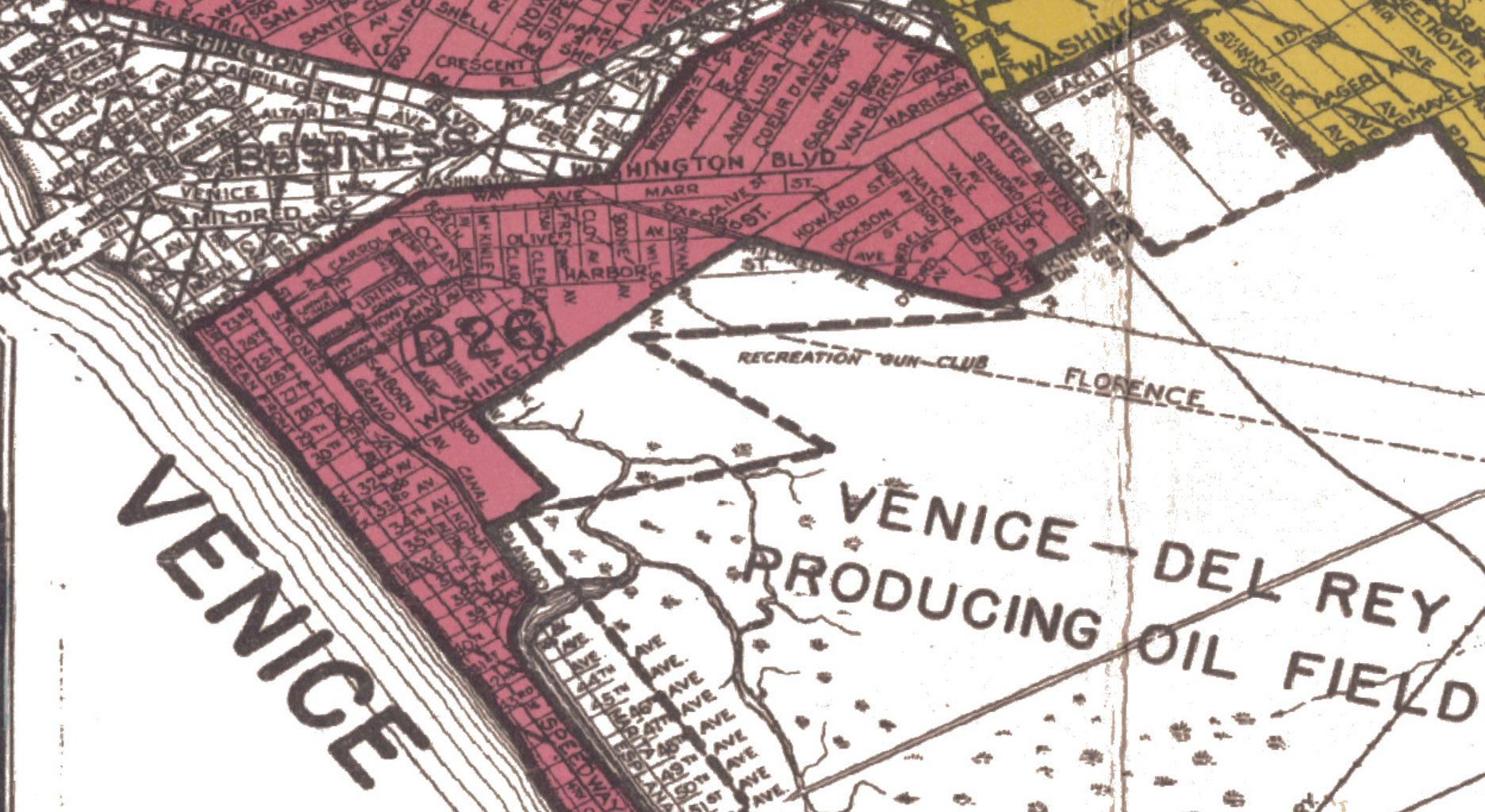
Venice was redlined in the 1930s for 15% of its area containing families of “Mexican, Japanese, and Italian” origins and 4% “Negroes,” according to written records. The decision in the 1940s to funnel federal money for housing away from the area is no small part of why today’s homelessness along its beachsides, followed by policing, have markedly increased over the years.

A screenshot of a map from 1939 by the Home Owners Loan Corporation, marking Venice for disinvestment from federal dollars for housing.

Appraisers for the federal government arrived to Venice in 1939 and misleadingly claimed, “Many mortgage institutions will not operate in area.” They also went on to call the community “blighted” for its multi-ethnic workers and families. At this point, if you’ve read about redlining on this blog, it should be clear that such language by government officials was not only malicious, but consequential in that disparaging language against non-whites was instrumental for states and cities to decide where wealth and poverty would reside, respectively.

Over time, as the militaristic takeover of Echo Park this past March showed, public officials in L.A. would largely choose to expend public tax dollars to formerly redlined areas in the form of policing, that is, policing poor people in these communities on the basis of “Neighborhood Watch” and also “super-predator” theories, which supposed that youth and working age-adults in such “slum” areas were simply more predisposed to commit crime given their impoverished living conditions. Of course, in order for these theories to work, city officials just had to ignore the fact that opportunities for wealth and home-ownership for Black and immigrant communities in “slums” were choices first taken away from them by the federal government and complicit municipal and state actors.

A screenshot of a map from 1939 by the Home Owners Loan Corporation, marking Echo Park for disinvestment from federal dollars for housing.

But don’t let what escaped real estate appraisers in the 1940s escape you in the 2020s: Disinvestment in non-white communities and the inverse for whites was and remains backwards planning since whiteness could not and still cannot survive as an investment without supportive non-white labor pools nearby. The very development of the Venice canals in the early 1900s was only possible because of Black labor. In fact, Black labor was so crucial to the construction of Venice beach that families were moved out to what would become the Oakwood neighborhood in order to speed up work for the grand opening of the famous beachside in 1905.

Canal scene in Venice Beach’s inductive year of 1905; Photo courtesy of the L.A. Public Library

Yet when federal appraisers arrived in 1939, on seeing “Black, Mexican and Japanese” residents alongside white European immigrant households, they were under strict orders from the Federal Housing Administration’s 1936 manual:

“The Valuator should investigate areas surrounding the location to determine whether or not incompatible racial and social groups are present, to the end that an intelligent prediction may be made regarding the possibility or probability of the location being invaded by such groups. If a neighborhood is to retain stability it is necessary that properties shall continue to be occupied by the same social and racial classes.”

Ironically enough, this logic, claiming that any and all whites interested in a home near Venice beach would turn away from the area on learning of Black and immigrant communities like Oakwood, was proven false by white influxes into Venice starting in the 1980s. Yet it’s nevertheless the logic of entitled homeowners associations in the neighborhood today, who assert as unscientifically as their peers did when “separate but equal,” or Jim Crow policy, was still law, that the very existence of unhoused people in the area depresses property values and “brings in crime,” something we’ll get back to in a moment.

For now, just note that housing shortages for Black and non-white immigrant communities in Oakwood would only be exacerbated after the population boom spurred by the end of World War II because of the pseudoscience of real estate assessments over the “compatibility” of such communities with the dominant white order.

Racial disinvestment against areas like Oakwood would continue well after the Fair Housing Act of 1968, when redlining was outlawed, with one exception: investment in policing budgets and details to patrol Black and Latino families in the vicinity. Like their contemporaries to the Southeast in Watts, then, despite the Fair Housing Act families were still discriminated in housing as well as in employment and educational opportunities, thus making them more vulnerable to L.A.’s expanding carceral state.

A real estate boom would hit the community in the late 1980s, abetted by an accompanying surge of policing, pushing major swaths of Blacks out of the historic neighborhood in particular. By 1990, the Black population in Oakwood fell by eight percentage points down to 22% of the area, a substantial drop from a high of 44% in 1970. Latinos and whites, by contrast, increased by five and three percentage points, to make up 50% and 26% of the Oakwood population in the years before the Rodney King rebellion, respectively.

By 2000, the Black population in Oakwood fell again by another seven percentage points to 15% of the area, while the Latino population saw its first decline after four decades of growth by three percentage points down to 47%. Over the course of the new millennium, however, Latinos would continue to leave Oakwood, following in the footsteps of Blacks, whose displacement from the area began as early as when Latinos grew to comprise half of households there in 1970. As of 2019, the percentage of Black families in the area was less than 12%, while the Latino population decreased to 30%. White families, by contrast, now form 73% of the Oakwood neighborhood, something that must have seemed unimaginable to many Black and Latino youth policed up and down its corners in the early 1990s.

A gang injunction by the LAPD in Oakwood was initiated in 1999, even as research showed that “gangs” across L.A. by the 2000s were largely inactive compared to the 1970s and 1980s.

An LAPD gang injunction map from 2013, allowing them to stop, harass, and arrest any “suspected” gang members.

Compounding a dearth of housing and employment opportunities, the injunction would harass and jail generations of working-age Black and Latino residents in the area until an ACLU lawsuit slowed it down in 2016. Yet by the early 2010s, as Brown families to the northeast in Echo Park would also find, the damage was done. In the words of one life-long resident of Oakwood from a 2018 interview:

“Families moved out to get their kids away from the gang injunction because you couldn’t be anywhere in Venice and not get stopped or harassed or arrested by the police if they deemed you a gang member.”

Additionally, an inspection of data from the Million Dollar Hoods project shows that over a five year period, from 2012 – 2017, police made over 3,300 arrests in the Venice beach area, with Black and Latinos accounting for 57% of arrests despite making up just 27 percent of the area’s population by 2008. Black men in particular were arrested at a rate seven times higher than their share of the population.

Conservative estimates of LAPD expenditures on arrests in the Venice beach neighborhood from 2012 – 2017.

Today, Council District 11, where Venice and Santa Monica are based, stands to see a continued decline of Black and Latino households at the same time that homelessness continues to soar for these two groups across Los Angeles. Since 2011, CD-11’s rate of unhoused people has grown by 160% to more than 3,200 people, making it the sixth most impacted district in Los Angeles today, and by extension, another resourceful hub for police activity.

This is because while the number of unhoused people in L.A. grew by leaps and bounds over the 2010s, research suggests that homelessness, followed by policing apparatuses and their budgets, grew most in formerly redlined areas.

For example, in 2019, just three of fifteen districts in L.A. contained 41% of the city’s homeless population, all three of which were heavily redlined or marked for disinvestment for their Black and immigrant residents during the federal housing administration’s development programs; neighborhoods in these areas include Skid Row and Boyle Heights, South Central or South Los Angeles, and Leimert Park and the Crenshaw corridor, where rapper Nipsey Hussle was slain in March 2019.

We also now return to the question of “crime,” particularly as it’s said to concern unhoused people. In the 1980s and 1990s, white liberal and conservative politics asserted that crime in L.A. was largely due to Black and immigrant “gangs.” Today, homeowners associations and their backers increasingly attribute crime to unhoused people, nearly 3/4ths of whom are Black and Latino in Los Angeles. Yet since the early 1990s through 2019, while homelessness increased in the city, reports of violent and “property crimes” across the nation–and in L.A. County–generally fell by more than half.

As recently as 2019, there were approximately 555 violent crimes per 100,000 people, compared to nearly 1,800 such crimes reported in 1990. There were also 2,200 property crimes per 100,000 people (not including arson) in 2019, though compared to 5,700 such crimes reported in 1990.

The point is so important it merits repetition: While homelessness in Los Angeles County has increased yearly since the early 1990s, both violent and property related crimes here have largely continued to fall since their 1990 levels.

An analysis of the crime rate by the Pew Research Center showing fallen crime rates from “’93 to…infinity?’”

But might the drop in crime be explained by the increased police budgets after all? Contrary to such rhetoric from police unions and their public official liaisons, “more cops” have not equaled more public safety. As Aya Gruber recently noted in a brilliant essay on “bluelining,” or police-patrol as a new form of redlining against historically discriminated communities of color, experts have long held that random preventative patrols, along with rapid response time to calls, neither reduce crime nor induce fear in people considering a criminal act. Additionally, Gruber points out:

“Researchers have also determined that ‘proactive policing,’ which includes ‘quality of life’ offenses, street sweeps, and stop-and-frisks, does not reduce, and in fact, may increase, crime (emphasis J.T.’s).”

If not for the continued policing of non-white bodies via gang injunctions and increasingly due to “homelessness,” then, exactly where would police have gone over the last 30 years? Something tells this writer that “preventing,” or rather responding, to 500 violent crimes and 2,200 property crimes per 100,000 households to the tune of billion$ would be more difficult for police unions and public officials in L.A. to justify annually. Yet it’s increasingly the case as more of us bear down on the city and county’s historic over-expenditures on its police state.

As author Alex Vitale noted in The End of Policing (2017): “The reality is that the police exist primarily as a system for managing and even producing inequality by suppressing social movements and tightly managing the behaviors of poor and nonwhite people: those on the losing end of economic and political arrangements.”

Moreover, in Los Angeles, there is overwhelming evidence to show why policing non-white communities into submission is not a sustainable path for the city, state or federal government. This August will mark 56 years since the war-zone in Watts, when the LAPD and Mayor Yorty called on National Guard troops to descend on Black bodies in the South L.A. community after their rebellion against continued police brutality there. The reign of fire led to the police murder of 26 civilians, the injuries of thousands more, and subsequent “riots” in response to over-policing and disinvestment against Black communities in sister cities over the following years.

This past April marked 29 years since 64 people lost their lives across Los Angeles, including ten murdered by police, while 54 others were killed amid looting and civil unrest; 3/4ths of those killed were Black, Asian-American and Latino. And as with thousands of other deaths and damages in cities all over the U.S. following the 1960s–each loss of life and damage was preventable, pronouncing the indignity of the “red line” against non-white communities well beyond the 1930s.

What’s also true is that a major part of why L.A. & Cali have always operated–dangerously–in isolation is because of Washington D.C’s refusal to rein in their correspondents when acting unilaterally against “poor” people. Yet as the progenitor or “forefather” of the Federal Housing Administration program that has segregated Black and immigrant neighborhoods in the inner city for nearly 100 years now, Washington D.C. is not extricable from discussions of equity, reparations, and reconciliation for housing, employment, and other opportunities taken from us.

In concert with a new civil rights movement, then, picking up where our first civil rights leaders left off, it’s now time for communities, from Oakwood and all of Venice, to Echo Park and beyond, to mark every dollar lost on policing rather than resourcing our neighborhoods. In a fair hearing, whether on the streets of D.C., or before the United Nations, each dollar represents what we are owed—with interest—in a new, New Deal for the 21st century.

J.T.

Making Our Neighborhood – The Pamphlets

Making Our Neighborhood – The Pamphlets (English version; inside)
Making Our Neighborhood – The Pamphlets (English version; outside)

We are going Chocolate Factory with the campaign for these pamphlets, dropping off packs at legacy businesses throughout East Hollywood this week. After the first batch runs out, supporters can check back with http://www.jimbotimes.com to purchase sheets in packs.

Versions in Español, Armenian, Thai and Tagalog are also soon forthcoming.

RSVP to our Panel Series at Easthollywood.Eventbrite.com.

J.T.