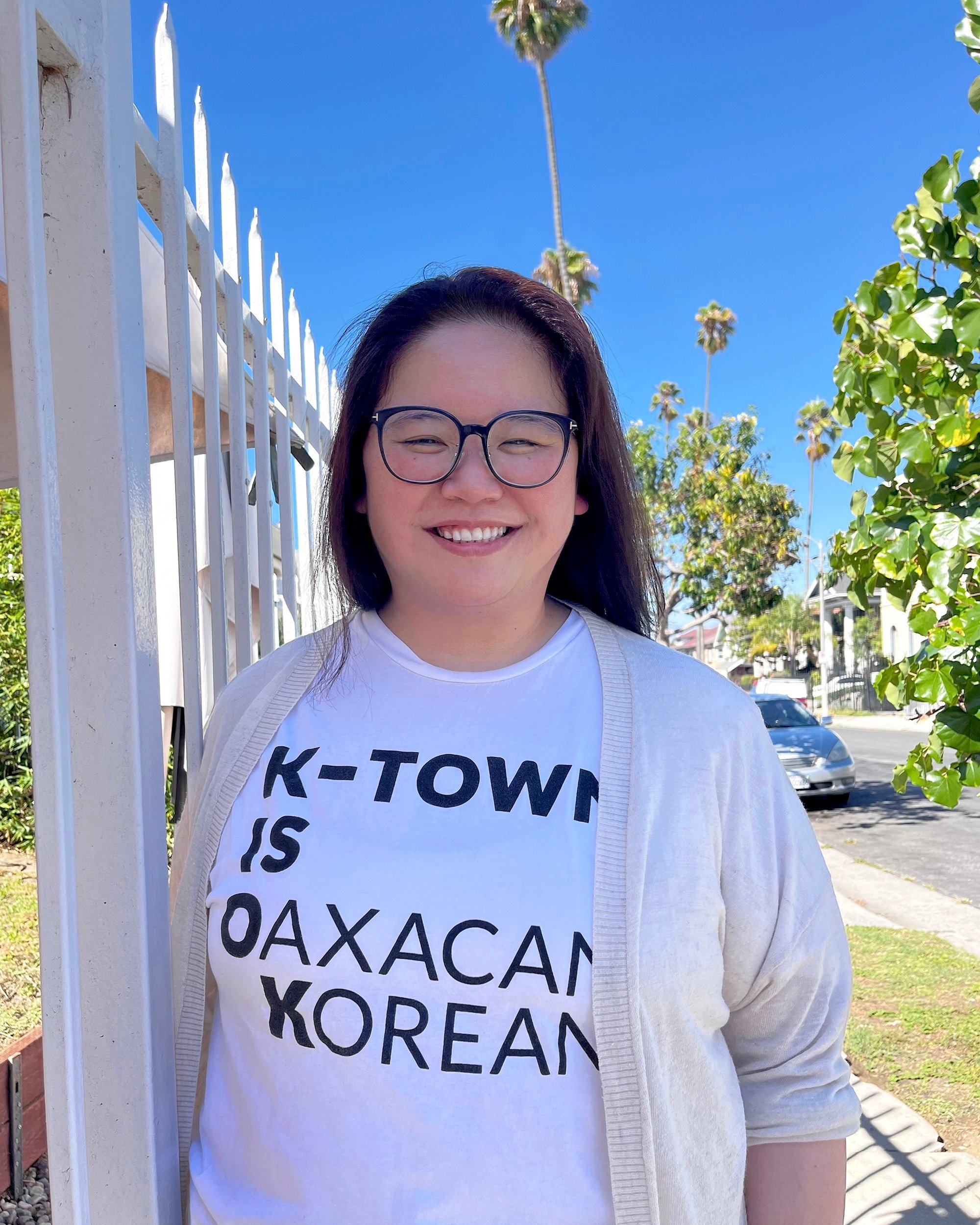
Soo Mee Kim: Sociologist and Koreatown Researcher

Interview has been edited for length, flow, and clarity. Soo Mee Kim photographed by Helen H. Kim. Archival photos provided by Soo Mee Kim.


Helen: Soo Mee, I appreciate the fact that you have both an embodied experience of K-Town as well as a scholarly perspective regarding placemaking. 

Soo Mee: Thank you. It’s true–I live in Koreatown, I’ve written about Koreatown, and did my PhD dissertation on K-Town as well. 

Helen: Oh, wow. How did you land on K-Town as the topic for your dissertation?

  Photo by Avital Oehler
Photo by Avital Oehler

Soo Mee: I was at the University of Illinois for my PhD and on one of my breaks when I came home, I saw that they had put in those urban markers on Olympic by Western and Vermont. I was fascinated by the cultural and political power dynamic shifts that were happening and it kind of got my brain tickled a little bit so I started to work with the idea of Koreatown as the topic for my research. Before that, I wasn’t really looking to study our community or anything related to our community because of how that is perceived in academia as the ultimate navel-gazing, especially for academics of color.

Helen: So tell me a bit more about your dissertation. 

Soo Mee: My research was on how immigrant-heavy communities like those in Koreatown—including both Korean and Latinx communities—that don’t have much traditional political capital, such as the right to vote, find other means to gain political power. Sure, money is one way, but I talked about how the lack of access to traditional political capital led to a need for the Koreatown community to find a way to be heard by the City Council and the Mayor and how building of cultural spaces like Koreatown can provide a way to create a claimable space that allows a political voice that can be heard. Outside of the Neighborhood Council, you cannot vote in the city unless you’re a U.S. citizen. Koreatown is one of the largest neighborhoods in Los Angeles and, back in 2012 to 2013 which was the period I focused on, it was 2.7 square miles with around 130,000 residents. That’s an incredibly dense population where so many were not able to vote in local elections. The shifts in dynamics were ultimately about the type of capital that these communities were trying to build in order to make a claimable space. For example—I don’t know if you remember—but in 2008 or 2009, there was a filing for Little Bangladesh, which led to Koreatown needing to officially file for a new boundary designation despite being originally designated in 1980 and the Korean community starting to grow there in the 1960s. We probably shouldn’t get into that right now because there’s so much more to that, but official designation of neighborhoods play an important role in allowing neighborhood communities to potentially qualify for certain types of funding and other types of recognition. 

If we could think of K-Town as a brand and support it as that, the amount of money that can be negotiated to flow back into the community could be abundant. Before the 2010s, when the era of foodies was in full swing, you really started to see an engagement of non-Korean people with Korean food. And Yelp played this role—just like Jonathan Gold did—to say, “Here’s the safe path to this foreign food you don’t know.” So if we had been able to have more nuanced conversations and dealt with community organizations and businesses, as well as the City and the Neighborhood Council and all of those things back then, I feel like we could have made bank for the whole Koreatown community. 

Helen: I think the branding issue gets complicated because some people will treat it as a Korean thing because it says “Koreatown”. But, as you and I know, Koreatown isn’t about “just the Koreans”. In fact, some people will go so far as to say it’s not about Koreans at all. That part I disagree with. I literally visited three Korean homes today in K-Town including yours so, um, yes, Koreans do live here. 

Soo Mee: But again, like you said, there are a lot of Koreans who still think that K-Town is just about Koreans. And that’s the complexity of claiming a space, right? I wish there had been a larger, collective conversation with the different communities of Koreatown to treat it as a brand. But if we go back in time to 2012, 2013, Koreatown was just not at that place yet. 

Helen: Oh, definitely not. Koreatown couldn’t capitalize on the possibility of “branding”, as you say, because there’s just so much trauma. So let’s go further back in time. Tell me when you first got to K-Town.  

Soo Mee: I immigrated to the U.S. in ’92 and came straight to K-Town, weeks after the Civil Unrest, in May. I was eight, so I didn’t know what was going on. We were just leaving Korea. My mom was very sad. My dad was already here for a little bit, just to set us up. My family was never rich. We were working poor. My parents decided to come to the U.S. for financial survival with whatever they could scrape together. I think it was still a time when people in Korea were being sold this idea that, if you’re willing to work hard, you can make it here in America.

I got chicken pox within, like, three weeks of coming here. I think it must have been one of the neighbor’s kids or something like that. And I couldn’t sleep because of the time difference, so I remember watching a Freddy Krueger movie and being scared out of my mind. It was just on TV and I didn’t know what I was watching. 

Helen: So watching Freddy Krueger is one of your earliest Koreatown memories? 

Soo Mee: Yes. I also remember all the news coverage because things were still so raw with what happened with the Civil Unrest. I just remember seeing a lot of people crying on TV. I also remember my parents borrowing money so that I could go to a 학원 {hagwon / cram school} to learn English because they didn’t even put me in ESL {English as a Second Language} at school. I didn’t know the alphabet. My parents panicked.

Helen: Why didn’t they put you in ESL? 

Soo Mee: I have no clue why but I never got ESL. So I went to this place called Elite Hagwon to learn English. I don’t know if it still exists but it was on Wilshire and Wilton.

About a year and a half later, we moved to the Valley because my parents were afraid that I would have an accent if we were in K-Town. Neither of my parents really knew English enough for the accent to become a problem, if that makes sense. The barrier was language, period. So I don’t know where they got this very hyper-focus on accents. I assume someone complained about someone having an accent, or maybe someone shared about an experience they had at my mom’s church. I feel like it’s kind of a word-of-mouth-generated concern more than anything, which then relates to them hearing about discrimination, about not-so-great treatment because of someone’s accent. 

Helen: I’ve never asked my parents about the accent thing specifically, but my dad in particular was obsessed about my English proficiency. I don’t get the sense this was something he’d been told. He just inherently felt like, “Well, we can’t do anything about the way she looks or what family she comes from. But we can maybe help her so that she speaks like an American.”

Soo Mee: It’s about fitting in and not sticking out, right? 

Helen: Right. It’s a card to play, I guess. 

Soo Mee: Yeah. A leg up when there’s already this assumption that there’s going to be discrimination, or that you’ll have to fight more for opportunities. So, because we landed in K-Town right around the Civil Unrest, I feel like we were in this weird bubble of a time period where some things became hyper-crystallized for community members all at once, if that makes sense. I think they saw something happen that they didn’t quite understand, but they saw that one of the issues was that they were seen as perpetual foreigners. And that aspect still resonates. I think when you’re perceived as foreign, you’re not heard. Literally. They see the face, they hear a different accent, and they decide even before they consider the words coming out that they don’t understand what you’re saying. 

Helen: Yes, I’ve had that experience, even though I don’t have an “accent,” per se… So what is Koreatown to you now, as an adult? 

Soo Mee: I think, for me, Koreatown is very much about memories. It’s a constant overlap of the past and the present. I don’t know if you remember that there used to be a library by the KFC, across from the big church on Western and Beverly.

Helen: Oh, yeah, Oriental Mission Church. 

Soo Mee: There was a library near there. So, my parents would drop me off there during the summer, because they were working all the time. There used to be a mom-and-pop place next door where I would eat 돈가스 {tonkatsu}. I would go to the KFC if it was really hot because their AC was freezing to the point that I would get a stomachache. Those were my summers, you know what I mean? I would read Korean comic books at the library. I never truly appreciated that at that time, but you’re in L.A., and you go to the public library and get the latest edition of this anthology of Korean comic books. That’s pretty fun, you know? 

Also, for me, Koreatown’s really about growth in a lot of different ways. Obviously, there’s a lot of development happening. But aside from real estate developers, I also see an influx of developers of social good. Sometimes in a very positive way, sometimes not in the most positive way. But either way, I think we’ve come a long way in terms of conversations between different communities. We’ve still got a long way to go, though. 

We have a lot of folks with good intentions organizing a lot of different things. But, again, if we could kind of get it together, the amount of capital that could be provided for a lot of people would be so different. I think one of the barriers is a lack of awareness of history for every community represented. For example, a lot of folks don’t realize the nuances of the diversity within the Latino community, and that becomes a rather complex issue to navigate, right? I once did a project with KYCC’s Koreatown Storytelling Program (KSP). I was teaching at Emerson at the time so KSP, my students, and I developed a panel of Koreatown Latinx residents. It wasn’t a huge panel and I think it ended up being mostly Central American folks. We wanted to understand their experiences during the Civil Unrest. We talk about the Korean side, we talk about what the Black community went through, but we don’t talk about (as much) the huge contingent of the Latino community that was present at that time. And so one of the panelists talked about how she had originally left her hometown because of the violence there, and the Civil Unrest brought it all back. The point was for her to get away from that, and she had to relive similar feelings for multiple days. I think those are things that we never really quite navigated collectively, and we still need to have those conversations because even though it’s 30 years ago, it is so raw for some folks. 

I don’t know if you ever heard the Radio Korea recordings. 

Helen: Yeah, I have.

Soo Mee: I went to the USC library when I was doing field work. And the librarian got me a copy. That, for me, made it really emotional. 

Helen: It actually made me feel sick when you asked about the recordings because I remember the feeling when I first heard them. 

Soo Mee: There’s a woman on there asking about her store, saying, “Oh, is that on fire?! Oh my god, what are we going to do?” and  “We don’t have insurance!” A lot is in that one clip. Institutional failures. Redlining. Economic divestment from neighborhoods, right? All of these things all rolled into that simple clip. A lot of the recordings are like that. 

Helen: It’s all just so raw. 

Soo Mee: It’s not that I needed to hear it to understand the rawness. But it made me ask how long this is going to stay raw for a lot of communities in K-Town. I can’t play it at presentations because it makes me very upset. Plus, people who do not speak Korean would not fully understand the tone.

Helen: It wouldn’t hit them the same. 

Soo Mee: It wouldn’t hit them the same. It doesn’t matter if they have subtitles. It’s that nuanced linguistic and cultural barrier, right? And that made me really double down in what I decided to put forward as my research. Because it’s beyond navel gazing. It’s really about representation of narratives. No one has to agree with me. They can take my data and look at it in different ways, absolutely. But I feel like I brought something of value to the table as a Korean American academic. 

I remember for either the 20th or 25th anniversary, a UC Riverside professor named Edward Chang put together a conference where he had invited a lot of well-known folks. Some Korean American journalists who were active at that time but also a diverse set of folks who weren’t all Korean. I think people were saying “Civil Unrest” or “an Uprising”. And there was a woman who did not like that at all, and when the mic was going around, she grabbed the mic and she basically scolded the younger generation for not calling it a riot. Even naming the thing is very complicated. I call it “Civil Unrest” because it’s the most neutral term that I can think of, but I know that folks that would rather have me utilize the term “Uprising” or “Riot.” When I teach it, I can’t call it just one of those things. It is all of those things. But when I’m talking about the Korean American perspective, I specifically call it 사이구 {sa-ee-gu / “429” for April 29, 1992}. But when we talk about institutional issues and, you know, all the things that ultimately led up to what happened in ‘92, it gets more complicated than what to call it, right? 

South L.A. never recovered after the 1965 Watts Rebellion. And that was, what, 27 years before ‘92, and then basically 27 years after ‘92 was George Floyd, right? When the protests were happening in 2020, I was very curious about whether K-Town would be affected or not. And it wasn’t. It was the Westside. If you want to fight the institutional powers, it’s going to be the Westside, not Central or East, right? Seeing that, I felt like it indicated that the conversation changed in Los Angeles, at least a little bit. What the white-centering system wants us to look at is always inward or at each other instead of the very core issue, which is the centering of whiteness in policy, right? And I think the movement at least in Los Angeles in 2020 to protest by the Grove instead of by Western was because of the conversations we’d been having. 

And part of the overall conversation is the Asian American community experiencing this collective and empowered desire for recognition that we exist, that we all have experiences based on our community standings or our ethnic background. But, actually, I don’t have a home in that identity of “Asian American”. But I know that’s what I have to call myself. Maybe if you’re second-generation you have a more rooted understanding of that, especially if you grew up without a community of your specific ethnic group available to you. Then the idea of Asian-American-ness could be very vital. For me, I understand “Asian American” just like I understand K-Town as a brand and as a community. 

Helen: So it sounds like you perceive “Asian American” more as a platform rather than an identity. 

Soo Mee: Yes. 

Helen: Do you feel like what you said about the Asian American community is the heart of some of the friction we have in Koreatown? Everyone wants an acknowledgment. We are all trying to be heard. And so as I’m doing that, the person next to me is suddenly shouting really loudly. And I’m like, “Hey, I’m trying to get myself recognized!” And we start trying to kind of one-up each other. We are all so desperate for recognition, because we feel we haven’t gotten yet. 

Soo Mee: Yeah, and I think that’s true for all communities of color. “Why don’t they care about us?” It’s always there at the tip of the tongue, the tip of our minds, right? This is the point of the social construction of the way race works in this country, to make us always say, “What about us?” when we should be asking, “Why are we centralizing whiteness all the time in this country?” Why aren’t we challenging these notions that are clearly meant to disenfranchise people of color, Black communities, indigenous communities? Why do we keep saying, “What about us?” We’re obsessed with this idea of piecemealing out privileges, and that will just keep whiteness centered forever. 

Helen: So what do we do about this in Koreatown? Like, what do you hope for the future of K-Town?

Soo Mee: My hope for Koreatown is that we slow down for more conversations. If we could take the time as the overall Koreatown community to choose processes for more equitable housing and, even for commercial development, figure out how they can benefit the community in a very concrete way–“If you’re gonna come here and open up your business, we want X, Y, and Z.” We have so many opportunities with big and small companies opening up in K-Town. Why aren’t we demanding things that are more community-oriented? That’s my hope for the future of Koreatown. Slowing down so that there could be more consideration. More inclusion. 

The last thing I wrote about in my dissertation is this idea of creating a consumable space to become a claimable space. And that’s why I’m so stuck on the idea of K-Town as a brand. And creating a brand that we can get behind, if that makes sense. But how do you communicate that to everyone? Because the lack of trust is real. And I understand that 100%. But I feel like we’re all still too polite and we don’t want to say what we really are worried about, much less what we want. What if we could have a conversation where people could express what they want—representation—and what the worries are, right? “We’re afraid you’re going to only represent the Korean community,” for example. Then I think there could be a kind of “come-to-Jesus” moment, right? I just wish we could hear each other’s concerns, and not hear them as a dig. But we do. So K-Town still feels very precarious to me.


Connect with Soo Mee: Website | Instagram

Susan Park: Community Organizer for Korean Language Access

This interview has been edited for length, flow, and clarity. Photos provided by Susan Park.


Helen: I get the sense that you make time for the community a lot, on top of all the things that you already do! So thank you for making time for K-Town Is OK. To start, could you tell me a bit about your immigration story?

  Winter 1969/1970, Seoul
Winter 1969/1970, Seoul

Susan: I was born in Seoul, South Korea, in October of 1969. My family moved to Los Angeles in January of 1975. I distinctly remember that my father, older brothers, and I did not want to move to America. It was my mother who wanted to come. I say “moved” rather than “immigrated” because the decision was not one of need. It was one of choice. My family was upper class in Korea and we had a lot of social currency and political power. 

I also think that saying you’re an immigrant implies some kind of benevolence on the part of America, which I did not feel and don’t think really exists. When we came to Los Angeles in January of 1975, we were treated like pariahs. 

Helen: By whom? 

  Seoul, late 1972/early 1973: Susan with her two older brothers and uncle, who was a member of South Korea’s National Assembly
Seoul, late 1972/early 1973: Susan with her two older brothers and uncle, who was a member of South Korea’s National Assembly

Susan: By everyone. By non-Koreans. My best friend back in Korea dealt with a really heavy stigma because she was the child of a North Korean defector who was accused of being a spy by the South Korean government. And now, in America, I was like, “Okay, so now I know what it feels like to be my friend.” My family and I experienced people yelling racist slurs at us when we were walking down the street. This was a really common occurrence. It was like Trump’s America. 

Asian Americans who are five, seven, ten years younger than me will sometimes say, “It wasn’t that bad. Are you sure?” I have to explain to them that things got a little bit better every year. When they were in kindergarten, I was already in fifth, sixth grade, or even 10th grade. So there was a big, big difference in our experiences. 

  Los Angeles, March of 1975: A park near Hancock Park, celebrating Susan’s oldest brother’s 11th birthday
Los Angeles, March of 1975: A park near Hancock Park, celebrating Susan’s oldest brother’s 11th birthday

Helen: I came almost ten years after you, and I see how there would be that big difference. Even within my own family, my sister is five years younger than me, and our high school experiences were very different. The racial dynamics were strikingly different at the same school, half a decade apart.

Susan: Every year, it just kept changing. Things are still changing, but they’re changing asymmetrically. 

Helen: What are your earliest memories of Koreatown? 

Susan: Koreatown wasn’t really Koreatown when we moved. It was just a few stores. In Korean, we would just call it 한인촌 {Hanin-chon}—you know, the Korean neighborhood or village. There were some stores on Olympic, a few on Western. Koreatown back then was a high-crime area. So if we were racialized and attacked while walking somewhere, say, north of Hancock Park, it was worse in Koreatown. It was an inhospitable place for a lot of Koreans.

Helen: But your family would go there anyway? 

Susan: Yeah, we’d go there to shop. We would go to Olympic Market. There was another Korean market down the street, I think in the same strip mall where 함흥회관 {Ham Hung Restaurant} is, that little plaza. We’d also go to 김방아 {Kim Bang Ah, an iconic K-Town shop from 1969 to 2018} to get 메주 {meju | dried fermented soybeans in brick form} and 떡 {tteok | rice cake}. And then for other things like herbs and mochi, we would go to Chinatown and Little Tokyo. Back then, Chinatown was just banging. You could barely walk the streets because there were so many Asians who came to shop in Chinatown.

Back in 1975 or thereabouts, you were probably rich if you were coming to America. You had enough money to buy a plane ticket. This was back then when the living wage in Korea was a few dollars a day. I mean, imagine, right? 

Helen: Coming to America was a dream in the 70s, in that it was both an aspiration and an impossibility for a lot of people.

Susan: Yeah. And you had to have somebody in America who could sponsor you. [Immigration and Nationality Act of 1965 opened immigration for people outside of non-Western, non-Northern Europe. There was a seven-category preference system, with one of the categories being having relatives who were U.S. citizens or legal permanent residents.] That meant you were from a multi-generationally literate family. So most of the Koreans who came back then were highly skilled, part of the professional class. And they built lots of very tight-knit Korean communities in Koreatown and the San Fernando Valley, and it was based on your dad’s hometown, your mom’s hometown, or the same high school, junior high, college, whatever, they attended back in Korea. 

Helen: Sounds like that was true for your family as well? 

Susan: Yeah. 

Helen: So what is K-Town to you now? 

Susan: It’s home, and it’s a big part of my heritage as a Korean in America. I have a very long memory of Koreatown: the growth of it, the decimation of it in 1992, and the regrowth of it, which was led by corporate and retail real estate developers. There’s also the gentrification, even by Korean-Americans who come from other parts of the country.

Helen: What do you find unique about Koreatown in the larger landscape of L.A.? 

Susan: If you’re engaged with Korean businesses in Koreatown and the business owners see you as understanding Korean cultural norms and the language and such, it feels like you’re living in a small town. I drop off a fancy watch that my aunt gave me at the watch store, or I drop off my car to get service for tires. I don’t get a ticket, I don’t get anything. It’s just, “I’ll see you later,” you know? I tell non-Koreans friends about this and they’re like, “What? You just left a watch there? You left your car there? They didn’t give you a receipt? Is it just trust?”

And then Koreans in Koreatown, especially the elders… You have a lot more people from the provinces. So you’re more likely to hear 사투리 {satoori | Korean regional dialects} in Koreatown. It’s not super common, but it’s more common than other parts of L.A. I would say, overall, Koreans in Koreatown are different from Koreans who live elsewhere. 

Helen: You mean like the Valley or Orange County? 

Susan: Yeah. It’s very different. Koreatown is like a very small town. It’s not even like Seoul. It would be like a little neighborhood in Seoul, or a little village somewhere. People just act like that. Like, with some of the Korean seniors I help or church elders I meet for the first time, they totally act like we’re back in Korea, in 1975. It’s like, “Oh, you’re Korean? Then we’re 식구 {shikgu | family}.” Sometimes a very dysfunctional family. 

It’s like this even with American-born Koreans in Koreatown. This woman who I met for only the second time was like, “I don’t know why, but I feel so protective of you. I’m just going to treat you like my little sister, my 동생 {dongsang}.” So Koreatown does feel more like family in a way. It was very easy for me to start my nonprofit and gain a lot of immediate support from Koreans and Korean nonprofits. 

Helen: K-Town is also such a multiethnic, multicultural neighborhood. Could you speak to some of the changes you’ve seen in the perception of Koreans here over the years?

Susan: There were these narratives that had been brewing for a while, like, ”the Koreans stopped Little Bangladesh from getting a Neighborhood Council” or “the Koreans stopped a shelter from being built on Vermont” or “the Koreans are so insular”—that portrayed Koreans as being racist and as being a monolithic, singular voice. The most vocal group of Korean protestors at the homeless shelter rally were hired by real estate companies and developers to be vehemently against it. These people got conflated with all the groups of Koreans who came out. The real issue was that then Council Member Herb Wesson didn’t consult with Koreatown leaders and residents about the shelter. There’s this myth that Asians have too much. Meanwhile, I was seeing the rise of homelessness among Koreans and other AAPIs in Koreatown and how this was not being addressed. 

There’s also a sense of fighting for limited resources in Koreatown among Koreans and between different groups. Unfortunately, dialogue is extremely difficult since there are so many immigrant groups who can’t communicate with each other. This is why I think more bilingual children of immigrants need to step up to the plate for community healing and reconciliation. Marginalized peoples are in the same boat.

There are other weird narratives about Koreans not belonging in Koreatown. I started hearing from some people in the Latino political class that Koreans don’t live in Koreatown. And then we saw that whole controversy come to light in the recording of Nury Martinez, Gil Cedillo, and Kevin de Leon. They wanted a Latino takeover. Gil Cedillo says there aren’t Koreans in Koreatown: “It’s all Latinos, ha ha ha.” Their statements were so intentional and planned. 

Helen: And Cedillo said it so confidently… So what was your reaction to that? 

Susan: “Koreans exist in Koreatown!” You know, we built it from nothing. It used to be a terrible neighborhood that nobody wanted. We did not displace anybody. Koreatown is multi-ethnic, but it is also very Korean. My Cielo invited me to speak at a massive Oaxacan rally following the release of the Nury Martinez tapes.

There’s this idea that Koreans are all doing really well just because there’s a Korean-owned bank and it has a Korean sign. But I don’t own that bank. The Korean bank is just another corporation. We don’t even have any Korean credit unions. 

Helen: What I hear you saying is that people mistakenly assume that the presence of Asian-owned corporations in the enclave means that individuals who may be doing small business or living there have some correlating success or wealth.

Susan: Yes. Like we’re just this one big blob. I went to L.A. tenants’ meetings, and I was told that the Koreans own everything here but they don’t live here, that they are not tenants here. There are low-income, working-class Koreans whose presence is being denied, in Koreatown as well as south of Koreatown. There are a lot of older Koreans who live near West Adams, USC, and then to South Central. 

Helen: Seeing these issues arise drew you into more activism and involvement, I’m assuming? 

Susan: Yeah. I started a nonprofit called Asian Americans for Housing Environmental Justice to address issues of Koreans being displaced, and even erased in Koreatown. 

KYCC made a decision in 1992 to become multicultural and diverse, and that’s great. And the same thing with the Koreatown Immigrant Workers Alliance, KIWA. It used to be the Korean Immigrant Workers Alliance but in 1992 they made the decision to change their name and their path. We’re at the point where almost all of KYCC’s constituents are Spanish-speakers or Black or Indigenous, and Koreans are actually disproportionately underrepresented and underserved. KIWA is mostly Latino-serving. There are very few Koreans they’re serving, very few. They were trying to support the Korean workers at Coway [unionized in 2022], but that’s the first in a long, long time. I’ve got pretty decent knowledge of what’s going on with Koreatown nonprofits. 

As a high-level bilingual person with a very long history in Los Angeles, and knowing all the details of Koreatown—who the players are, where the narratives come from—I thought I was in a unique position to address these issues. 

Helen: We’ll come back to the specific issues your nonprofit addresses. Earlier, you mentioned Koreatown in 1992. What are your memories of the ‘92 riots/uprising?

Susan: I remember it really well. I remember feeling like Koreans were being targeted and scapegoated. It was national. There were things going on in New York too, for example. I thought it was really unfair to paint all Koreans in a certain light. Around that time, Radio Korea also had a hand in making Koreans feel entrenched and battled in specific areas like South Central. And though it all, I felt like the Korean side of the story wasn’t being heard. 

First of all, America holds Asians with accents largely in contempt. Then you have Korean-Americans who were trying to speak up without being prepared for it, with their halting English. They were recent immigrants so they didn’t know anything about Black American history. Nobody teaches you that before you come to America. They weren’t even teaching Americans Black American history. So the Koreans fell into the claptrap rhetoric of respectability politics, saying, “We work hard, we work hard,” which is going to fall on deaf ears. Black Americans work hard. Other people work hard. So we didn’t look good in the media. I resented the L.A. Times for framing the whole thing as a Black-Korean conflict. That was all over national media and I really felt like what the hell? 

Obviously, there were times when Koreans behaved inappropriately. The worst case was Latasha Harlins. [Harlins was a 15-year-old African-American girl who was mortally shot by South L.A. convenience store owner Soon Ja Du, 13 days after the videotaped beating of Rodney King which led to the ‘92 Uprising.] That was tragic. 

The Korean-American community has changed so much. But when the riots happened, that generation were folks who had experienced Japanese colonialism and war as children if they were older, or grew up in a post-war economy with all of the trauma, grinding poverty, and military dictatorship. 

Helen: In fact, the day that Korea was liberated from Japanese rule was also my dad’s third birthday. August 15,1942. 

Susan: So the older Koreans can get triggered when they hear that somebody’s attacking Koreans, you know? That sense of existential threat still affects us, that multi-generational PTSD.

Helen: Then do you think there’s a certain amount of validity in the comment that Koreans can be insular?

Susan: Well, when I was a kid, Korean food was thought of as just gross. 

Helen: Yup, totally.

Susan: Stinky, fermented. When I invited non-Korean kids over to my house, there was always some form of negative comments. So why do I want you in my home? Why do I want to explain my food to you? 

You know, there’s this American thing of, “Explain yourself and your history to me before I try to understand you.” Look, people don’t need to explain themselves to me for me to treat them like a human being. You don’t need to know my history for that, okay? There’s an American cultural tendency that all Americans pick up, where we want people to explain themselves to us. Like, “What are you doing here? Tell me about your culture, invite me to your party.” Not to mention the thing of grouping all Asians together. Most of the other children of color I grew up with were Black and Mexican. I’m comfortable at a cookout or Mexican kid’s birthday where there’s a pinata and the adults are drinking beer. I know these kinds of cultural behaviors better than I would if I went to a Filipino family reunion. Korea and the Philippines aren’t even near each other. But we still get boxed in with people we have nothing in common with. 

Helen: Something that’s really interesting to me is how you used to think as a kid, “Why do I need to explain my food to you?” but skip to 2023 when you’re explaining our food to people. 

Susan: This has been a high demand for a long time because I used to write about food for LA Weekly and KCET Good Food. And people were always like, “Why don’t you write about Korean food?” But back then, there was just not enough basic information out there about Korean food. So I’m really grateful for people like Maangchi and Korean Bapsang and My Korean Kitchen and Kimchimari. They did a great job of explaining the basics of Korean cooking to people. Now we’re at a time globally where there are enough people who know the basic stuff. People want more and they’re ready for it. They’ve studied enough Korean stuff so that I can drop more detailed, more complex information and they understand it. So that’s why I’m doing it now. 

Helen: I guess the distinction is that there isn’t that sort of entitled demand in the desire for information now. 

Susan: Yeah, it’s not entitled. 

Helen: You can tell that they’re genuinely interested. 

Susan: I mean, bless her. Maangchi was trying to pitch Korean food at a time when a lot of people didn’t know about it. People back then were like, “Well, what’s so special about this?” Maagnchi explained all the basic stuff to them. And now there are more people who say, “No, we know this is special.” 

There’s so much space in the world now for different kinds of messaging about Korean food. So I can see lots of like niches for myself. I really get deep into the history, etymology, and details of Korean food. Even Korean-Americans, they could ask their parents about these things but their parents will say, “What are you talking about?” 

Helen: Right. I feel like a lot of immigrant parents weren’t thinking in that intentional way about passing things down. They were head down and deep in survival mode, just trying to keep moving forward. Like, with my parents, if I really sit them down and ask specific questions, they have so much wealth of wisdom. So I’m trying to do more of that now. But when I was growing up, the answers to my questions were really basic, even if they did have the knowledge.

Susan: But now they’re giving you more detailed answers? 

Helen: Yeah. 

Susan: And they like doing that. 

Helen: Yeah, absolutely. 

Susan: My parents spent a lot of time teaching me things. Sometimes it was like a hostage situation when they were explaining things. 

Helen: Ha, that’s with my dad, too. 

Susan: Yeah, but I could tell now they enjoy talking about things. Back then, they were just like, “We have to give you all this information, like an encyclopedia. Because you’re gonna forget!” The anxiety of existential threat. 

Helen: Absolutely. Gosh, I felt that in my gut! 

We’ve covered such a wide range of topics today. I have one, final question. In light of your history and the work you do through Asian Americans for Housing and Environmental Justice, what is your hope for the future of Koreatown? 

Susan: The Koreans need help. They really know so little about American process. And Koreans who don’t speak English are also widely mistreated by non-Koreans. I see it every day in Koreatown. There needs to be increased access for Koreans and fellow AAPIs who have limited English proficiency (LEP), other linguistically marginalized people such as Indigenous people and even Black Americans who are also marginalized because they speak in African American Vernaculars vernacular. A lot of Koreans just don’t know what their rights are. They don’t really get any social services beyond the bare minimum. Right now and in the long term, the primary goal of my nonprofit is language access. So whatever programming we do, it’s for increased language access.

I want linguistically marginalized people to have more say in urban planning and environmental planning in Koreatown, to know what their rights are, and to be engaged with each other through my nonprofit and the community spaces I create. I’m good at that kind of stuff. I call it linguistic reconciliation rather than racial reconciliation. 


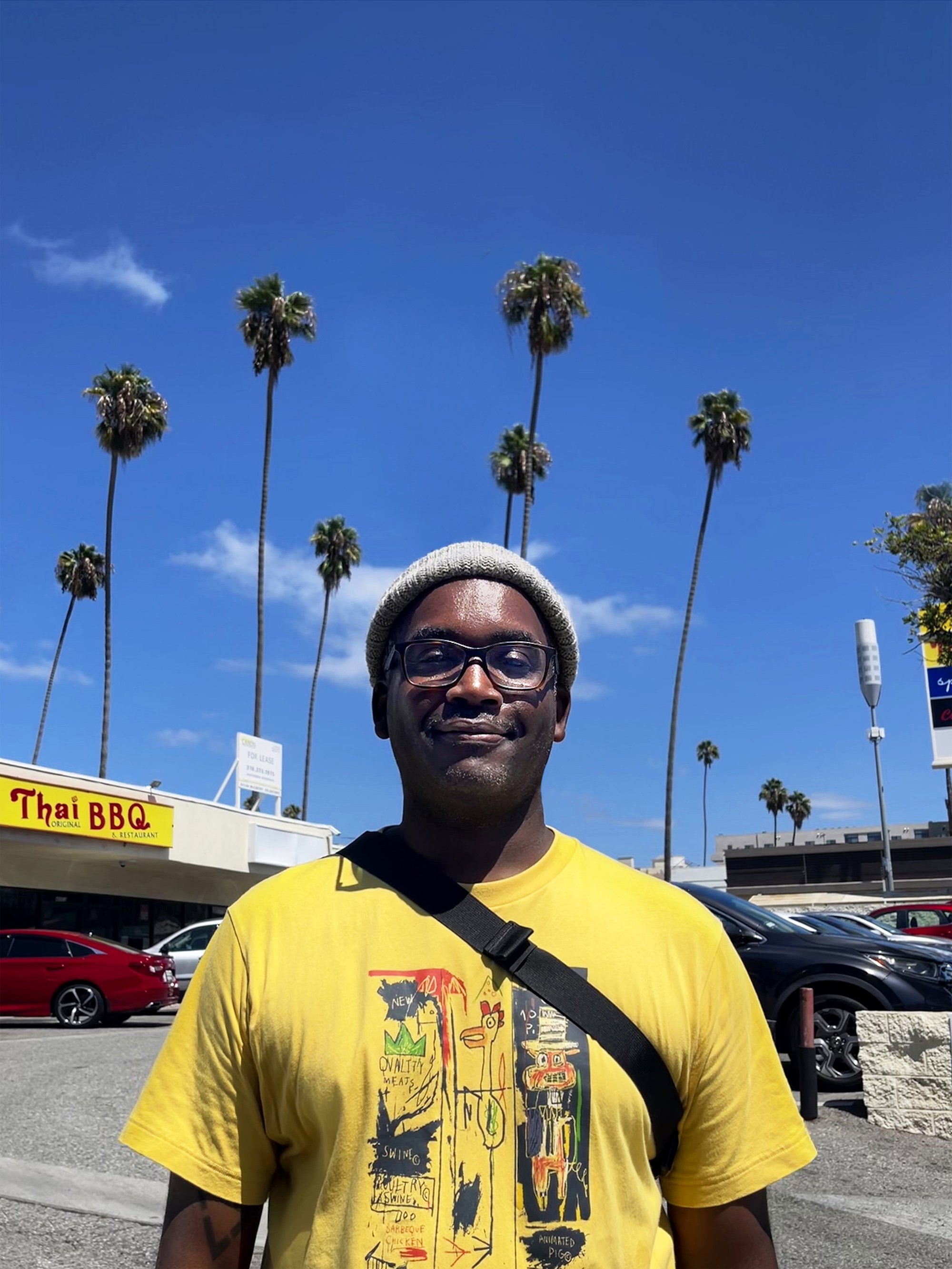
Kwasi Boyd-Bouldin, Artist/Photographer

Above portrait by Helen H. Kim. All artwork below by Kwasi Boyd-Bouldin. This interview has been edited for length, flow, and clarity.


Helen: How did your fascination with documenting places develop? 

Kwasi: Well, I lived in a couple of different places as a kid, so neighborhoods always had a fascination for me. Like, how I would move to a new neighborhood and it would start becoming really familiar to me. Also, skateboarding was a really big part of my life. Even before skateboarding, I liked riding my bike. I was just one of those kids that was in the street all the time. So I started from riding my bike to getting heavy into skateboarding. Then I got older and got into graffiti. And graffiti became the lens through which I kind of viewed things. But these things were never really separate from each other. They all have a real connection to a geographic location. So that’s how my fascination with places got built. 

Helen: Speaking of which, can you tell us about your history in K-Town? 

Kwasi: So, basically, I moved to Koreatown when I was 10. I lived in the same apartment until the time I was 23, and then I got my own place right off of Olympic and Western, where I lived until I was in my early 30s. 

Jimmy: Do you know why your mom decided to move to Koreatown? 

Kwasi: It was a better neighborhood than where we were living. And rent was cheap. For a really long time. That was not only with Koreatown but also the Central Hollywood area.

Helen: So what do you think kept you in Koreatown? 

Kwasi: I just didn’t leave, you know what I mean? The main thing that kept me in Koreatown for so long was the rent when I moved out into my own place. That apartment was $550 a month and it was rent-controlled. The rent was starting to go up in the area by the time I left but I was still only paying $825. That’s how I was able to put myself through school, how I was able to be a photographer and buy film, how I was able to be an artist and afford supplies. I lived in K-Town, worked in Downtown, went to LACC and Cal State LA. And I just always had a camera with me in my daily routine, photographing Koreatown. I was burning through roll after roll and just recording everything, you know? The only reason I moved out of K-Town is because I got engaged and we needed a bigger place. We have kids now and, even though rent is still expensive where we live, we have a lot more physical space for them than what we could afford out here. But both sets of grandparents are in Koreatown, so we’re always around.

Jimmy: It sounds like family is pretty key. 

Kwasi: Yeah. Like, you can’t really replicate or communicate what it was like when we were coming up but we like having the kids around it all.

Helen: There’s this thought that there’s a lack of history or rootedness here, or that there’s an overall sense of disconnect. But for the people that grew up here and have stayed here, our experience of L.A. is, like, in a weird way, a provincial or small-town way of living. Your mom still lives here and you come over on Sundays. I was talking to my mom on the way here to let her know that I’ll be over for dinner later. Like, I go over to my parents’ for dinner every week, you know? And that actually exists in L.A. and in Koreatown. 

Kwasi: I was born in New York. I moved here when I was two. L.A. wasn’t aspirational for me, and it wasn’t exceptional. It just was what it was. I bump into people I went to elementary school with, working at a store that they’ve been working at forever. You get a chance to see people living their lives in L.A. in a way that mainstream media doesn’t see. But, I mean, this is very much the case for K-Town. It’s very much the case for, you know, Boyle Heights or South L.A.

Helen: What do you think distinguishes Koreatown as a neighborhood within the context of L.A.? 

Kwasi: Well, I mean, I think that K-Town is really different now to when I was younger. There’s a lot of hype now. It’s kind of weird. 

Helen: I know, right? 

Kwasi: When I was younger, “Koreatown” was the label because businesses were Korean. I had a few neighbors who were Korean but I had more Korean neighbors when I lived in Hollywood and, really, my neighbors were from all over the world. So the name wasn’t a mislabeling but it also wasn’t the whole story. Like, if you lived in K-Town, you knew what that name meant, and it didn’t necessarily mean that the people were Korean. And, there was this sense of community. There was gang activity and all that sort of thing but it wasn’t as epic as it was in some other parts of the city.  

And when I say “community,” skateboarding was huge in this area. You go back to all the skating videos from the 90s and they’re all filmed on Wilshire. So being a latchkey kid and being able to skate on Wilshire—that’s what all the neighborhood kids did, hanging out and skating. A lot of the communities in Koreatown—not all of them, but a lot of them—were really racially mixed. You pretty much only saw that in K-Town and parts of Hollywood, a little bit on the Westside. So that intersection, that free flow of different types of people, was kind of unique to the area. 

Helen: Being that you were a latchkey kid, what were your go-to afterschool snacks? 

Kwasi: Oh, there’s a lot. I used to really like… What are they called? Ho Hos? No, Zingers! And this candy that’s kinda like SweeTarts, but in a long pack. Kinda chalky and in, like, thin discs… 

Helen: I know what you’re talking about. Necco. Necco Wafers. 

Kwasi: Yeah, yeah, yeah. Also, my friends in elementary school introduced me to Tamarindo (Mexican tamarind candy). That, and the corn with the mayonnaise. And I used to like random things from the neighborhood ice cream trucks. Different trucks that frequented different neighborhoods had different snacks. I used to go to a private school for a few years called Our Savior right off of 6th and Wilton, and it was really reflective of the changing demographics in the area because it was literally half Black and half Korean, with couple Filipino and couple Latino kids. So at that school, the ice cream truck that used to come around there had more Asian snacks. That’s where I used to get Thai iced tea when I was like five. 

Helen: Wait, you were having Thai iced tea when you were five? 

Kwasi: Yeah, caffeine doesn’t bother me. I can have coffee and literally go to sleep right after.

Helen: You were a very sophisticated five-year-old! You’re all, “Ice cream? Forget that, I’ll have the tea.”

Kwasi: Yeah, you know, I was a fancy kid.

Helen: Feel free to reshape this question however it fits with your experience, but I’m curious to know how your identity as an African American man intersects with or was shaped by Koreatown. 

Kwasi: That’s just who I was in this place. But, I mean, I did live in K-Town during the L.A. Riots and that was intense because I was young. 

Jimmy: Oh, right. You here when the riots were taking place. 

Kwasi: Yeah, I was here. So there was like a hardening of racial lines in a lot of ways for a while. But, honestly, l was in junior high school and there wasn’t Twitter or the internet, so a lot of how things were wasn’t necessarily in my face. In general, there weren’t a lot of Black people in Koreatown but, like I said, it was so racially diverse—the crews and everyone. It wasn’t utopia, but it was fine, you know what I mean? I don’t think I came across anything particularly harsh—or particularly good—because I was Black in Koreatown. So I guess in that way it was pretty much the same as it was if you were anything else in Koreatown. After the Riots, when I told people, “I live in Koreatown,” they were like, “Wow, that’s weird,” because of the tension between Blacks and Koreans in the city as a whole.  

Helen: How old were you when the riots happened? 

Kwasi: Let me see… It was ’92, so I think I was 13. I was going to Bancroft Middle School in Hollywood at the time. I was the magnet kid that normally took the school bus home. But there were no school buses because there was an uprising. So I had to walk home. I don’t know if you all remember but it broke out south of us and the news was like, “It’s moving north.” What was crazy is that the way the media reported on that time and the way it was on the ground were actually really different. They were saying that Black people were coming up north into K-town as a mob. But that’s not really what happened. It was more that people in general were really upset. And the media couldn’t recognize that, much less understand it. 

So the day after it all started, my mom still had to go to work. And I went to school. And we had to walk home, me and my buddy Jaime. Bancroft is off Santa Monica and Highland so we just took Santa Monica all the way to Western. And the big Sears was on fire. The corner of Santa Monica and Western was on fire. 

Helen: So you’re seeing this as you’re walking?

Kwasi: Yeah, we literally walked by the place and it was on fire. Like, people were running out of the building. It was crazy. I was a latchkey kid because it was the ‘90s. So my mom wasn’t going to be home for a minute. I stayed at Jaime’s house for about an hour and then I walked home. I took Western down to Oakwood, and then Oakwood to Normandie, and then Normandie down. And right at Normandie and Beverly, there used to be a Chief Auto Parts and a 7-Eleven and a Chinatown Express and a liquor store. And the owners of that liquor store were on the roof with shotguns and I was 13 and I was like [whistles]. Later, I read the stories and stuff about how it was at California Market and down the street but I didn’t walk past that so I didn’t see it. But it was, like, cracking on literally every corner. 

Helen: Did you have conversations about any of this with your mom? 

Kwasi: No, not really. Even though my mom’s clearly American, she’s not from L.A. So although there wasn’t a barrier with language or anything like that, I was the person that was experiencing things and then explaining it all to her, you know? Her perspective was informed by what was on the news and my perspective was more informed by being—

Helen: Literally on the streets. Wow. So with all that happening with the Riots or the Uprising, did it shift how you perceived Koreatown or L.A. in general? Did you feel a shift in how you yourself were perceived?

Kwasi: I mean, I felt a shift, but the shift had a lot more to do with me growing up and starting to be perceived not as a Black kid but as a Black male. So it wasn’t necessarily because of 1992 and the Uprising. People start looking at you a certain way, you know what I mean? Living in Koreatown wasn’t always dope. Racism was always there. But I wouldn’t describe my whole childhood through that and I wouldn’t say that tainted how I experienced Koreatown. I always want to stress that. 

Helen: I totally get that. So, a few moments ago, you mentioned there weren’t a lot of Black people in Koreatown. Did you have a longing for that aspect of community? 

Kwasi: Yeah. That’s why I sought it out. But it’s L.A., so my culture was there. I wasn’t removed from it because I lived in Koreatown. I know it’s hard for some people who don’t have that connection, but my mom was who she was—very Southern—and I had four older siblings who were also around, so I was always surrounded from that perspective. 

Helen: So now as an artist, husband, and father, what do you think of present-day Koreatown? 

Kwasi: I mean, I like that there is some cultural weight to it outside of L.A. I read something about how some chef—I think he was Korean chef—he was saying how there are more high-end Korean restaurants in Koreatown than there are in the part of Korea that he’s from. It’s kind of cool for the area to have that level of development and that kind of reputation but I also feel like some of it is a projection, like with the rest of L.A. A lot of K-Town is unaffected by this stuff. It’s got all the same problems, and a lot of things have gotten a lot worse. The main thing is that the rent is just too high. Koreatown used to be a place where the rent increase wasn’t as big of a thing as it was in other places like Hollywood or Downtown. But it’s just like the rest of L.A. now. I feel like it’s lost a little bit of what made it dope to me growing up. Which was that, because it was an affordable place to live, everyone lived here. Like I said, it wasn’t a utopia, but there was a real opportunity to have a cool community. 

Like, even when I wasn’t a kid, when I was living off of Olympic and Western. The Starbucks that’s right there at Serrano and Wilshire? I was a 30-year-old dude that had a standing coffee date with this 54-year-old guy named Ted from Eritrea. We’d just sit at the Starbucks and talk about life and stuff. When Korea was hosting the World Cup, we watched the games together on the big screen there. People were losing their minds. Or like when the Lakers were winning championships. Robert Horry made that shot at the last minute and you heard the whole neighborhood scream. Literally, it was like, “Aaahhh!” from all the apartments. 

Helen: That’s beautiful. 

Kwasi: I feel like moments like that are gone. I think L.A. in general is losing a part of what it is because prices are getting so high. 

Helen: We have a lot of affection for L.A., partly because of the nostalgia for what it used to be. But we’re also realists. So considering the reality, what is your hope for the future of Koreatown? 

Kwasi: I don’t know. I don’t think I can have a hope for it. I really wish I did, but there’s no way out of the current situation without lowering the rent. There just isn’t. I’m fortunate. Like, I’ve been able to carve out a career for myself and we’re not struggling in any way. But everyone needs too many breaks just to live an okay life. They just need too many things to go their way. And if none of that stuff goes your way, you’re fucked. That’s L.A. in general, and I don’t necessarily see anyone in any position of power really talking about it like that. Or, even when they are, they’re triaging. They’re not addressing the fact that, like, you can’t get a single for under $1,500. That’s insane! What if you have a family? So, you know, my hope would be that that would be fixed. That’s my fantasy. 

I’ve been photographing the area so much because I can remember a time before things started to slide. And then, right when I thought it wasn’t going to slide anymore, it just accelerated. Even now, I really wish I could be like, “This has to be the bottom, like, it’s totally the bottom, right?” But there is no bottom. Without any incentive to fix things, there’s not ever going to be a bottom. 

Helen: So with this downward trajectory, what keeps you pursuing your documentation of place? 

Kwasi: Well, I mean, you have to. I think that if people from here aren’t telling what happened, then no one else could possibly get it right. So documenting is important. And, you know, people are still making their way here. Kids are still laughing and smiling. It’s so easy for me to be like, “Aw, it’s all shit!” But people are still living their lives. And maybe that’s where the answer is, where the hope is. You know, I feel like it’s important to be present so it’s not just outside people thinking, “Oh, this is a problem,” without the context of what came before, why it is the way that it is. L.A. is an interesting place. Everyone gets it wrong. I’m just too invested in L.A. to not interpret it constantly. We’re not going to raise our kids anywhere else so I may as well try to do something where I’m at. My art has given me a way to talk about things. Not as an authority but with a sense of investment. 

Jimmy: When you come to Koreatown with your family, with your daughters, what do you show them? 

Kwasi: My daughters are still so young. So we’re either hanging out at my in-laws house or we’re hanging out at my mom’s house. But with either one of them, we’ll go for walk in the neighborhood or go to Paris Baguette. We never want them to not feel comfortable in K-Town or in L.A. in general. 

Jimmy: I do wonder how y’all as parents present your respective cultures to your daughters, because that has to include a number of things. Language, food, music… The list goes on. 

Kwasi: One of the things I try to tell my daughters—and I show them how dope and vast the world is—is that they have a grandmother from Taipei and one from Savannah, and that’s them. We present both but we don’t really point out, “Oh, this is this,” or, “That is that.” We just present it as a whole. Whatever your culture might be and wherever you might be from, if you pour as much as you can into your kids, into who they are, when the world inevitably starts throwing those darts at them, it doesn’t work because they already have their foundation. That’s pretty much our approach. 

Jimmy: I mean, I think of something as simple as what you had said in terms of snacks. 

Kwasi: Right. It’s all pretty organic. My wife grew up with a lot of snacks that I didn’t grow up with. Just by default, my daughters will often have rice and seaweed for breakfast. Because that’s their mom, you know? These influences percolate into different places and, for them, there’s nothing exceptional about it.

Helen: Just like L.A. wasn’t exceptional for you. 

Kwasi: There’s nothing exceptional about it. From eating soul food to Taiwanese food to McDonald’s or whatever. It’s not an experience that other people have in the same way but, for us, it’s just the most natural experience. 

Jimmy: That’s badass.


Connect with Kwasi: Website | Instagram

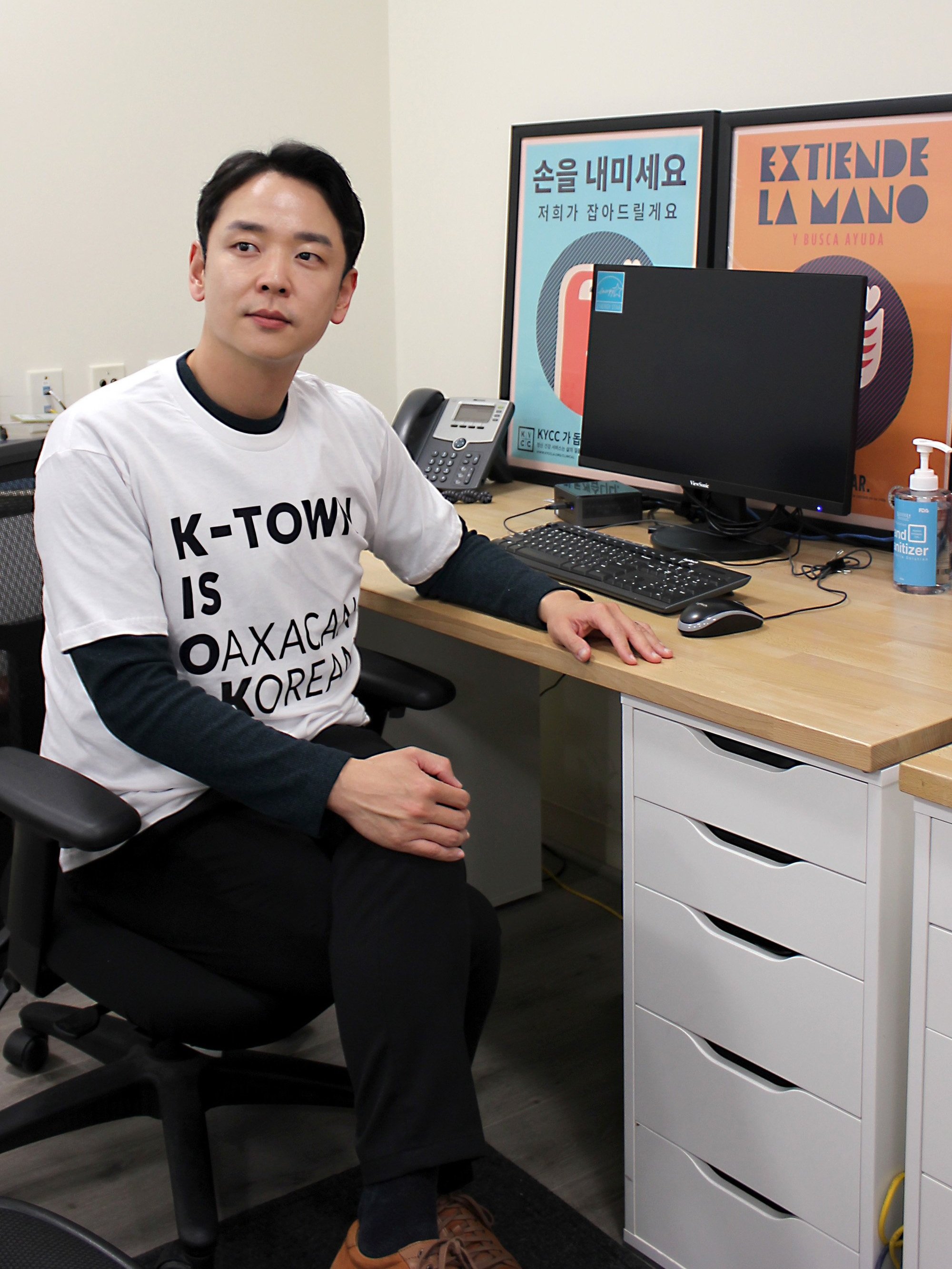
Steve Kang, Director of External Affairs, KYCC

This interview has been edited for length and clarity. Photos by Helen H. Kim.


Helen: Out of curiosity, where did you grow up? 

Steve: I came over to the U.S. after I completed third grade in Korea. I grew up in La Crescenta and now live in Koreatown with my wife and daughter. 

Helen: How cool—that’s the same town my family moved to after living in K-Town for a few years. Can you tell me one of your earliest memories of K-Town? 

Steve: One of my earliest, earliest memories of K-Town is going to Ham Ji Park as a child. The one on Pico, the original location. That was back in the day: the go-to, waiting in line, hole-in-the-wall, my parents driving us out from La Crescenta after they got off of work to eat late at night.

Helen: What kind of work did your parents do when they landed in the U.S.? 

Steve: In the beginning after we immigrated, my mom worked at a clothing store and my dad worked at a bookstore in K-Town. And then they had a bunch of side businesses from vending machines to copy machines. Now they own a few dollar stores. 

Helen: How did you get involved with KYCC? 

Steve: It just came organically. I love this community. I first joined the KAC—Korean American Coalition—another nonprofit in the same building as KYCC. KAC focuses on civic engagement and political awareness while KYCC is more of a direct social service provider. KAC does advocacy work, but KYCC is more about delivering mental health counseling, youth services, etc. KYCC has always been like a big brother to KAC, in that KYCC is bigger and has more mainstream penetration, name brand, and awareness. I always looked up to KYCC Executive Director Johng Ho. That’s how I first got to know KYCC.

After working for some elected officials, I wanted to come back to Koreatown to serve. I felt that this community, despite being super dense, was always neglected politically. We were always an afterthought. So I wanted to come back, having learned how the system works. When I saw an opportunity here at KYCC, I jumped at it. That was about five years ago.

Helen: What do you find unique about K-Town in the context of Los Angeles? 

Steve: So many people think K-Town is just about the Korean American community: Korean businesses, Korean people. Yes, the Korean community is very proud that this is sort of the mecca for Koreans in America. We have the most diversity in terms of the Korean culture and food and all of that than other Korean communities across the country. But if you look at the numbers, the Latinx community makes up a large percentage of the population and also some of the retailers as well. There are other diverse communities too. So I would say that this area really reflects the diversity of Los Angeles as a whole. This is something not a lot of people recognize. Also, despite the glitz and glamour of the gentrification that’s been happening, the general population for the most part is still very much underserved and low-income. And homelessness is real here in Koreatown. 

Helen: Do you feel that the homelessness issue is somehow different here than other areas of L.A.?  

Steve: There is a small but growing number of Korean or AAPI homeless population. 

Helen: I’ve started to see that, too. 

Steve: Yeah. If you look at the official data, AAPI and Korean homelessness is either non-existent or extremely low. But what we’ve noticed in our field is that ethnic Koreans who are unhoused tend to not stay at a single spot for a long time, and they tend to be very ashamed of their situation. So they stay in one place for less than 24 hours. They tidy up really nicely and they keep moving from one block to another. They’re here in Koreatown, just in the shadows. So they’re not collected in the data and the metrics, and people are shocked. They’re like, “Oh, my god, there are actually Koreans who live on the streets!” I’m like, “Yes, there’s quite a few.” We’re just not aware of the accurate number because the traits are a little bit different. 

Helen: Do you think that—despite a sense of stigma and shame that are specific to the Korean culture—they’re still in the K-Town area because of its familiarity? 

Steve: Yes.

Helen: Because if their only concern is not to be traced, they could go elsewhere in the city, right?

Steve: What we found is that they do feel a bit more safe here. When you’re out on the street, you’re constantly robbed, you might be harassed, and other things might happen, but they feel the power in numbers. The fact that the storefronts and community members are Korean American make them feel a bit more safe. I would say Koreans are very generous in terms of food and other supportive things that they give out to people on the street. 

The other issue we at KYCC have been dealing with is that we’ve been pushing government stakeholders to be more culturally sensitive to the language needs, like the outreach workers, for example. They don’t have anybody that speaks Korean. That’s been a big issue. 

Helen: So you find that some of the ethnically Korean folks who’re unhoused only speak Korean?

Steve: Yeah. For example, I got a random call from a food bank in Hollywood last year, even though I’m not an expert in homelessness issues. They said, “Hey, this is a cold call because we have an 80-year-old Korean grandmother who has been receiving services from us. We have no way of communicating with her because she doesn’t speak any English, and we have no staff that can speak Korean.” So I went out there, you know, just to check it out, and I was heartbroken. Her tent was on the glitzy Hollywood Blvd Walk of Fame. No family. She had some psychological issues that she was dealing with but, because of that language barrier, she wasn’t able to receive services. 

Now she’s housed and she’s much better, but it took a year and multiple agencies. That’s the issue with our system. There’s so much red tape, bureaucracy, and legal barriers to get one person housing. 

Helen: I could talk to you for hours about that. 

Steve: I’m so frustrated. 

Helen: I’ve been curious about homelessness in the AAPI/Korean community based on some personal observations so it’s good to get insight from you.  

You already touched on this but what are your thoughts about our City Hall leaders’ perceptions of and actions in K-Town? 

Steve: When I first got my feet wet here in K-Town about 10 years ago, we were really an afterthought. The phrase that I heard back then was that Koreatown and Korean Americans were like the ATM machines for politicians. Elected officials, from city to federal, would come around to collect campaign money from successful small business owners here. They wouldn’t address K-Town needs or concerns but go back to help their own communities. I saw that K-Town was neglected and we didn’t get any of the tax dollars or investment that we needed. At the same time, my eyes were opened to the fact that there’s more than 100,000 people that live here. We’re the most densely-populated area in the County of L.A., only second to Manhattan in terms of the density.

Helen: Wow.

Steve: But then the amount of resources that are poured into this area was minuscule compared to other parts of the city and the county. Now, fast forward to 2022. We still have room for improvement but things are changing. We have a ways to go but people are starting to take notice because we’re registering more Koreans to vote. Thanks to the vote-by-mail system, we are voting in higher numbers. For example, in this past election cycle, AAPIs were the second largest in terms of the percentage of voter turnout, about 46%. That’s sending shockwaves in the mainstream politics. So we’re finally seeing political advertisements in Korean. We’re seeing politicians come into K-Town to woo voters and ask for their support. Politicians are now hiring Korean staff. Before we had to plea for them to hire one; now it’s a must. We also have Korean Americans in some higher offices. The perception is changing and I’m very much hopeful for the future. 

Helen: What role do you feel Koreans play in preserving the K-Town community? 

Steve: The younger 1.5 and second generation Koreans are trying to build bridges. Earlier this year, we commemorated the 30th anniversary of Sa-i-gu’s (Korean term meaning “4-2-9”, referring to April 29, the day in 1992 when the Rodney King verdict triggered the L.A. Uprising that devastated K-Town). Despite the fact that 30 years have passed, not much healing has happened. I wasn’t here when that happened but Johng Ho was and he was on the front line helping people.

What the younger, bicultural people of the 1.5 and second generation are trying to do is speak with our counterparts in South L.A.—the African American community and the Latinx community—to have dialogue so that there won’t be another ‘92 or other cultural misunderstandings. Also, in order to preserve K-Town, Koreans need to recognize other community members who live here as allies. Just because the neighborhood is called Koreatown doesn’t mean it’s only for Koreans. K-Town welcomes everybody. We’ve been involved in some difficult conversations and more need to be had, but I think it’s a step in the right direction. 

Helen: As you said, it’s actually quite a diverse community. What can you say about the contribution of Oaxacan and Latinx folks to K-Town? 

Steve: Oh, it’s huge! We have Guelaguetza Restaurant on Olympic Boulevard. It’s to the Oaxacan community what Chosun Galbee is to the Korean community. These hallmark establishments are an indication how ingrained these two communities are in K-Town.

Helen: Whoa, you are so right! 

Steve: Yeah, right? I think it’s the best analogy. There are other things too, obviously. We have Oaxacan staff members here at KYCC. We know that they contribute heavily to K-Town. So the fact that those council members made those awful comments? That’s the old mentality that we’re trying to fix. 

Helen: Yes! 

Steve: So we’re glad that they’re leaving or will be gone soon, with their perceptions that Koreans don’t engage and don’t vote, making discriminatory remarks against people within their own community. It’s awful. We’re trying to change all that. I think the new people coming into power recognize and respect that change. We’re very hopeful that, within the next couple of weeks, there’s going to be new leadership. 

Helen: When there’s a changing of the guards, there’s always this new, energizing awareness that new people bring, creating a lot of hope. But, also in the changing of the guards, some things worth preserving can get lost. Do you have a word of caution for the new leadership coming onboard?

Steve: What I’ve seen in the political lens is that they run a great campaign. Once they get into power, they kind of get sucked into that vortex and forget some of the promises and the community-centered approach that they advocated during their campaign. One word of caution and advice I would love to send to our newly-elected officials is: “Please don’t forget about us.” Look what those former council members said behind closed doors. For many decades, K-Town was divided at the city council level into multiple pieces so that we didn’t have a collective voice. We rectified that this past cycle. That was a huge undertaking, right? We want to keep that momentum going. I hope the new council members and other elected officials remember that historical precedent and continue to move us forward. I’m cautiously optimistic. 


Connect with KYCC:
Website | Facebook | Twitter | Instagram | YouTube